The plague rarely affects humans, though the US sees about 7 cases a year. Here’s why

Advertisement

Advertise with us

Colorado health officials have confirmed a human case of the plague, the rare bacterial infection infamously known for killing tens of millions in 14th century Europe. Today, it's easily treated with antibiotics.

Read this article for free:


or

Already have an account? Log in here »

To continue reading, please subscribe:

Subscribe and receive a limited-edition Free Press branded hat or tote.

Digital Subscription

One year of digital access for only $205*

  • Enjoy unlimited reading on winnipegfreepress.com
  • Read the E-Edition, our digital replica newspaper
  • Access News Break, our award-winning app
  • Play interactive puzzles

*First annual payment billed as $205.00 + GST for one year. This annual subscription will automatically renew at $233.00 + GST every 52 weeks (10% off the regular annual price of $259.35). Offer available to new and qualified returning subscribers only. Cancel any time.

To continue reading, please subscribe:

Add Free Press access to your Brandon Sun subscription for only an additional

$1 for the first 4 weeks*

  • Enjoy unlimited reading on winnipegfreepress.com
  • Read the E-Edition, our digital replica newspaper
  • Access News Break, our award-winning app
  • Play interactive puzzles
Start now

*Your next Brandon Sun subscription payment will increase by $1.00 and you will be charged $17.95 plus GST for four weeks. After four weeks, your payment will increase to $24.95 plus GST every four weeks.

Hey there, time traveller!
This article was published 10/07/2024 (801 days ago), so information in it may no longer be current.

Colorado health officials have confirmed a human case of the plague, the rare bacterial infection infamously known for killing tens of millions in 14th century Europe. Today, it’s easily treated with antibiotics.

The Centers for Disease Control and Prevention estimates there are seven human cases of plague per year in the U.S., and in February, Oregon officials reported it in a person who likely got it from their sick cat.

Surprised to hear the plague is still around? Here’s what to know.
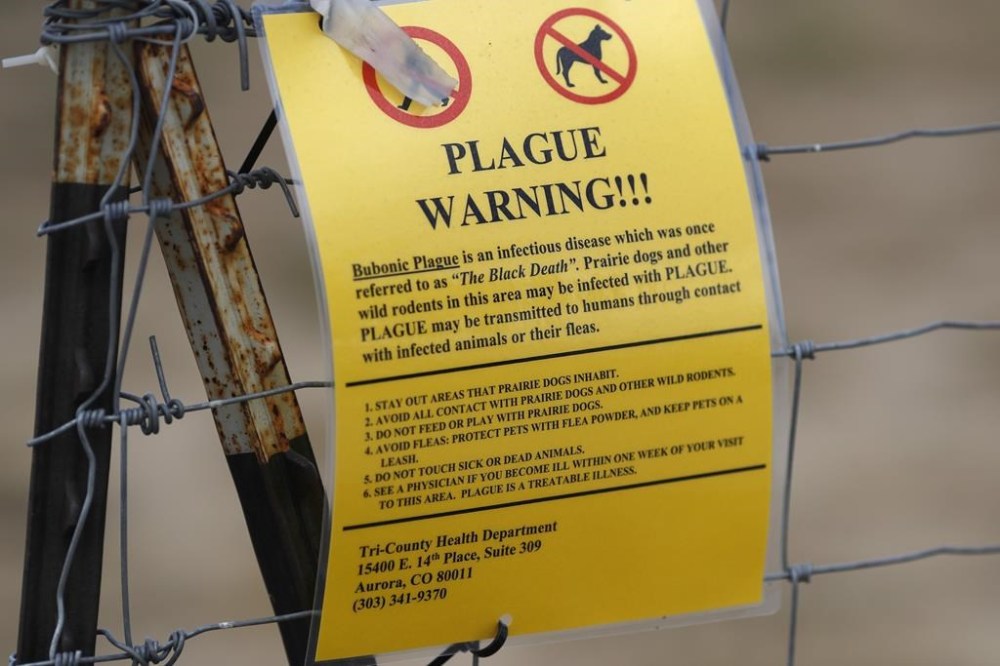
FILE - In this Aug. 10, 2019 file photo, a sign warning of bubonic plague is displayed at a parking lot near the Rocky Mountain Arsenal Wildlife Refuge in Commerce City, Colo. The bacteria which causes the disease is transmitted through the bites of infected fleas, which spread it between rodents, pets and humans. (AP Photo/David Zalubowski)

What is the plague?

The bubonic plague is the most common form of the bacterial infection, which spreads naturally among rodents like prairie dogs and rats.

There are two other forms of the plague: septicemic plague (which spreads through the whole body) and pneumonic plague (which infects the lungs).

Bubonic plague causes painfully swollen lymph nodes that are most commonly found in the groin, armpit and neck, called buboes. It will often advance and turn into the other two forms of plague if untreated.

Other symptoms of the plague include sudden high fever and chills, headaches, and pain in the abdomen, legs and arms, according to the Cleveland Clinic.

How can you get the plague?

The bacteria is transmitted through the bites of infected fleas, which spread it between rodents, pets and humans.

People can also get plague through touching infected bodily fluids, so health experts recommend taking extra care when handling dead or sick animals. The plague can also spread through the respiratory droplets of a patient who has pneumonic plague.

Pneumonic plague is the most deadly and easiest to spread, with a nearly 100% fatality rate untreated, said Lisa Morici, a microbiologist and immunologist at the Tulane University School of Medicine.

Where does the plague exist?

In the U.S., most cases happen in rural areas of northern New Mexico, northern Arizona, southern Colorado, California, southern Oregon and far western Nevada, according to the CDC.

Worldwide, plague is found the most in Congo, Madagascar and Peru, according to the World Health Organization.

How do you treat the plague?

The plague was never eradicated, but we’ve gotten better at preventing its spread and treating it in humans.

When treated early with antibiotics, the plague can be cured. The key is to get to a doctor fast — otherwise the plague can be deadly.

And, as the old adage goes, prevention is better than a cure.

Keeping areas around the home clear of debris and other things that can attract rodents can lower the risk of infection, as can making sure pets are up to date on flea treatments. When hunting, camping or otherwise spending time outdoors, the CDC recommends using a bug spray with DEET to keep fleas and other disease-spreading pests away.

Is there a vaccine?

Yes, but the WHO only recommends it for people who are at high risk of infection, like laboratory and health care workers. There’s no plague vaccine available in the U.S.

Morici said there is need for more research, because while the vaccines used in other parts of the world work against bubonic plague, there isn’t strong evidence to show they protect against the pneumonic form of plague.

Testing a plague vaccine would be ethically and logistically difficult, she said.

“Because the bubonic form is quite treatable with antibiotics and also quite rare — you don’t see thousands and thousands of cases of plague a year — there’s just not a huge market for a plague vaccine at this point in time,” Morici said.

___

The Associated Press Health and Science Department receives support from the Robert Wood Johnson Foundation. The AP is solely responsible for all content.


Report Error Submit a Tip

More Stories

Kinew delivered what most of us wanted; now we’ll have to deal with the consequences

Dan Lett 5 minute read Preview

Kinew delivered what most of us wanted; now we’ll have to deal with the consequences

Dan Lett 5 minute read Updated: Yesterday at 8:43 AM CDT

Premier Wab Kinew has decided to adopt permanent daylight savings time, which means a permanent end to the spring forward, fall back tradition of adjusting our clocks. And absolutely no one is surprised.

Read
Updated: Yesterday at 8:43 AM CDT

‘She was looking to destroy me’: convicted harasser faces new charges

Dean Pritchard 6 minute read Preview

‘She was looking to destroy me’: convicted harasser faces new charges

Dean Pritchard 6 minute read Thursday, Sep. 17, 2026

When Agnieszka Ciochon-Newton moved into the 55-plus apartment building on Stradbrook Avenue last year, she came across as “timid, soft-spoken and sensitive,” said building manager Tanya Owen.

Little did Owen know the meek-looking 58-year-old woman would soon turn her life and the lives of many of her tenants upside down and threaten her career and family.

“She was looking to destroy me for a simple tenant disagreement,” Owen said Thursday.

Court records show Ciochon-Newton was arrested earlier this month and charged with seven counts of criminal harassment, two counts of uttering threats and one count each of fraud, breaking and entering, attempting to obstruct justice, intimidation of a justice official, mischief and defamatory libel.

Read
Thursday, Sep. 17, 2026

Desperate Poilievre wants Canadians to believe the sky is falling when it’s just cloudy outside

Tom Brodbeck 5 minute read Preview

Desperate Poilievre wants Canadians to believe the sky is falling when it’s just cloudy outside

Tom Brodbeck 5 minute read Yesterday at 12:47 PM CDT

Pierre Poilievre has a problem.

Canadians just don’t seem to be paying much attention to him anymore.

So, naturally, the Conservative Opposition leader has decided to turn up the volume.

At a recent party caucus retreat in Penticton, B.C., Poilievre delivered the familiar message: Canada is in trouble, Canadians are hurting and the Liberal government is making everything worse.

Read
Yesterday at 12:47 PM CDT

Canada-U.S. trade relationship is broken, but the damage can — and will — be repaired

Tom Brodbeck 5 minute read Preview

Canada-U.S. trade relationship is broken, but the damage can — and will — be repaired

Tom Brodbeck 5 minute read Thursday, Sep. 17, 2026

Canada needs to get serious about diversifying its trade beyond the United States. But at the same time, Canadians should expect relations with the U.S. to normalize after Donald Trump is no longer in the White House.

For generations, Canada-U.S. trade was considered almost a fact of geography. The two countries share the world’s longest undefended border, deeply integrated supply chains and a century of commercial relationships.

Canadian manufacturers depend on American customers. American manufacturers depend on Canadian suppliers. Energy, agriculture, automotive production and countless other industries operate across the border as though it barely exists.

That isn’t going to change dramatically, even in the midst of a bitter trade war unleashed by the U.S. president.

Read
Thursday, Sep. 17, 2026

Steinbach Credit Union member warns others after scammer steals $10K

Scott Billeck 5 minute read Preview

Steinbach Credit Union member warns others after scammer steals $10K

Scott Billeck 5 minute read Yesterday at 5:19 PM CDT

A Winnipeg single mother whose bank account was drained of nearly $10,000 says Steinbach Credit Union needs to warn its members about what she believes is a broader security problem.

The woman, who is not being named to protect her identity, said a scammer gained access to her account earlier this week after calling SCU’s contact centre, claiming to be her and successfully completing the credit union’s authentication process.

She said she knows of at least six others who have experienced similar incidents in which callers impersonate SCU account holders and pass the authentication checks.

The woman discovered something was wrong when her minor son asked why money had been transferred out of an account they jointly hold.

Read
Yesterday at 5:19 PM CDT

Not good bet to shoulder gambling issue alone

Maureen Scurfield 5 minute read 2:01 AM CDT

DEAR MISS LONELYHEARTS: We’re living a lie over at our house, but it’s holding the family together.

I know my husband is deeply into gambling. If it weren’t for my steady job I don’t know where the family would be! I insist on paying all of our bills. I also funnel some major cash off to my sister, in case my husband tries to tap into my accounts somehow when I’m out of the house.

He doesn’t know my passwords, since I keep changing them, but he sometimes shows up behind me when I’m online, like he’s dying to ask something.

I say, “What are you looking at? Stop looking over my shoulder!” Then he makes a lame joke and goes away.