NASA telescope spots a super Jupiter that takes more than a century to go around its star

Advertisement

Advertise with us

CAPE CANAVERAL, Fla. (AP) — A super Jupiter has been spotted around a neighboring star by the Webb Space Telescope — and it has a super orbit.

Read this article for free:


or

Already have an account? Log in here »

To continue reading, please subscribe:

Subscribe and receive a limited-edition Free Press branded hat or tote.

Digital Subscription

One year of digital access for only $205*

  • Enjoy unlimited reading on winnipegfreepress.com
  • Read the E-Edition, our digital replica newspaper
  • Access News Break, our award-winning app
  • Play interactive puzzles

*First annual payment billed as $205.00 + GST for one year. This annual subscription will automatically renew at $233.00 + GST every 52 weeks (10% off the regular annual price of $259.35). Offer available to new and qualified returning subscribers only. Cancel any time.

To continue reading, please subscribe:

Add Free Press access to your Brandon Sun subscription for only an additional

$1 for the first 4 weeks*

  • Enjoy unlimited reading on winnipegfreepress.com
  • Read the E-Edition, our digital replica newspaper
  • Access News Break, our award-winning app
  • Play interactive puzzles
Start now

*Your next Brandon Sun subscription payment will increase by $1.00 and you will be charged $17.95 plus GST for four weeks. After four weeks, your payment will increase to $24.95 plus GST every four weeks.

Hey there, time traveller!
This article was published 24/07/2024 (810 days ago), so information in it may no longer be current.

CAPE CANAVERAL, Fla. (AP) — A super Jupiter has been spotted around a neighboring star by the Webb Space Telescope — and it has a super orbit.

The planet is roughly the same diameter as Jupiter, but with six times the mass. Its atmosphere is also rich in hydrogen like Jupiter’s.

One big difference: It takes this planet more than a century, possibly as long as 250 years, to go around its star. It’s 15 times the distance from its star than Earth is to the sun.
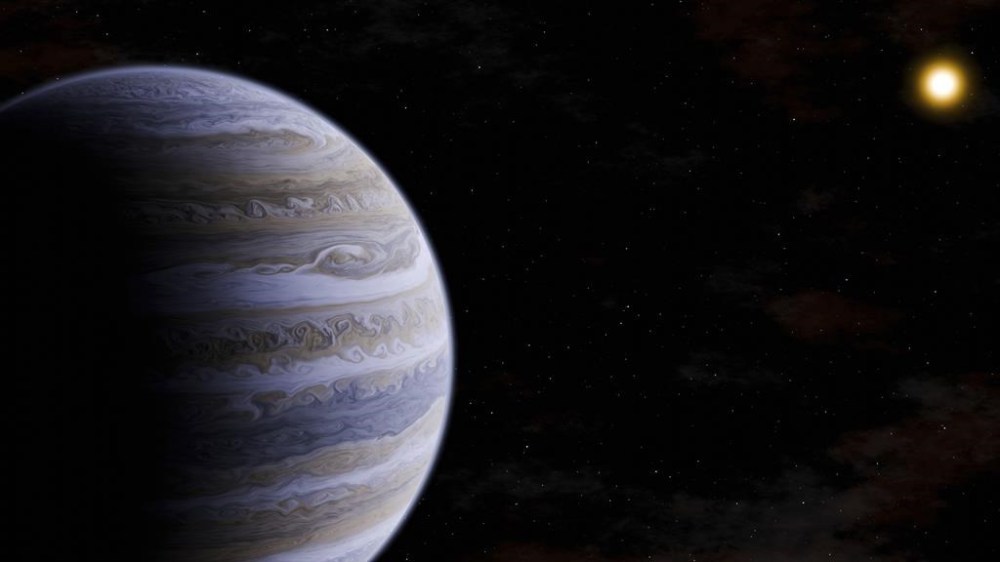
This illustration provided by the Max Planck Institute for Astronomy in July 2024 depicts a cold gas giant orbiting a red dwarf. Scientists had long suspected a big planet orbited the star Epsilon Indi A, but not this massive or far from its star. An international team led by Max Planck Institute for Astronomy’s Elisabeth Matthews in Germany collected the images in 2023 and published their findings Wednesday, July 24, 2024, in the journal Nature. (T. Müller (MPIA/HdA) via AP)

Scientists had long suspected a big planet circled this star 12 light-years away, but not this massive or far from its star. A light-year is 5.8 trillion miles. These new observations show the planet orbits the star Epsilon Indi A, part of a three-star system.

An international team led by Max Planck Institute for Astronomy’s Elisabeth Matthews in Germany collected the images last year and published the findings Wednesday in the journal Nature.

Astronomers directly observed the incredibly old and cold gas giant — a rare and tricky feat — by masking the star through use of a special shading device on Webb. By blocking the starlight, the planet stood out as a pinpoint of infrared light.

The planet and star clock in at 3.5 billion years old, 1 billion years younger than our own solar system, but still considered old and brighter than expected, according to Matthews.

The star is so close and bright to our own solar system that it’s visible with the naked eye in the Southern Hemisphere.

Don’t bet on life, though.

“This is a gas giant with no hard surface or liquid water oceans,” Matthews said in an email.

It’s unlikely this solar system sports more gas giants, she said, but small rocky worlds could be lurking there.

Worlds similar to Jupiter can help scientists understand “how these planets evolve over giga-year timescales,” she said.

The first planets outside our solar system — dubbed exoplanets — were confirmed in the early 1990s. NASA’s tally now stands at 5,690 as of mid-July. The vast majority were detected via the transit method, in which a fleeting dip in starlight, repeated at regular intervals, indicates an orbiting planet.

Telescopes in space and also on the ground are on the hunt for even more, especially planets that might be similar to Earth.

Launched in 2021, NASA and the European Space Agency’s Webb telescope is the biggest and most powerful astronomical observatory ever placed in space.

___

The Associated Press Health and Science Department receives support from the Howard Hughes Medical Institute’s Science and Educational Media Group. The AP is solely responsible for all content.

Report Error Submit a Tip

More Stories

Bombers ride Collaros’s arm to win over Stamps

Taylor Allen 6 minute read Preview

Bombers ride Collaros’s arm to win over Stamps

Taylor Allen 6 minute read Saturday, Oct. 10, 2026

Zach Collaros must’ve found the fountain of youth during his most recent absence.

Nobody has feared the Winnipeg Blue Bombers’ passing attack all season, and yet, their veteran pivot aired it out early and often on Saturday night in a game they needed to win.

Led by Collaros and go-to target Dorian Singer, the Bombers prevailed 33-28 over the Calgary Stampeders in front of a sold-out crowd at Princess Auto Stadium to heavily increase their odds of making the playoffs.

“That’s vintage Eight-Ball right there. You love to see it,” said receiver Nic Demski. “Especially the opportunity that we had and him coming back this week, it was just a picture-perfect story.”

Read
Saturday, Oct. 10, 2026

Puerto Vallarta boards up as Hurricane Simon hits Category 4 strength

The Associated Press 3 minute read Preview

Puerto Vallarta boards up as Hurricane Simon hits Category 4 strength

The Associated Press 3 minute read Saturday, Oct. 10, 2026

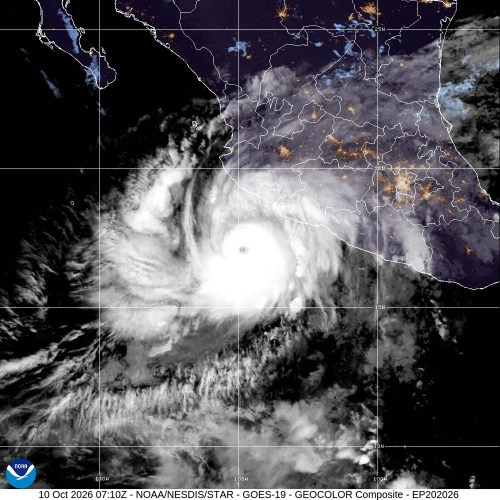
PUERTO VALLARTA, Mexico (AP) — Simon has strengthened into a powerful Category 4 hurricane as it barrels toward Mexico’s coast.

The National Hurricane Center in Miami said Saturday that Simon’s maximum sustained winds increased to 150 mph (240 kph). A storm of that strength or greater is considered a major hurricane.

The center said it expected Simon “to be near or just inland” of Mexico's west-central coast on Sunday. The hurricane could bring as much as 10 to 20 inches (25-50 cm) of rain over parts of southwestern Mexico, with some areas in the states of Michoacan, Colima and Jalisco receiving up to 30 inches (76 centimeters).

“This rainfall will produce life-threatening flooding and mudslides, especially in areas of steep terrain,” the center warned in a bulletin that also urged residents to take immediate action to prepare as tropical-storm conditions were expected to arrive Saturday afternoon.

Read
Saturday, Oct. 10, 2026

Manitoba e-scooter legislation changes set to impose speed limit, age restrictions, sidewalk ban

Matthew Frank 5 minute read Preview

Manitoba e-scooter legislation changes set to impose speed limit, age restrictions, sidewalk ban

Matthew Frank 5 minute read Updated: Yesterday at 5:14 PM CDT

People riding e-scooters and other personal electric vehicles in Manitoba will have to strap on a helmet, stay off sidewalks and follow new age limits once new provincial rules for the devices take effect next year.

The vehicles, which also include electric skateboards, hoverboards and unicycles, will fall under The Highway Traffic Act starting in 2027, according to the province’s website. E-bikes are excluded from the new rules, according to the province’s frequently-asked-questions page.

All riders must be at least 16 years old and wear properly fitting helmets — that goes for passengers, too, the province said.

The proposed new legislation sets a speed limit of 25 km/h and would prohibit personal electric vehicles from sidewalks unless signs specifically allow sidewalk use. Riders would be using shared paths or roads with speed limits of 50 km/hr or less. They won’t be allowed to operate the vehicles under the influence of alcohol or drugs and they must use hand signals and obey traffic signs.

Read
Updated: Yesterday at 5:14 PM CDT

Jets encouraged by play through first five games

Mike McIntyre 6 minute read Preview

Jets encouraged by play through first five games

Mike McIntyre 6 minute read Saturday, Oct. 10, 2026

Turkey. Stuffing. And a heaping helping of rest and recovery.

The Winnipeg Jets have plenty to be thankful for this holiday weekend, including a solid 3-1-1 start to the NHL campaign. Players and coaches are also counting their blessings at finally getting a breather after a busy stretch of five games in eight days.

“We don’t have another (break like this) until a week before Christmas. So we’re going to take advantage of it,” head coach Scott Arniel said following the club’s first regulation loss, a 5-1 stinker on Friday night against the visiting Anaheim Ducks.

To borrow a funny old Thanksgiving-related phrase from former defenceman Nate Schmidt, the hockey club was “leaking gravy.” They looked like a group that could use a timeout — which they’ll get since they don’t play again until hosting the Minnesota Wild on Tuesday night.

Read
Saturday, Oct. 10, 2026

Hurricane Simon pounds resorts and vulnerable towns along Mexico’s Pacific coast

Fernando Llano And Martin Silva, The Associated Press 5 minute read Preview

Hurricane Simon pounds resorts and vulnerable towns along Mexico’s Pacific coast

Fernando Llano And Martin Silva, The Associated Press 5 minute read Updated: 2:38 AM CDT

PUERTO VALLARTA, Mexico (AP) — Hurricane Simon pounded Mexico’s Pacific coast as a Category 3 storm on Sunday, its eye remaining just offshore as its most powerful winds and rain slammed people living between the Sierra Madre and the ocean.

The hurricane's center swirled parallel to the coast, closing in on the Puerto Vallarta area, where its most damaging winds and rain were expected to hit around midnight and continue through Monday morning. Its maximum sustained winds weakened late Sunday to 115 mph (185 kph), according to the U.S. National Hurricane Center in Miami, but it was still expected to remain a dangerous hurricane.

That’s not good news for people in and around Puerto Vallarta, a popular tourist destination in the state of Jalisco. Just inland and uphill from the resort areas, many Mexicans live in communities where housing might not stand up to the storm.

By late Sunday, Simon's eye was moving northwest about 45 miles (75 kilometers) south of Cabo Corrientes at about 5 mph (7 kph). A senior hurricane center specialist, Philippe Papin, said this westernmost tip of mainland Mexico is the area most likely to get a direct hit from the system. Cabo Corrientes is at the southern tip of Bahia de Banderas, the wide bay where Puerto Vallarta looks out to the Pacific.

Read
Updated: 2:38 AM CDT

Bombers beat Stamps, claim season series

1 minute read Saturday, Oct. 10, 2026

The Winnipeg Blue Bombers defeated the Calgary Stampeders 33-28 on Saturday night in front of a sell-out crowd at Princess Auto Stadium.

With the win, the Blue and Gold improve to 8-8 and bump up to fourth in the West Division standings. If the Saskatchewan Roughriders (8-7) lose to the Montreal Alouettes (12-3) on Monday, the Bombers will move up to third.

With the loss, the Stampeders drop to 8-9 and fall to fifth place which has them currently on the outside of the playoff picture.

The Bombers now just need to finish the season with at least the same record as Calgary or Saskatchewan to qualify for the post-season since they own the tiebreaker over both West Division foes.