UN asks nations to better prepare, cool the vulnerable as ‘extreme heat epidemic’ breaks records
Advertisement
Read this article for free:
or
Already have an account? Log in here »
To continue reading, please subscribe:

Digital Subscription
One year of digital access for only $205*
- Enjoy unlimited reading on winnipegfreepress.com
- Read the E-Edition, our digital replica newspaper
- Access News Break, our award-winning app
- Play interactive puzzles
*First annual payment billed as $205.00 + GST for one year. This annual subscription will automatically renew at $233.00 + GST every 52 weeks (10% off the regular annual price of $259.35). Offer available to new and qualified returning subscribers only. Cancel any time.
To continue reading, please subscribe:
Add Free Press access to your Brandon Sun subscription for only an additional
$1 for the first 4 weeks*
- Enjoy unlimited reading on winnipegfreepress.com
- Read the E-Edition, our digital replica newspaper
- Access News Break, our award-winning app
- Play interactive puzzles
*Your next Brandon Sun subscription payment will increase by $1.00 and you will be charged $17.95 plus GST for four weeks. After four weeks, your payment will increase to $24.95 plus GST every four weeks.
Read unlimited articles for free today:
or
Already have an account? Log in here »
Hey there, time traveller!
This article was published 25/07/2024 (752 days ago), so information in it may no longer be current.
BENGALURU, India – After three of Earth’s hottest days ever measured, the United Nations called for a flurry of efforts to try to reduce the human toll from soaring and searing temperatures, calling it “an extreme heat epidemic.”
“If there is one thing that unites our divided world, it’s that we’re all increasingly feeling the heat,” United Nations Secretary-General Antonio Guterres said Thursday at a news conference where he highlighted that Monday was the hottest day on record, surpassing the mark set just a day earlier. “Earth is becoming hotter and more dangerous for everyone, everywhere.”
Nearly half a million people a year die worldwide from heat related deaths, far more than other weather extremes such as hurricanes, and this is likely an underestimate, a new report by 10 U.N. agencies said.
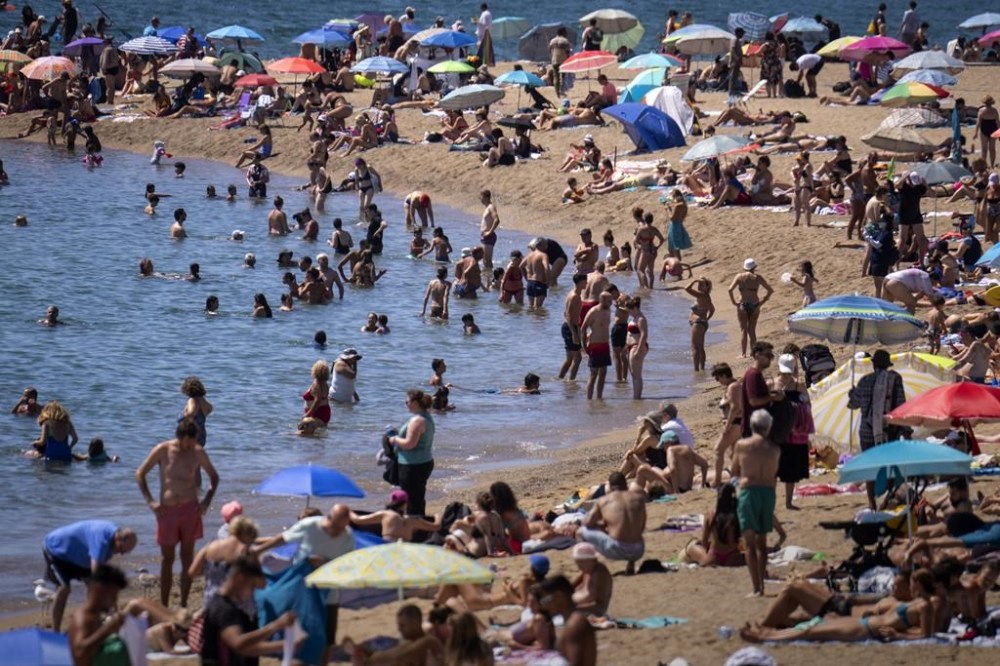
“Billions of people are facing an extreme heat epidemic — wilting under increasingly deadly heat waves, with temperatures topping 50 degrees Celsius around the world,” Guterres said. “That’s 122 degrees Fahrenheit and halfway to boiling.”
The dire warnings came after a barely noticeable respite in back-to-back record global heat.
The European climate service Copernicus calculated that Tuesday’s global average temperature was 0.01 Celsius (0.01 Fahrenheit) lower than Monday’s all-time high of 17.16 degrees Celsius (62.8 degrees Fahrenheit), which was .06 degrees Celsius hotter (0.1 degrees Fahrenheit) than Sunday.
All three days were hotter than Earth’s previous hottest day in 2023.
“We are not prepared,” the U.N. report said.
Guterres urged countries of the world to adopt several proposals aimed at reducing heat deaths, starting with help to cool and care for the most vulnerable people — the poor, elderly, young and sick.
The U.N. also called for better heat wave warnings, expanding “passive cooling,” improved urban design, stronger protections for outside workers, as well as greater efforts to tackle human-caused climate change that’s worsening weather extremes.
But officials said most work will have to be done by countries, with the U.N. offering aid and coordination, especially when it comes to beefing up weather warning systems.
If countries adopt the United Nations heat-fighting recommendations, “these measures could protect 3.5 billion people by 2050, while slashing emissions and saving consumers $1 trillion a year,” Guterres said, citing a U.N. Environment Programme estimate.
Better heat-health warning systems in 57 countries could save 98,314 lives per year, the report said, based on World Health Organization and World Meteorological Organization estimates.
“Crippling heat is everywhere, but it doesn’t affect everyone equally,” Guterres said. “Extreme heat amplifies inequality, inflames food insecurity and pushes people further into poverty.”
More than 1,300 people died during this year’s annual Haj pilgrimage after walking in scorching heat.
Earlier this year, India’s prolonged heatwaves resulted in the deaths of at least 100 people. However, health experts say heat deaths are likely undercounted in India and potentially other countries.
Last year, the United States had its most recorded heat deaths in more than 80 years, according to an Associated Press analysis of Centers for Disease Control and Prevention data. The death certificates of more than 2,300 people mentioned excessive heat, including 874 deaths in Arizona.
Deadly heat is not new, but scientists say it has been amplified in scale, frequency and duration with climate change.
Extreme heat, wildfires, floods, droughts and ever more fierce hurricanes are symptoms and “we need to fight the disease,” Guterres said. “The disease is the madness of incinerating our only home. The disease is the addiction to fossil fuels. The disease is climate inaction.”
“Many things are being done, but too little, too late,” he said. “The problem is that climate change is running faster than all the measures that are now being put in place to fight it.”
Before July 3, 2023, the hottest day measured by Copernicus was 16.8 degrees Celsius (62.2 degrees Fahrenheit) on August 13, 2016. In the last 13 months that mark has now been beaten 59 times, according to Copernicus.

Humanity is now “operating in a world that is already much warmer than it was before,” Copernicus Director Carlo Buontempo said.
“The steady drumbeat of hottest-day-ever records and near-records is concerning for three main reasons. The first is that heat is a killer. The second is that the health impacts of heat waves become much more serious when events persist. The third is that the hottest-day records this year are a surprise,” said Stanford University climate scientist Chris Field.
Field said high temperatures usually occur during El Nino years — a natural warming of the equatorial Pacific that changes weather worldwide — but the last El Nino ended in April.
Field said these high temperatures “underscores the seriousness of the climate crisis.”
“Unfortunately people are going to die and those deaths are preventable,” said Kristie Ebi, a public health and climate professor at the University of Washington. “Heat is called the silent killer for a reason. People often don’t know they’re in trouble with heat until it’s too late.”
“At some point, the accumulated heat internally becomes too much, then your cells and your organs start to warm up,” Ebi said.
The “big driver” of the current heat is greenhouse gas emissions, from the burning of coal, oil and natural gas, Buontempo said. Those gases help trap heat, changing the energy balance between the heat coming in from the sun and that escaping Earth, meaning the planet retains more heat energy than before, he said.
Other factors include the warming of the Pacific by El Nino; the sun reaching its peak cycle of activity; an undersea volcano explosion; and air with fewer heat-reflecting particles because of marine fuel pollution regulations, experts said.
The last 13 months have all set heat records. The world’s oceans broke heat records for 15 months in a row and that water heat, along with an unusually warm Antarctica, are helping push temperatures to record level, Buontempo said.
___

Borenstein reported from Washington, D.C., Arasu from Bengaluru, India.
___
Follow Seth Borenstein at @borenbears and Sibi Arasu on X at @sibi123
___
The Associated Press’ climate and environmental coverage receives financial support from multiple private foundations. AP is solely responsible for all content. Find AP’s standards for working with philanthropies, a list of supporters and funded coverage areas at AP.org.