Scientists seeing change in puffins as the tuxedo birds adapt to climate change

Advertisement

Advertise with us

FREDERICTON - The puffins of Machias Seal Island are feeling the heat.

Read this article for free:


or

Already have an account? Log in here »

To continue reading, please subscribe:

Subscribe and receive a limited-edition Free Press branded hat or tote.

Digital Subscription

One year of digital access for only $205*

  • Enjoy unlimited reading on winnipegfreepress.com
  • Read the E-Edition, our digital replica newspaper
  • Access News Break, our award-winning app
  • Play interactive puzzles

*First annual payment billed as $205.00 + GST for one year. This annual subscription will automatically renew at $233.00 + GST every 52 weeks (10% off the regular annual price of $259.35). Offer available to new and qualified returning subscribers only. Cancel any time.

To continue reading, please subscribe:

Add Free Press access to your Brandon Sun subscription for only an additional

$1 for the first 4 weeks*

  • Enjoy unlimited reading on winnipegfreepress.com
  • Read the E-Edition, our digital replica newspaper
  • Access News Break, our award-winning app
  • Play interactive puzzles
Start now

*Your next Brandon Sun subscription payment will increase by $1.00 and you will be charged $17.95 plus GST for four weeks. After four weeks, your payment will increase to $24.95 plus GST every four weeks.

Hey there, time traveller!
This article was published 28/07/2024 (807 days ago), so information in it may no longer be current.

FREDERICTON – The puffins of Machias Seal Island are feeling the heat.

Scientists say there is a link between warming waters and changes in the birds’ size and their beaks, as well as fluctuations in reproduction and the survival of chicks.

Machias Seal Island is a flat, treeless piece of rock located about 19 kilometres southwest of New Brunswick’s Grand Manan Island at the mouth of the Bay of Fundy. It is a sanctuary for seabirds, including about 8,600 breeding pairs of puffins.
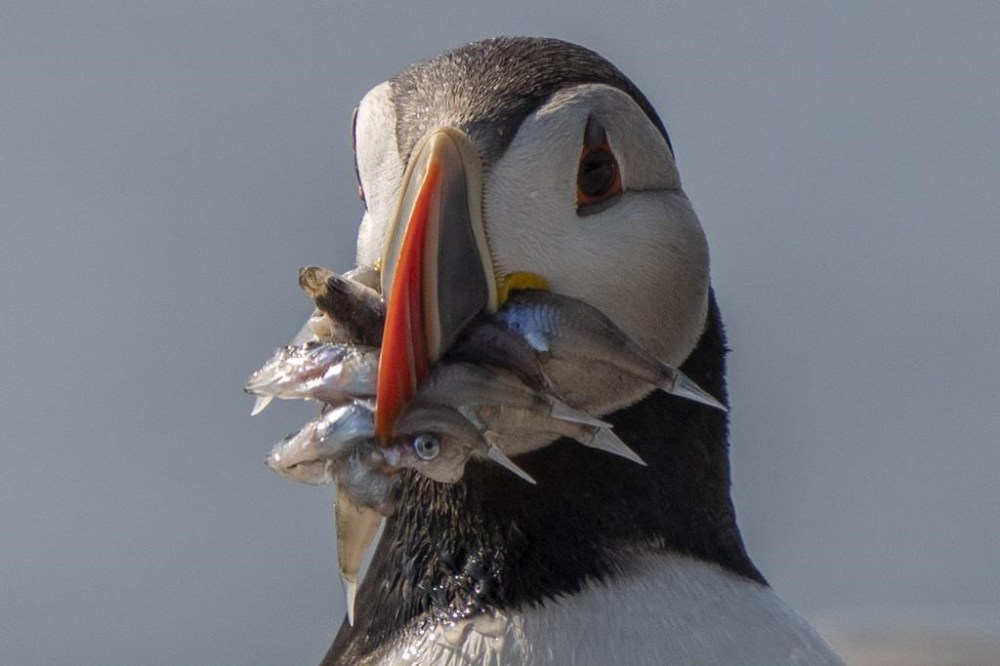
Puffins are feeling the heat. These defining birds of Machias Seal Island off the coasts of New Brunswick and Maine are feeling the effects of warming waters with scientists seeing changes in size of puffins, their bills and also fluctuations in reproduction and survival of chicks.An Atlantic puffin clamps down on baitfish it will feed to a chick on Eastern Egg Rock, Maine, Sunday, Aug. 5, 2023. THE CANADIAN PRESS/AP/Robert F. Bukaty

Heather Major, a marine biology professor at the University of New Brunswick, and her team are studying puffins and other birds on the island with a focus on the impacts of climate change.

Data on puffins on Machias Seal Island have been collected since 1995 and one of the most notable observations made by scientists is that when the birds are old enough to leave the island to go to sea, they are smaller than they used to be.

“We don’t know what that means for their survival, or their probability of returning as adults,” Major said in a video interview last week from the island.

“And that’s really interesting because that is one of the changes that you expect to see in a warming environment. A smaller body size means you’re able to dump heat more effectively.”

As Major spoke outside the research centre, razorbills, common murres, Arctic terns and other birds flew behind her, keeping up a stream of chirps and trills.

Over the past 10 years, she said, scientists have noted the puffins’ hatch date has become later, with chicks emerging toward the end of June rather than mid-June. And the birds’ distinctive brightly coloured beaks — which they use to carry fish and possibly to attract mates — are getting larger, she said.

The reason for the bigger beaks is unclear, but one hypothesis is that puffins may be using them to get rid of body heat; the larger the beak the more heat that can be shed.

On average, Major said, about 55 per cent of the island’s puffin chicks survive to go out into the ocean at the end of summer. Many then return to the island as adults to breed.

Over the past 10 years, scientists have seen a concerning trend, as the number of birds making it out to sea fluctuates wildly.

“What’s happening is that we’re getting these really, really good years followed by really, really bad years,” Major said. “We see these really big fluctuations that we don’t see earlier in the data set, and that seems to be related to things that are happening in the ocean.”

Puffins can live up to 30 years, and a stable population requires each pair successfully produce two chicks that survive to adulthood, which works out to one chick every few years. So far, that threshold is being met. But Major worries that if the fluctuations continue, the puffin population may start to fall.

The drops in reproductive success coincide with years where the ocean was “really” warm, which leads to a decrease in food for the chicks, she said.

Puffins are listed as “vulnerable” by the International Union for Conservation of Nature, which means they face a high risk of extinction in the wild.

Andrew Allyn, a researcher at the Gulf of Maine Research Institute, said the waters in the region have warmed by about 1.6 C since the 1980s, with the area heating up most during the summer. He said the region has seen marine heat waves over the past 10 to15 years.

“Marine heat wave events at the surface are becoming more frequent, more intense, and longer lasting, both globally and in the Gulf of Maine,” he said.

Major said a favoured food for puffins is Atlantic herring, which is rich in fat and helps chicks grow enough to be able to leave the island. But scientists are seeing less herring in chicks’ diets and more prey with a lower energy content, such as squid and sand eels.

“It’s interesting because it could be that there’s herring out there, but that for some reason, the puffins can’t find it,” she said.

Allyn said just as humans adapt their behaviour on land when temperatures soar — cranking on the air conditioner or jumping in the water to cool off — marine species may have similar coping mechanisms. For example, he said herring might choose to temporarily seek out cooler, or deeper waters and then limit their movements, which could explain why puffins can’t find them.

Major and her team have put tracking tags on puffins to see how far out the birds are going to get their food, including how deep they have to dive. It is stressful for parents to have to search further and dive deeper to find fish for their chicks, carrying the food in their beaks back to the chicks, she said.

“It adds more energy that the adults have to spend, and then reduces their body condition and can impact their survival.”

This report by The Canadian Press was first published July 28, 2024.

Report Error Submit a Tip

More Stories

Tenants battling landlords find help in short supply from province

Scott Billeck 14 minute read Preview

Tenants battling landlords find help in short supply from province

Scott Billeck 14 minute read 6:00 AM CDT

For nearly three years, Quincy Houdayer and Avery Helm repeatedly pressed their landlord to address plumbing failures, water damage and other maintenance problems at their West Broadway apartment, with records showing some issues persisted until the couple turned to the Residential Tenancies Branch.

Emails and text messages between the tenants, Clearwater Management and the RTB reviewed by the Free Press document recurring leaks and flooding, periods without heat or hot water, concerns about mould and basement conditions and repeated followups from the couple seeking repairs.

“Most of the experiences we’ve had with them can be boiled down to, like, they either are very dismissive about it, they act like it’s not their problem… or they will just fully, blatantly ignore you,” Helm said, adding that the only way to get Clearwater to respond was to threaten going to the RTB, a provincial government agency.

RTB data obtained by the Free Press also shows 13 orders involving the three-building complex at 193-197 Furby St. in 2026 alone. All but one favoured the tenant, while the remaining order ruled in favour of both the tenant and landlord on different items.

Read
6:00 AM CDT

Israel and Palestine: 30 wasted years

Gwynne Dyer 5 minute read 2:00 AM CDT

Here is how the high command of the Israel Defence Forces (IDF) laid down the rules for “remotely” killing suspected Palestinian activists in the densely populated Gaza Strip after the surprise Hamas attack on Israel on Oct. 7, 2023.

Carney: Trump’s ‘energy ceasefire’ could ‘de-escalate’ war in Ukraine

Kyle Duggan, The Canadian Press 4 minute read Preview

Carney: Trump’s ‘energy ceasefire’ could ‘de-escalate’ war in Ukraine

Kyle Duggan, The Canadian Press 4 minute read Sunday, Oct. 11, 2026

OTTAWA - Mark Carney thanked U.S. President Donald Trump for “his leadership toward securing an energy ceasefire" between Ukraine and Russia, the Prime Minister's Office said on Sunday.

But on the same day, Carney also expressed to Ukraine's leader that Trump's new diesel supply agreement with Russia undermines Canada's efforts to end the war in Europe.

Trump posted on his Truth Social account on Sunday that Ukraine and Russia have agreed to an "energy ceasefire," but did not immediately offer any details.

Carney expressed “strong support for this agreement," according to a readout from the PMO that followed a conversation between the two leaders. And on his own social media account, Carney offered that Trump’s newly announced “energy ceasefire” could help wind down Russia’s war against Ukraine.

Read
Sunday, Oct. 11, 2026

Riding the Unity Bus to rally support for Canada in Alberta

Melissa Martin 8 minute read Preview

Riding the Unity Bus to rally support for Canada in Alberta

Melissa Martin 8 minute read Updated: Yesterday at 9:57 PM CDT

WAINWRIGHT, Alta. — The Unity Bus arrives right on time, pulling into a parking lot on the edge of this town of about 6,600 people close to the Alberta-Saskatchewan border. As the vehicle slows to a halt, resplendent in its patriotic red-and-white paint, a small group of supporters stand waiting, decked in their own maple leaf garb.

The Unity Bus’s doors open and former Alberta deputy premier Thomas Lukaszuk bounds to the ground. The supporters, volunteers with Lukaszuk’s Forever Canadian campaign, welcome him with applause; he greets them with open arms. He knows many by name, having been to Wainwright four times; some of them fondly call him “the boss.”

“Do you need some stickers?” he asks. “Do you need some swag to give away?”

It’s a chilly Thanksgiving Monday morning on the eastern edge of Alberta. A sharp wind nips at exposed skin and drab grey clouds hang low in the sky. Such weather does not encourage high spirits, but Lukaszuk and these volunteers can’t afford to let theirs falter: in just one week, on Oct. 19, Albertans will vote on a historic question on whether to remain in Canada.

Read
Updated: Yesterday at 9:57 PM CDT

A question of public utility

Tom Pearson 5 minute read 2:00 AM CDT

The editorial page of the Free Press often provides perspectives that are thought-provoking and sometimes contradictory. Keeping the lights on, (Oct. 5) by Hal Turner and Wasteful operations should be held accountable, (Oct. 6) by Barry Prentice are both thought-provoking. They are not contradictory because they cover two quite different topics. Where they differ is in their delivery and the quality of the underlying facts.

Mr. Turner provides what is, in my view, the most cogent rationale for gas-fuelled generation that I have read. He highlights the essential aspect of power supply to Manitobans. He supports the argument for natural gas generation with succinct, relatable facts and anecdotes relating to what other comparable utilities have done. He states that, “Manitoba Hydro’s experts are neither anti-wind nor pro-fossil fuel.” They are simply seeking the best possible solution for Manitobans — a fact many special-interest groups either ignore or sadly, impugn.

Although some would argue the contrary, I believe that Mr. Turner’s position and longevity in the Manitoba Hydro organization lend gravitas to his column. Mr. Turner understands that “keeping the lights on” is a non-negotiable requirement and a public trust.

Before I turn to Mr. Prentice’s column, I should disclose that before I retired (it’s been a while), I was responsible at different times for Winnipeg’s regional water system and subsequently water supply from source to tap. In that context I was also responsible for the operation of the Greater Winnipeg Water District (GWWD) railway. Like Mr. Turner’s perspective on the supply of electricity to Manitobans, I regard the supply of safe drinking water to Winnipeggers as a public trust.

Backstreet Boys extend Toronto residency to 11 nights

The Canadian Press 2 minute read Preview

Backstreet Boys extend Toronto residency to 11 nights

The Canadian Press 2 minute read Sunday, Oct. 11, 2026

TORONTO - Hit '90s boyband The Backstreet Boys are adding more tour dates to their Toronto residency.

What was first announced as a four-night run at Rogers Centre has swelled to 11 shows, with the band's recent announcement they're adding concerts on March 5 and 6.

The band says on its website the new dates were added "due to overwhelming demand."

Dubbed “Into the Millennium – Homecoming: Live in Canada,” the residency will kick off on Feb. 12.

Read
Sunday, Oct. 11, 2026