

Cheating stains Canada’s Olympics
Advertisement
Read this article for free:
or
Already have an account? Log in here »
To continue reading, please subscribe:
Digital Subscription
One year of digital access for only $1.44 a week*
- Enjoy unlimited reading on winnipegfreepress.com
- Read the E-Edition, our digital replica newspaper
- Access News Break, our award-winning app
- Play interactive puzzles
*Billed as $5.77 plus GST every four weeks. After 52 weeks, price increases to the regular rate of $19.95 plus GST every four weeks. Offer available to new and qualified returning subscribers only. Cancel any time.
To continue reading, please subscribe:
Add Free Press access to your Brandon Sun subscription for only an additional
$1 for the first 4 weeks*
- Enjoy unlimited reading on winnipegfreepress.com
- Read the E-Edition, our digital replica newspaper
- Access News Break, our award-winning app
- Play interactive puzzles
*Your next Brandon Sun subscription payment will increase by $1.00 and you will be charged $17.95 plus GST for four weeks. After four weeks, your payment will increase to $24.95 plus GST every four weeks.
Read unlimited articles for free today:
or
Already have an account? Log in here »
Hey there, time traveller!
This article was published 02/08/2024 (807 days ago), so information in it may no longer be current.
As is the case with many apologies issued in the glare of the public spotlight, the one issued by Canadian women’s soccer team head coach Bev Priestman this week fell squarely into the “sorry, but only sort of” category.
“I am absolutely heartbroken for the players, and I would like to apologize from the bottom of my heart for the impact this situation has had on all of them,” Priestman said after having been sent home from the Paris Olympics and suspended, along with two of her assistants, for a year.
The so-called apology, of course, followed last week’s revelation that the Canadian team had been caught using a drone to spy on the practice sessions of New Zealand, which Canada was scheduled to face in its first match of the Olympic competition.
Julio Cortez / The Associated Press
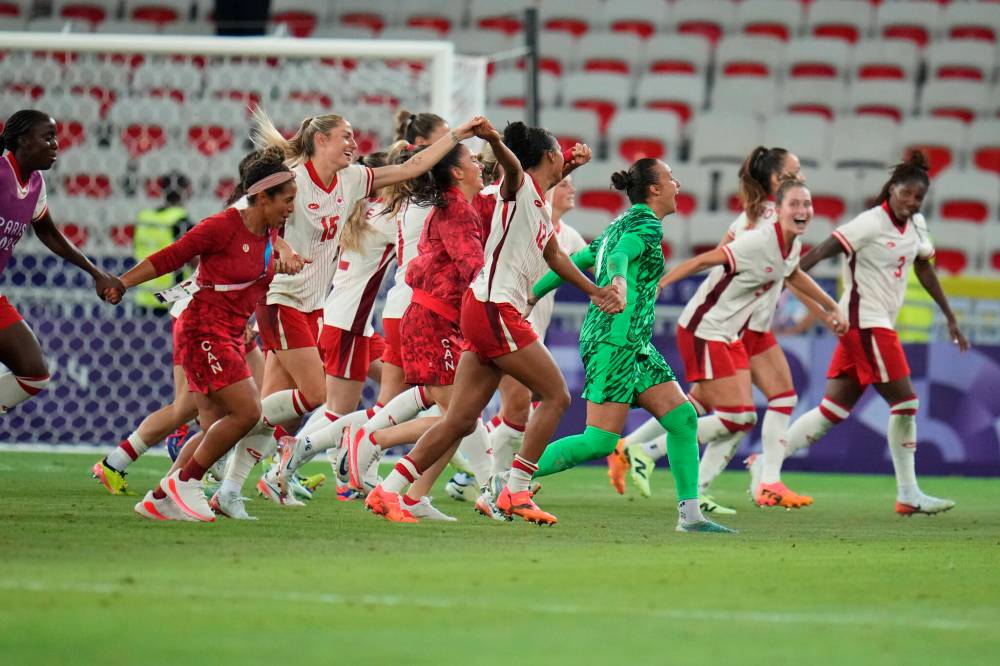
Canada players celebrate their side’s 1-0 win after a women’s Group A soccer match between Colombia and Canada, at the 2024 Summer Olympics, Wednesday.
In the immediate aftermath, an assistant coach and a non-accredited member of the Canadian team — the latter of whom was the drone operator — were sent home. Shock and vague denials were expressed, and an attempt was made to take a business-as-usual approach to the upcoming matches, but it didn’t take long for those investigating the incident to conclude responsibility for the cheating resided much higher up the chain of command.
Exit Priestman.
In addition to suspending her and the two assistants, FIFA (soccer’s global governing body) fined the Canadian Soccer Association more than $300,000 and, of more urgent concern to the team, penalized Canada six points — the equivalent of two preliminary-round victories — during the pool stage of the competition.
With sport officials and media sources aggressively investigating, it didn’t take long for a picture to emerge of a more extensive pattern of drone-spying behaviour. TSN reported a years-long program involving drone use to gather intelligence — including during the run to Canada’s 2021 gold-medal victory in Tokyo — by both the women’s and men’s national soccer teams.

All of which makes the tepid nature of Priestman’s strategically obtuse apology more unsatisfactory. Her heart breaks for the players, she says, and she’s sorry for the impact this has had on them. But there’s no expressed contrition for the systematic cheating, and there’s no apparent recognition that the impacts the team suffers as a result are the direct consequences of a shady gamble that was successful for a while but has now turned into a losing bet of epic proportions.

AP Photo/Julio Cortez
Canada’s Vanessa Gilles reaches for the ball during a women’s Group A soccer match between Colombia and Canada, at the 2024 Summer Olympics, Wednesday, July 31, 2024, at the Nice Stadium in Nice, France.
Priestman must surely have known getting caught cheating would bring dire consequences for the players, regardless of whether they were aware their on-field tactics were shaped by illegally obtained surveillance information.
The final outcome of “dronegate” — surely someone has attached that threadbare moniker by now — remains to be seen. Canada’s appeal of the six-point penalty was summarily dismissed by an arbitration court, but the lost points were rendered moot on Wednesday by the team’s 1-0 victory over Colombia, which advanced Canada to a quarter-final matchup with Germany.
The reputational damage is done. It matters little whether the use of drones to spy on opponents is a uniquely Canadian transgression or if such misbehaviour is more widespread in soccer and Canada was simply the only program dumb enough to get caught. Whatever Canada achieves in the next stage will be sullied by the “cheaters” label that Priestman and company have affixed to its efforts.
Canada deserves better from the teams it sends to compete on its behalf. And Priestman owes her adopted country a more direct coming-to-terms with the stain she has placed on the national team program and, more particularly, on the athletes who have sacrified so much for a chance to don a maple-leaf-adorned jersey.
THE CANADIAN PRESS/Scott Barbour
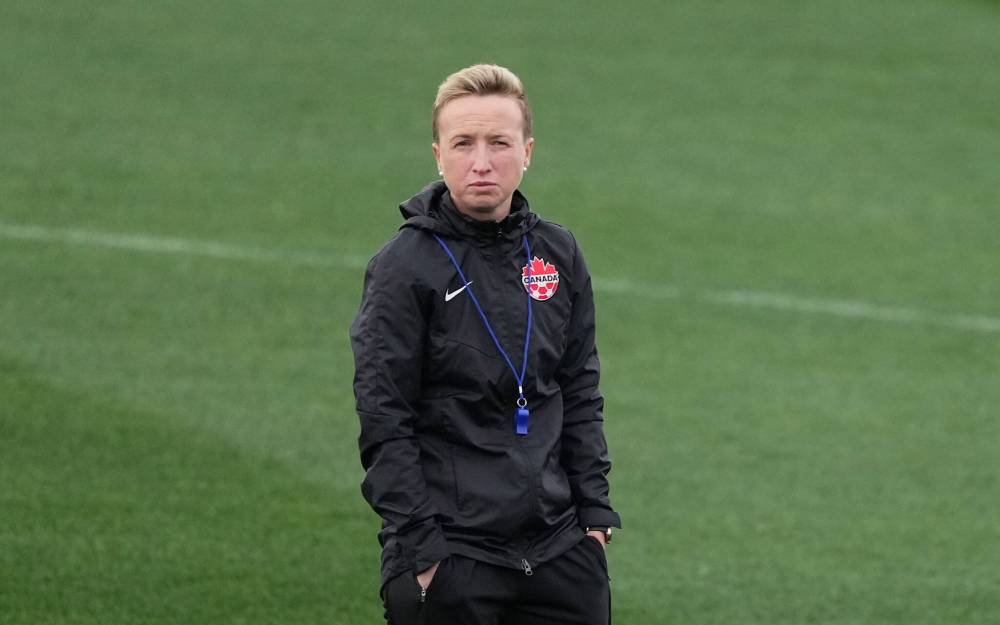
Bev Priestman