Microplastics are everywhere, but are they harming us?
Advertisement
Read this article for free:
or
Already have an account? Log in here »
To continue reading, please subscribe:
Digital Subscription
One year of digital access for only $1.44 a week*
- Enjoy unlimited reading on winnipegfreepress.com
- Read the E-Edition, our digital replica newspaper
- Access News Break, our award-winning app
- Play interactive puzzles
*Billed as $5.77 plus GST every four weeks. After 52 weeks, price increases to the regular rate of $19.95 plus GST every four weeks. Offer available to new and qualified returning subscribers only. Cancel any time.
To continue reading, please subscribe:
Add Free Press access to your Brandon Sun subscription for only an additional
$1 for the first 4 weeks*
- Enjoy unlimited reading on winnipegfreepress.com
- Read the E-Edition, our digital replica newspaper
- Access News Break, our award-winning app
- Play interactive puzzles
*Your next Brandon Sun subscription payment will increase by $1.00 and you will be charged $17.95 plus GST for four weeks. After four weeks, your payment will increase to $24.95 plus GST every four weeks.
Read unlimited articles for free today:
or
Already have an account? Log in here »
Hey there, time traveller!
This article was published 05/08/2024 (804 days ago), so information in it may no longer be current.
NEW YORK (AP) — Microplastics have been found in the ocean and the air, in our food and water. They have been found in a wide range of body tissues, including the heart, liver, kidneys and even testicles.
But are they actually harming you?
Evidence suggests they might, but it’s limited in scope. Some researchers are worried, but acknowledge there are lots of unanswered questions.
Dr. Marya Zlatnik, a San Francisco-based obstetrician who has studied environmental toxins and pregnancy, has seen studies raising concerns about microplastics’ impact on the health of babies and adults.
But it’s a young research field, and it’s not something she generally discusses with patients.
“I’m not entirely sure what to say yet,” Zlatnik said.
Here’s a look at what’s known so far:
WHAT ARE MICROPLASTICS?
Plastics are man-made materials — many of them derived from oil or other petroleum products. They can break down into smaller particles, through exposure to heat and weather and even animal digestion.
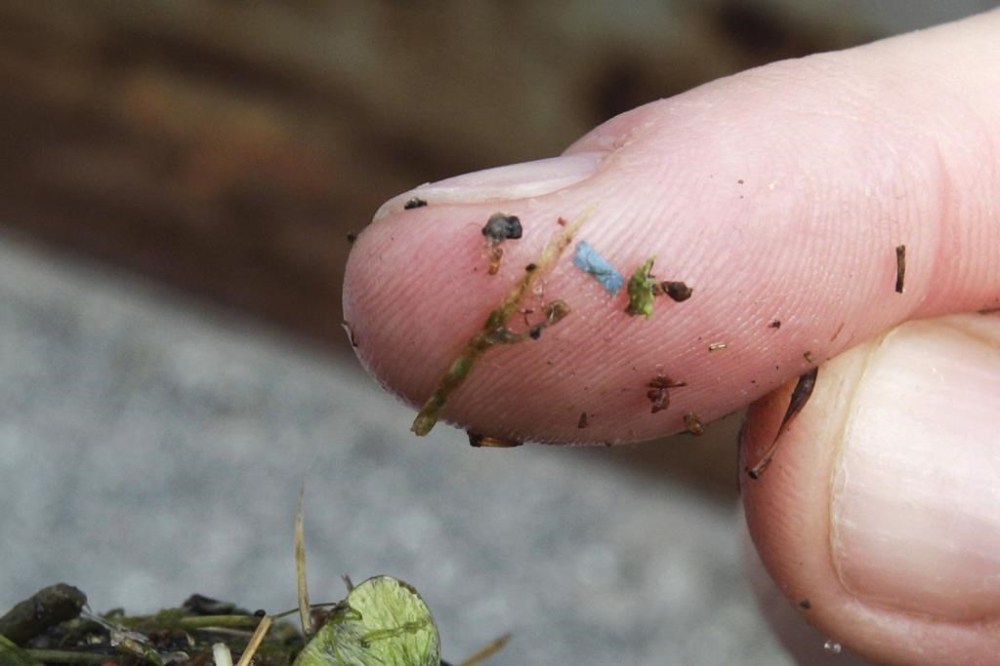
Researchers have increasingly been interested in microplastics, which can be as wide as a pencil eraser or as small as a fraction of the width of a human hair. Nanoplastics, another area of study, are even smaller.
These minuscule plastics have been detected in air, water and soil, in milk, and in bottled and tap drinking water. They also have been found in a variety of foods, including salt, sugar, honey, rice and seafood.
ARE THERE MICROPLASTICS IN YOU?
Most likely yes.
There is scientific debate about how much people inhale and ingest, and it can vary on what they eat and drink and where they live, researchers say.
Some Australian researchers, on behalf of the World Wildlife Fund, calculated in 2019 that many people each week consume roughly 5 grams of plastic from common food and beverages — the equivalent of a credit card. That estimate is not universally embraced by researchers, but is commonly mentioned in news articles.
Researchers are still trying to understand exposure levels, but study after study is finding signs of plastics in body tissues.
“Microplastics have been measured in pretty much all of the body tissues that have been evaluated,” said Tracey Woodruff, a University of California at San Francisco researcher. Scientists have even reported finding them in the penis, in ovaries and in placentas.
WILL MICROPLASTICS HURT YOU?
That’s still being sorted out.
A 2022 World Health Organization report concluded there was no clear risk to human health, based on the available evidence.
There’s also not an obvious signal of widespread public health impact, at least in terms of mortality. Cancer, heart disease and stroke death rates have been falling, not rising.
But researchers only started measuring plastics in the human body — and trying to assess the health effects — in recent years. Some of that work is only coming to fruition now.
It makes sense that microplastics are harmful because they contain toxic chemicals, said Woodruff, who was part of a team that reviewed nearly 2,000 studies about microplastics at the request of California legislators. It may be, for example, that microplastics play a role in rising occurrences of some cancers in younger people, she said.
Available information indicates plastics can spark inflammation and cause other problematic changes in the body that can, for example, raise the risk of heart attack and stroke.
A small study in the New England Journal of Medicine earlier this year suggested, but did not prove, that patients with evidence of plastics in their arteries were at greater risk of death from heart attacks and strokes. But an expert not involved in the research suggested the study may have overstated any effects.
“Even though there’s a lot we still don’t know about microplastic particles and the harm they cause to humans, the information that is available today is in my mind very concerning,” said Dr. Philip Landrigan, of Boston College.
WHAT CAN YOU DO ABOUT MICROPLASTICS?
There are ways to reduce potential microplastics exposure, researchers say.
Take your shoes off before you go in the house, to avoid tracking in plastics-laden dust (not to mention germs, dirt and other debris) throughout your home.
Eat foods — especially fresh fruits and vegetables — that you prepare in the home.
Don’t microwave a meal in a plastic tray, no matter what TV dinner instructions might say, Woodruff said.
And opt for reusable stainless steel or glass water bottles, rather than disposable plastic ones, she added.
Zlatnik, the obstetrician, noted that families with limited incomes may have bigger things to worry about.
“If someone is worried about where their next meal is going to come from, I’m not going to give them advice to keep their leftovers in glass containers and to not microwave in plastic,” she said.
___
The Associated Press Health and Science Department receives support from the Howard Hughes Medical Institute’s Science and Educational Media Group. The AP is solely responsible for all content.