Great Barrier Reef waters were hottest in 400 years over the past decade, study finds

Advertisement

Advertise with us

WASHINGTON (AP) — Ocean temperatures in the Great Barrier Reef hit their highest level in 400 years over the past decade, according to researchers who warned that the reef likely won’t survive if planetary warming isn’t stopped.

Read this article for free:


or

Already have an account? Log in here »

To continue reading, please subscribe:

Subscribe and receive a limited-edition Free Press branded hat or tote.

Digital Subscription

One year of digital access for only $205*

  • Enjoy unlimited reading on winnipegfreepress.com
  • Read the E-Edition, our digital replica newspaper
  • Access News Break, our award-winning app
  • Play interactive puzzles

*First annual payment billed as $205.00 + GST for one year. This annual subscription will automatically renew at $233.00 + GST every 52 weeks (10% off the regular annual price of $259.35). Offer available to new and qualified returning subscribers only. Cancel any time.

To continue reading, please subscribe:

Add Free Press access to your Brandon Sun subscription for only an additional

$1 for the first 4 weeks*

  • Enjoy unlimited reading on winnipegfreepress.com
  • Read the E-Edition, our digital replica newspaper
  • Access News Break, our award-winning app
  • Play interactive puzzles
Start now

*Your next Brandon Sun subscription payment will increase by $1.00 and you will be charged $17.95 plus GST for four weeks. After four weeks, your payment will increase to $24.95 plus GST every four weeks.

Hey there, time traveller!
This article was published 07/08/2024 (751 days ago), so information in it may no longer be current.

WASHINGTON (AP) — Ocean temperatures in the Great Barrier Reef hit their highest level in 400 years over the past decade, according to researchers who warned that the reef likely won’t survive if planetary warming isn’t stopped.

During that time, between 2016 and 2024, the Great Barrier Reef, the world’s largest coral reef ecosystem and one of the most biodiverse, suffered mass coral bleaching events. That’s when water temperatures get too hot and coral expel the algae that provide them with color and food, and sometimes die. Earlier this year, aerial surveys of over 300 reefs in the system off Australia’s northeast coast found bleaching in shallow water areas spanning two-thirds of the reef, according to Great Barrier Reef Marine Park Authority.

Researchers from Melbourne University and other universities in Australia, in a paper published Wednesday in the journal Nature, were able to compare recent ocean temperatures to historical ones by using coral skeleton samples from the Coral Sea to reconstruct sea surface temperature data from 1618 to 1995. They coupled that with sea surface temperature data from 1900 to 2024.
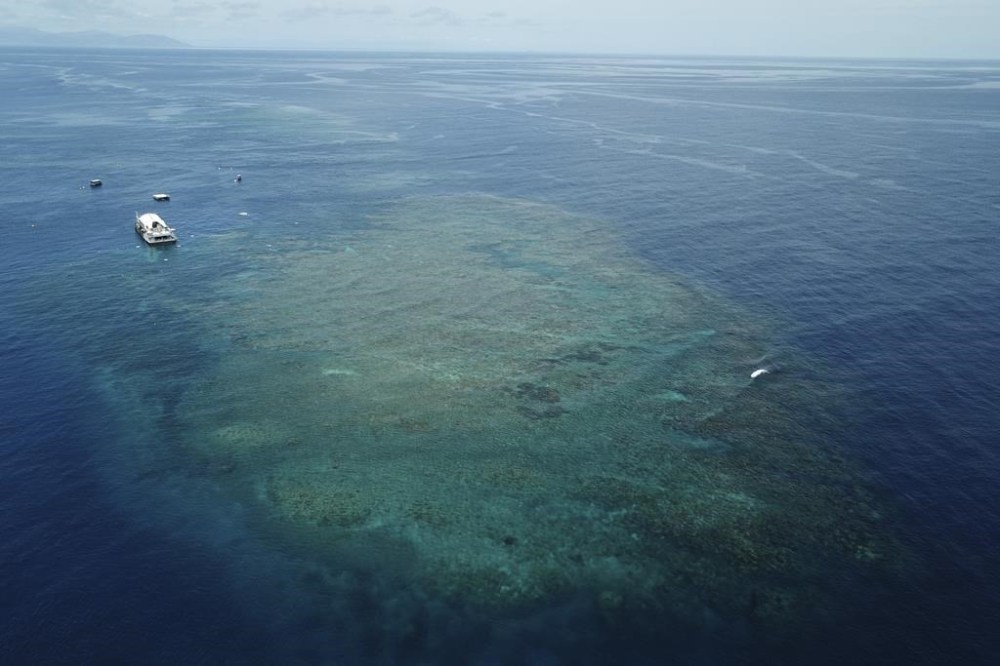
The Remoora pontoon, owned by Reef Magic, sits above a section of the Great Barrier Reef above Moore Reef in Gunggandji Sea Country off coast of Queensland in eastern Australia on Nov. 14, 2022. (AP Photo/Sam McNeil)

They observed largely stable temperatures before 1900, and steady warming from January to March from 1960 to 2024. And during five years of coral bleaching in the past decade — during 2016, 2017, 2020, 2022 and 2024 — temperatures in January and March were significantly higher than anything dating back to 1618, researchers found. They used climate models to attribute the warming rate after 1900 to human-caused climate change. The only other year nearly as warm as the mass bleaching years of the past decade was 2004.

“The reef is in danger and if we don’t divert from our current course, our generation will likely witness the demise of one of those great natural wonders,” said Benjamin Henley, the study’s lead author and a lecturer of sustainable urban management at the University of Melbourne. “If you put all of the evidence together … heat extremes are occurring too often for those corals to effectively adapt and evolve.”

Across the world, reefs are key to seafood production and tourism. Scientists have long said additional loss of coral is likely to be a casualty of future warming as the world approaches the 1.5 degrees Celsius (2.7 degrees Fahrenheit) threshold that countries agreed to try and keep warming under in the 2015 Paris climate agreement.

Even if global warming is kept under the Paris Agreement’s goal, which scientists say Earth is almost guaranteed to cross, 70% to 90% of corals across the globe could be threatened, the study’s authors said. As a result, future coral reefs would likely have less diversity in coral species — which has already been happening as the oceans have grown hotter.

Coral reefs have been evolving over the past quarter century in response to bleaching events like the ones the study’s authors highlighted, said Michael McPhaden, a senior climate scientist at the National Oceanic and Atmospheric Administration who was not involved with the study. But even the most robust coral may soon not be able to withstand the elevated temperatures expected under a warming climate with “the relentless rise in greenhouse gas concentrations in the atmosphere,” he said.

The Great Barrier Reef serves as an economic resource for the region and protects against severe tropical storms.

As more heat-tolerant coral replaces the less heat-tolerant species in the colorful underwater rainbow jungle, McPhaden said there’s “real concern” about the expected extreme loss in the number of species and reduction in area that the world’s largest reef covers.

“It’s the canary in the coal mine in terms of climate change,” McPhaden said.

___

This story has corrected attribution for the aerial surveys in the 2nd paragraph to the Great Barrier Reef Marine Park Authority, rather than NASA.

___

The Associated Press’ climate and environmental coverage receives financial support from multiple private foundations. AP is solely responsible for all content. Find AP’s standards for working with philanthropies, a list of supporters and funded coverage areas at AP.org.

Report Error Submit a Tip

More Stories

Doctor pays $500K to revamp courtyard at care home where he works

By Zoe Pierce 4 minute read Preview

Doctor pays $500K to revamp courtyard at care home where he works

By Zoe Pierce 4 minute read Yesterday at 5:06 PM CDT

Fifty years after Dr. Pravinsagar Mehta began caring for residents at Actionmarguerite, a courtyard he had long watched deteriorate is getting a new life after he and his wife committed $500,000 to its redevelopment and long-term maintenance.

Read
Yesterday at 5:06 PM CDT

U of M research role expands after $79-M federal injection

By Zoe Pierce 5 minute read Preview

U of M research role expands after $79-M federal injection

By Zoe Pierce 5 minute read 4:37 PM CDT

The University of Manitoba is playing in a new league.

A $79-million investment will bring five internationally recruited researchers to Manitoba to build “ambitious,” long-term research programs in areas of strategic national importance.

The five researchers will join the U of M thanks to the federal government’s $1.7-billion research talent initiative that’s designed to help Canadian universities compete globally for leading researchers.

The initiative’s flagship program, the Eddie Goldenberg Research Chairs of Canada, provides universities with the funding and resources to recruit world-class researchers, build research teams and pursue large-scale projects in fields considered important to Canada — from Arctic navigation and defence to sustainable mining, health equity and environmental law.

Read
4:37 PM CDT

Carney’s defence of Lake Ontario carries enormous weight

Niigaan Sinclair 5 minute read Preview

Carney’s defence of Lake Ontario carries enormous weight

Niigaan Sinclair 5 minute read 4:28 PM CDT

For centuries on Turtle Island (North America), explorers, map makers, and political leaders have erased Indigenous place names and substituted them — more often than not — with political, ethnocentric, and self-aggrandizing names.

In recent years, a few places on the continent have had Indigenous names re-established, but as of today, few of the original names are “official.”

So, it was no surprise when U.S. President Donald Trump on Thursday signed an executive order directing the U.S. Department of the Interior and Board on Geographic Names to take steps within 30 days to officially rename Lake Ontario as “Lake America.”

The move may have been a result of the Canada-U.S. trade war and Trump’s pettiness and ego, but it also fits in perfectly with his career.

Read
4:28 PM CDT

New Skyline: revolving restaurant to reopen atop Fort Garry Place

Aaron Epp 5 minute read Preview

New Skyline: revolving restaurant to reopen atop Fort Garry Place

Aaron Epp 5 minute read Wednesday, Aug. 26, 2026

Come fall, people will once again have the chance to dine more than two dozen storeys above Winnipeg’s downtown.

Alfonso Maury, former owner of Corrientes Argentine Pizzeria, is preparing to reopen the revolving restaurant on the 30th floor of Fort Garry Place. The venue, which has sat empty for the past six years, offers a panoramic view of the city.

Maury is aiming to open Dos Pampas Skyline Restaurant at the beginning of October. He plans to hire around 20 employees, who will prepare and serve an Argentinian-inspired menu he is currently putting together with head chef Norm Pastorin.

Dos Pampas will include seating for 120 customers, Maury said. Additionally, the restaurant will feature a lounge with couches and short tables where guests who have finished their meal but who aren’t ready to leave can enjoy dessert or another drink.

Read
Wednesday, Aug. 26, 2026

Five exceptional Manitobans reflect on what it means to be Canadian while bracing against Trump’s vitriol and economic upheaval

Aaron Epp 11 minute read Preview

Five exceptional Manitobans reflect on what it means to be Canadian while bracing against Trump’s vitriol and economic upheaval

Aaron Epp 11 minute read 1:35 PM CDT

Canadians have been trying to make sense of a new reality since Canada-United States trade talks broke down on Aug. 21.

The following day, President Donald Trump’s administration imposed 50 per cent tariffs on US$20 billion worth of Canadian exports to the U.S.

The federal government responded in kind a few days later, rolling out tariffs on $27.6 billion worth of imports from the U.S.

The Free Press contacted five Manitobans who have been appointed to the Order of Canada and asked them for their thoughts on the status of Canada-U.S. relations and what is means to be a Canadian today. Their responses have been edited for length and clarity.

Read
1:35 PM CDT

Entrepreneur Willow Wolfe conceived and crafted a better — and cruelty-free — paint brush

David Sanderson 8 minute read Preview

Entrepreneur Willow Wolfe conceived and crafted a better — and cruelty-free — paint brush

David Sanderson 8 minute read 3:09 PM CDT

NAROL — Talk about a brush with fame.

Fifteen years ago, Willow Wolfe, the founder of Willow Wolfe Painting Courses and Art Supplies, read about American actor/artist Richard Grieco’s experimentations with a style of painting he’d coined as “abstract emotionalism.”

Wolfe, whose personally designed line of synthetic paint brushes and watercolour workbooks are sold at more than 450 retailers around the globe, mailed Grieco (21 Jump Street, Veronica Mars) a set of brushes she felt would suit his needs.

The two have since remained in touch and this spring Grieco contacted Wolfe again, to let her know about a semi-autobiographical movie called The Painter he was directing and starring in.

Read
3:09 PM CDT