Sharing the chariot
Hare Krishna devotees roll out in vibrant style to celebrate annual Rath Yatra event

Advertisement
Read this article for free:
or
Already have an account? Log in here »
To continue reading, please subscribe:
Digital Subscription
One year of digital access for only $1.44 a week*
- Enjoy unlimited reading on winnipegfreepress.com
- Read the E-Edition, our digital replica newspaper
- Access News Break, our award-winning app
- Play interactive puzzles
*Billed as $5.77 plus GST every four weeks. After 52 weeks, price increases to the regular rate of $19.95 plus GST every four weeks. Offer available to new and qualified returning subscribers only. Cancel any time.
To continue reading, please subscribe:
Add Free Press access to your Brandon Sun subscription for only an additional
$1 for the first 4 weeks*
- Enjoy unlimited reading on winnipegfreepress.com
- Read the E-Edition, our digital replica newspaper
- Access News Break, our award-winning app
- Play interactive puzzles
*Your next Brandon Sun subscription payment will increase by $1.00 and you will be charged $17.95 plus GST for four weeks. After four weeks, your payment will increase to $24.95 plus GST every four weeks.
Read unlimited articles for free today:
or
Already have an account? Log in here »
Hey there, time traveller!
This article was published 10/08/2024 (797 days ago), so information in it may no longer be current.
When I got the email, I was surprised: There are Hare Krishnas in Winnipeg?
The email came from Komal Sharma, who was organizing the annual event Rath Yatra, or Festival of the Chariots, on behalf of the local chapter of the International Society for Krishna Consciousness (ISKCON).
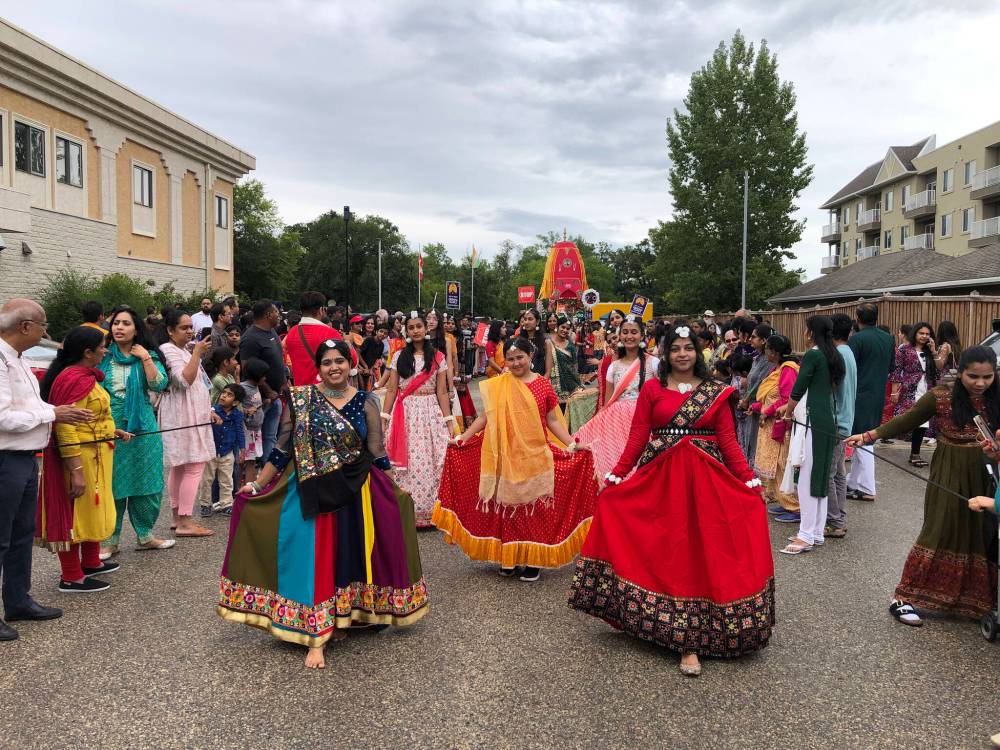
This year’s procession would be the first to take place on a city street, she said, and would involve the largest chariot ever to be pulled by devotees. On the chariot would be images of Lord Jagannath, a form of Lord Krishna, and his siblings Lord Baladeva and Lady Subhadra. The chariot would be adorned with colourful drapes, flowers and ornaments.
JOHN LONGHURST / FREE PRESS
Dancers (from left) Payal Pardasani, Angel Sharma and Ikankshi Prabhakar prepare to lead the Festival of Chariots procession organized by the local chapter of the International Society for Krishna Consciousness (ISKCON).
Right away, I told Sharma I had no idea Hare Krishnas were still around. My memories of the movement date back to the 1970s, when devotees in saffron robes — the men with their shaved heads — could be found in parks, malls and airports singing, chanting and seeking to attract new converts.
Back then, it was one of the most visible of the new religious groups in North America, part of the larger counter-culture movement occurring in the U.S. and Canada at that time. But since then, I hadn’t heard anything about them. I thought the group had disappeared.
I was wrong. Today, there are 10 ISKCON centres in Canada, and around 300 families are affiliated with ISKCON in Winnipeg. And for them, the Festival of Chariots is a very important celebration — one they were excited to share with the public last Sunday.
As for the Hare Krishna movement, it started in the 16th century as a branch of Hinduism; followers believe Krishna is the supreme God. The group’s name comes from its chant — Hare (pronounced “Harr-ee”, meaning blessed) Krishna — which devotees repeat over and over in the belief that chanting his name is a powerful way to connect with the divine and achieve inner peace.
During worship and prayer, devotees chant the following:
Hare Krishna, Hare Krishna, Krishna Krishna, Hare Hare,
Hare Rama, Hare Rama, Rama Rama, Hare Hare.
Devotees believe repetition of the mantra has a direct impact on the soul, awakening it to spiritual reality. Or, as Annapurna Chandra Devi Dasi put it at the Festival of Chariots event, it’s a way to “calm the mind and connect with the creator.”
Devi Dasi, who was travelling across Canada with her husband, Maha Devananda Das, to lead singing and chanting at Festival of Chariot events — he played guitar and she played a harmonium, also called a samvadini, a small and portable hand-pumped reed organ.
Through the chanting, devotees also proclaimed their willingness to serve God and all of humanity, she said, noting the goal was to lead people to action such as addressing issues like hunger and other needs.
“We are asking the Lord to be of service,” she said. “Not to just be concerned with ourselves, but to serve others and the creator and to spread a message of peace and unity and proclaim our willingness to live for a higher purpose.”
That purpose takes in all of creation, she said — humans, animals and the whole environment — since “all are part of the creator.”
Anyone can be a Hare Krishna devotee, Devi Dasi said, noting she was born and raised Roman Catholic. “You don’t have to convert. You can be Christian, Muslim or anything.”
Hare Krishna devotees are also vegetarians. They believe animals are created by God with a soul, and that eating an animal is an affront to God.
That’s what initially attracted Vrinda Mataji, who was serving as a supervisor at the Festival of Chariots. Raised in a vegetarian family, she used to think she was alone in abstaining from meat. But then she met Hare Krishna devotees and felt like part of a larger community.

Over time, as she explored the ancient Hindu scriptures such as the Bhagavad Gita and Bhagavat Purana, she found “answers to the most basic questions everyone has about life, the existence of evil and why bad things happen to good people” — explorations that led her deeper into the movement.
The festival itself opened with a service of chanting, with devotees sitting on the floor of the cultural hall of the Hindu Society of Manitoba. After the chanting, hundreds of people gathered in the Hindu Society parking lot to grab two long ropes to pull the chariot (on loan from the Calgary ISKCON centre) on to St. Anne’s Road.
For Komal Sharma, who invited me to the event, it was “a feast of devotion… we pull the chariot out of love.”
Along with that, it was also a way to reach out to Winnipeggers, and help people learn about Hare Krishna teachings and showcase the “rich cultural heritage of Vedic traditions and practices,” she said.
faith@freepress.mb.ca
The Free Press is committed to covering faith in Manitoba through our Religion in the News project. This reporting continues because readers like you step forward to fund it.
Donate now to support our reporting on religion.
Your donation is eligible for a charitable tax receipt.
BECOME A FAITH JOURNALISM SUPPORTER
Our newsroom depends on a growing audience of readers to power our journalism. If you are not a paid reader, please consider becoming a subscriber.
Our newsroom depends on its audience of readers to power our journalism. Thank you for your support.
The Free Press is committed to covering faith in Manitoba through our Religion in the News project. This reporting continues because readers like you step forward to fund it.
Donate now to support our reporting on religion.
Your donation is eligible for a charitable tax receipt.
BECOME A FAITH JOURNALISM SUPPORTER
Our newsroom depends on a growing audience of readers to power our journalism. If you are not a paid reader, please consider becoming a subscriber.
Our newsroom depends on its audience of readers to power our journalism. Thank you for your support.
Advertisement Advertise With Us
Advertisement Advertise With Us
The Free Press acknowledges the financial support it receives from members of the city’s faith community, which makes our coverage of religion possible.