Conservationists try to protect ecologically rich Alabama delta from development, climate change
Advertisement
Read this article for free:
or
Already have an account? Log in here »
To continue reading, please subscribe:

Digital Subscription
One year of digital access for only $205*
- Enjoy unlimited reading on winnipegfreepress.com
- Read the E-Edition, our digital replica newspaper
- Access News Break, our award-winning app
- Play interactive puzzles
*First annual payment billed as $205.00 + GST for one year. This annual subscription will automatically renew at $233.00 + GST every 52 weeks (10% off the regular annual price of $259.35). Offer available to new and qualified returning subscribers only. Cancel any time.
To continue reading, please subscribe:
Add Free Press access to your Brandon Sun subscription for only an additional
$1 for the first 4 weeks*
- Enjoy unlimited reading on winnipegfreepress.com
- Read the E-Edition, our digital replica newspaper
- Access News Break, our award-winning app
- Play interactive puzzles
*Your next Brandon Sun subscription payment will increase by $1.00 and you will be charged $17.95 plus GST for four weeks. After four weeks, your payment will increase to $24.95 plus GST every four weeks.
Read unlimited articles for free today:
or
Already have an account? Log in here »
Hey there, time traveller!
This article was published 13/08/2024 (740 days ago), so information in it may no longer be current.
MOBILE-TENSAW DELTA, Ala. (AP) — Thousands of American lotuses carpet the water’s surface, faces turned toward the morning sun. Bright yellow warblers flit among cypress trees along a creek bank. A paddlefish jumps as a motorboat rounds a bend.
The Mobile-Tensaw Delta — a lush, vibrant and surprisingly intact over 400-square-mile (1,036-square-kilometer) expanse of cypress swamps, oxbow lakes, marshland, hardwood stands and rivers — is teeming with more aquatic species than almost anywhere in North America. It’s considered one of the world’s most important delta ecosystems, yet its ecological riches are only a part of the even more diverse watershed that includes much of Alabama.
And the delta is the only place 77-year-old Lucy Hollings has called home.
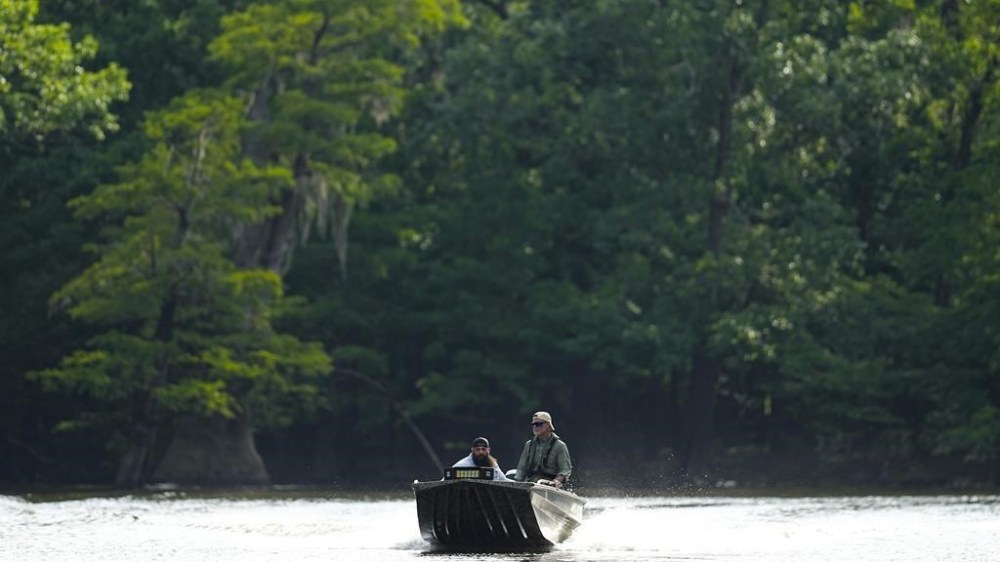
As a kid, she swam daily across the Tensaw River, gathering a mouthful of grass to prove she’d made it to the other side. Hollings — known as “Ms. Pie” — still fishes daily for white perch and largemouth bass. She’s sole proprietor of Cloverleaf Landing, a boat launch that offers anglers from far and wide access to the river and delta.
“I know I live in the most beautiful place in the world,” says Hollings, who cools off in the shade of towering sweetgum trees draped with Spanish moss and watches dazzling sunsets from her deck. “It’s a piece of heaven to me.”
The delta is a critical conduit between the rest of Alabama and the Gulf of Mexico — “a dynamo” that continually exchanges energy between the river systems and the Gulf, says Bill Finch, director of a forest research center. Two-thirds of the state drains to the delta, which cleans water and warehouses silt that could damage Mobile Bay and its renowned fisheries. It’s a spawning ground for many fish species. It’s home to hundreds of bird species, rare flowers and carnivorous plants.
So residents, scientists and environmentalists are working to protect the entire Alabama ecosystem considered crucial to the survival of species and the health of the delta and, ultimately, the Gulf of Mexico.
They’re acquiring property to prevent development and logging that chips away at forests, worsens flooding and threatens species — and as a buffer against climate change. They’re working with federal officials to alter dams that cut off fish from historic habitat and in urban areas to protect waterways and slow stormwater runoff.
And they’re trying to raise awareness of an important and unique area that many in the U.S. have never heard of and many in Alabama have never experienced.
“We can truly be protecting something that’s here rather than trying to restore something that’s been lost,” says Mitchell Reid, director of The Nature Conservancy in Alabama. “So many of North America’s systems are so altered that we’re trying to put Humpty Dumpty back together.”
“America’s Amazon”
Glaciers that covered much of North America never reached Alabama, where the relatively warm and humid climate has helped species proliferate.
What’s here astonishes biologists: American elms, decimated by disease in other parts of the country, thrive in the delta and its watershed, reflecting “this ancient, ancient heritage” of genetically hardy trees, says Finch, the forest researcher. It’s central to the nation’s oak diversity, with about 40 species, compared to about a dozen in the Great Smoky Mountains National Park.
Its fish diversity is unmatched on the continent, with about 350 species, including more than 230 in the 44,000-square-mile (113,959-square-kilometer) Mobile River basin. A single small Alabama river may have more species than all of California. There are over 100 crawfish species, almost three dozen turtle species. More mussel species than all of South America.
Experts say it’s impossible to protect the delta without considering the entire watershed, which reaches to Tennessee, Mississippi and Georgia. Some water begins in the Appalachian Mountains, moving through tracts of forest, urban areas and the delta until the Mobile River empties into the Gulf of Mexico at Mobile Bay.
“It’s really a jewel of an area in terms of conservation and preservation,” says Pat O’Neil, a biologist and former deputy director of Alabama Geological Survey. “There’s no other watershed in the country that rivals the diversity here. … It’s phenomenal.”
There still is much to discover, says Ben Raines, who has worked to spread awareness of the state’s ecological importance, first as environmental reporter at Mobile’s daily newspaper — where he rediscovered a crayfish thought to be extinct — and now as the environmental fellow at the University of South Alabama, where he’s the writer and filmmaker in residence, and as a boat captain offering nature tours. He dubbed Alabama “America’s Amazon” in a book and documentary.
“We don’t even know what’s here,” says Raines, cutting the motor as his boat glides into a thicket of sedges in the lower delta — the high-rises of Mobile visible in the distance, boat-tailed grackles eating cones from lotuses and alligators occasionally plying the waterway. “We’re losing things that haven’t been discovered and there are things still here that we think are gone.”
Altered ecosystem
The delta and its watershed are by no means pristine or untouched.
Forests of giant cypress and water tupelo were clear cut as recently as the 1980s by loggers who used helicopters to airlift them from swamps. Chemical plants, paper mills and a factory that made the now-banned insecticide DDT have contaminated land and water. Upstream dams altered waterflow into the delta, blocked fish passage and led to extinction of dozens of freshwater species, including fish, snails and mussels, some found only in the watershed.
Advocates say that makes their efforts imperative.
This spring, The Nature Conservancy bought 8,000 acres (3,237 hectares) of forested wetland between the Tombigbee and Alabama rivers at the top of the delta. The land, which regularly floods and is an important bird habitat and fish-spawning and feeding area, was in danger of being logged to produce wood pellets for European power plants.
“It would’ve been a horrible loss to the system,” says Reid, who calls the land “a critical piece of the puzzle” as the conservancy works to protect the upper delta.
Environmentalists also won a victory when a coal-fired power plant agreed in January to remove 21 million tons of coal ash stored in an unlined pit near the Mobile River. The state did not require its removal, although a breach could be potentially catastrophic for the delta. The EPA recently denied the state’s request to handle coal ash permits, saying its policies weren’t protective enough.
But other threats are unresolved. A canal built to connect the Tennessee and Tombigbee rivers in northern Alabama could allow invasive Asian carp to reach the Mobile River system and the delta, potentially devastating native fish. The U.S. Fish & Wildlife Service says carp have been found and removed downstream of the canal, with biologists relying on early detection while other control measures are considered.
Stronger hurricanes and saltwater surges have caused serious erosion and killed trees, according to biologists and Hollings, the lifelong resident.
Increased rainfall and sea level rise with climate change also will push saltwater farther into the delta — potentially causing forested areas to convert to marshland and shrinking the important area where saltwater and freshwater mix. That also adds urgency to efforts to acquire more land outside the delta for species to move in the future, says Judy Haner, the Alabama Nature Conservancy’s coastal programs director.
Species from the delta and its watershed could be transplanted to other states where they’ve been lost, says Finch the forest researcher, noting that’s already happening with some plants and mussels. And Alabama’s diverse, heat-tolerant species could be moved to other parts of the country as the climate changes, he adds.
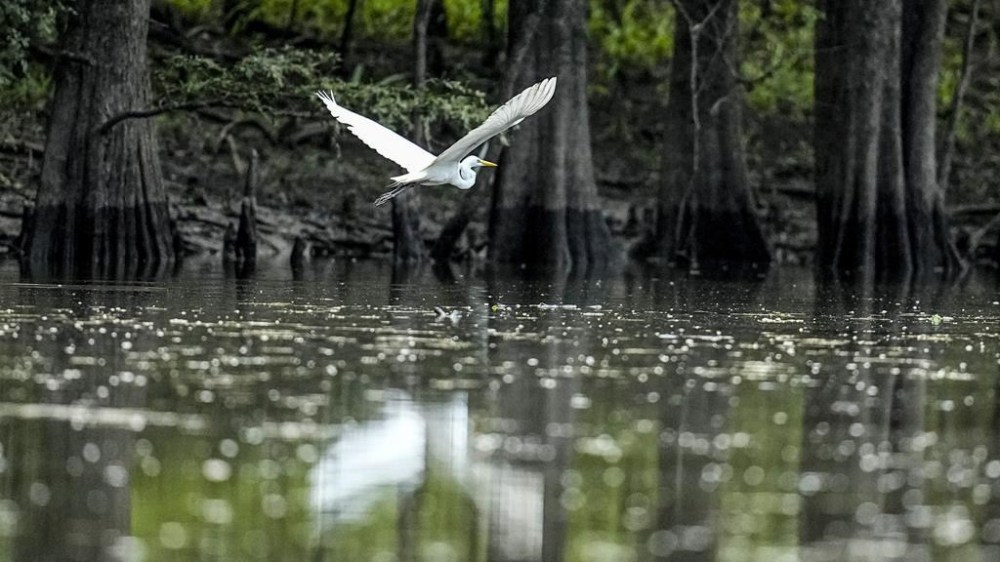
“Our great asset is understanding the biodiversity of this area,” Finch says. “It’s about more than ‘Let’s save this place because it’s pretty.’”
Everyone’s delta
Jimbo Meador has spent a lifetime here, hunting, fishing, shrimping, crabbing, frogging and trapping. For years, he offered boat tours for people who want to learn about the delta’s ecological riches.
After 82 years, he has stories. About flocks of ducks that once blackened the skies. About hunting invasive nutria — rodents brought from Argentina for their fur — that were destroying marshes until an alligator rebound helped control them. About endless days roaming the delta with childhood friends, fishing poles ready.
“I’m blessed to have been born when I was,” says Meador, known for his trademark long-billed cap, easy drawl and years of advocacy. “Each generation is losing some, but they don’t know what they lost. … Thank goodness we’ve got a bunch of conservation organizations.”
People haven’t always agreed how to preserve what’s left.
A decade ago, Alabama conservationists and famed biologist Edward O. Wilson undertook an effort to make the delta a national park, but it fizzled after some groups balked at federal oversight and others feared losing access.
“There’s all of these people (where) generation after generation after generation have had a camp up there or a houseboat up there, and you’re going to run them out? I don’t think so,” says Meador.
O’Neil, the former state geological survey official, says much of the land proposed for a national park was state-owned and already protected but available for hunting and fishing.
“The thing about conservation is it’s not a one-agency or a one-organization thing,” says O’Neil, noting that over 95% of land in Alabama is privately owned.
The key, he says, is cooperation between private landowners, the government and nongovernmental agencies: “When they get that mix just right … we have conservation that moves forward. We have species that are protected. We’ve been able to restore streams.”
Plans in progress
The Nature Conservancy is working with the U.S. Army Corps of Engineers to design fish bypasses around two aging dams on the Alabama River to allow species to swim up from the Gulf and delta to historical spawning grounds.
While similar projects out West often focus on one species, Reid says, the Alabama plan could benefit about 20. Biologists hope it will lead to rediscovery of the critically endangered Alabama sturgeon, which hasn’t been seen for more than 15 years, and recovery of the threatened Gulf sturgeon in the Mobile River watershed.
The conservancy also is working to restore ecosystems in urban areas as far north as Birmingham, about 200 miles (322 kilometers) from Mobile, to prevent floodwater from sending sediment down rivers that could harm the delta.
Some say the best way to get people to care is to help them experience the state’s waterways, forests and delta for themselves.
“You take people up there that’ve never seen it before and you explain to them how important it is and hopefully it helps,” says Meador, who took locals and visitors from other states and countries into the delta before suspending his business to care for his wife.
Conservationists say it’s important that the state and communities improve access to waterways and other natural areas, and to convince residents to advocate for preservation.

“We’re talking about this amazing, amazing place of life,” Reid says. “But we also recognize that when you have so much, there’s so much to lose.”
___
AP video journalist Stephen Smith contributed to this report.
___
The Associated Press receives support from the Walton Family Foundation for coverage of water and environmental policy. The AP is solely responsible for all content. For all of AP’s environmental coverage, visit https://apnews.com/hub/climate-and-environment