Charged and ready
Navigating the electric, and partially electric, vehicle landscape

Advertisement
Read this article for free:
or
Already have an account? Log in here »
To continue reading, please subscribe:
Digital Subscription
One year of digital access for only $1.44 a week*
- Enjoy unlimited reading on winnipegfreepress.com
- Read the E-Edition, our digital replica newspaper
- Access News Break, our award-winning app
- Play interactive puzzles
*Billed as $5.77 plus GST every four weeks. After 52 weeks, price increases to the regular rate of $19.95 plus GST every four weeks. Offer available to new and qualified returning subscribers only. Cancel any time.
To continue reading, please subscribe:
Add Free Press access to your Brandon Sun subscription for only an additional
$1 for the first 4 weeks*
- Enjoy unlimited reading on winnipegfreepress.com
- Read the E-Edition, our digital replica newspaper
- Access News Break, our award-winning app
- Play interactive puzzles
*Your next Brandon Sun subscription payment will increase by $1.00 and you will be charged $17.95 plus GST for four weeks. After four weeks, your payment will increase to $24.95 plus GST every four weeks.
Read unlimited articles for free today:
or
Already have an account? Log in here »
Hey there, time traveller!
This article was published 16/08/2024 (792 days ago), so information in it may no longer be current.
Globally, the automotive industry has invested more than US$1.2 trillion on zero-emissions driving, but the pace of sales of electric vehicles is slowing, in some cases, falling off a cliff.
While Hyundai continues to report traction in selling EVs such as the IONIQ5 and IONIQ6, other EVs are piling up on dealer lots. The early adopters — those who will jump on a new idea without regard for the hassles of ownership — have already eaten, so the industry’s challenge is to keep some momentum going as the federal government’s 2035 mandate of 100 per cent zero-emission vehicles looms.
There is a variety of options out there for anyone looking to green up their daily commute. Here’s a rundown:
Battery electric vehicles (BEV)
The holy grail of zero emissions, at least right now, BEVs run entirely on electric. These are also the vehicles that give potential customers pause, whether it’s from range anxiety, news reports of battery fires or the inability to install a charging device at home, which is a common concern for people renting in multi-family dwellings.
It’s important to point out that while battery fires are nearly impossible to extinguish using conventional firefighting techniques, they also happen at a fraction of the rate of fires involving gasoline-powered vehicles. Technology to reduce or eliminate the potential for fires is under development.
A BEV will accommodate the typical daily driving needs of 95 per cent of consumers, and many may require charging only once a week. Where they fall down is on road trips: in the city, BEVs, like hybrids, recharge slightly every time the vehicle slows down, so the city range often exceeds the highway range. On the highway, of course, vehicles rarely slow down, so the depletion of battery power is more rapid.
It is possible to take a road trip in a BEV in similar time to driving a gas-powered vehicle, but the risk is the charging stations you find might be full, inoperative or charge more slowly than anticipated. Plus, you have to plan your route based on availability of charging stations: maps of charging stations are readily available.
EVs range in price from the Chevrolet Bolt at $41,562, which arguably has the most stated range per buck at 417 kilometres. Its big brother, the Equinox EV, starts at $51,518 and offers as much as 518 km of range. Other offerings include the Hyundai IONIQ5 ($57,677) and Kia Soul EV ($45,933) and Nissan Leaf ($41,248). Offerings from Ford (F-150 Lightning), GMC (Hummer EV), Mercedes-Benz and Porsche can easily go north of $100,000. Prices do not include federal or provincial rebates.
Most BEVs qualify for $5,000 in federal rebates and in Manitoba, those priced less than $70,000 qualify for a $4,000 rebate. Pro-rated incentives exist for leases.
SUPPLIED The 2024 Chevrolet Equinox EV boasts up to 518 kilometres of range.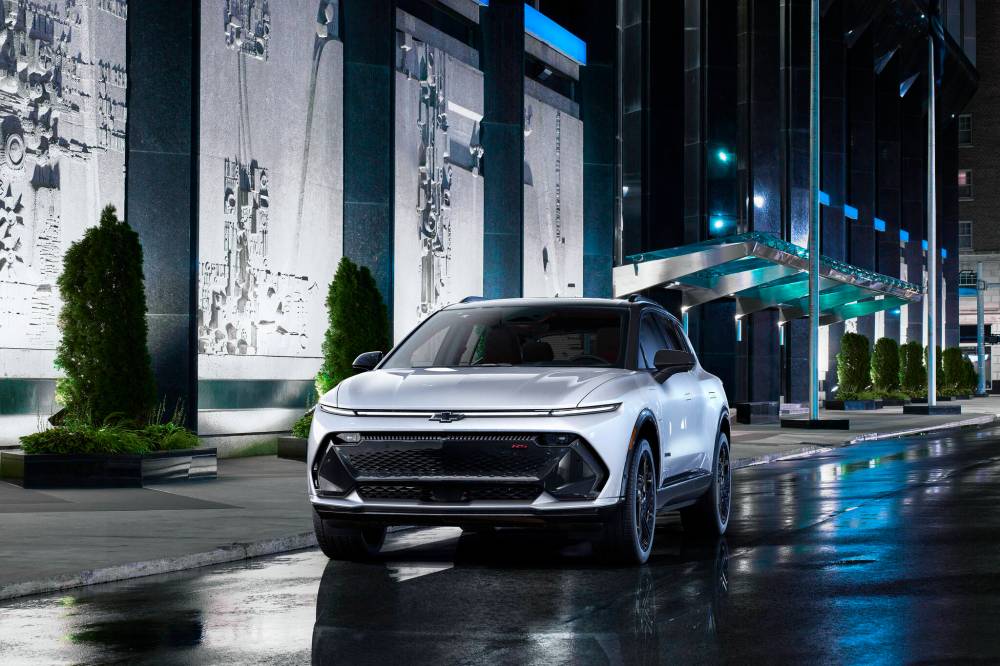
Plug-in hybrid electric vehicles (PHEV)
These vehicles use a larger battery than standard hybrid vehicles and require charging for the full benefit.
To qualify for federal incentives, a PHEV must have an EV-only range — when it’s driving fully on electric — of 50 km or more. The 2024 Mitsubishi Outlander PHEV qualifies for a full $5,000 federal rebate, as well as the $4,000 Manitoba rebate. Others, such as the Toyota RAV4 Prime, also qualify. Links to eligible vehicles will be included at the end of this story.
SUPPLIED The 2024 Toyota RAV4 Prime is a rebate-eligible plug-in hybrid that starts at $54,868.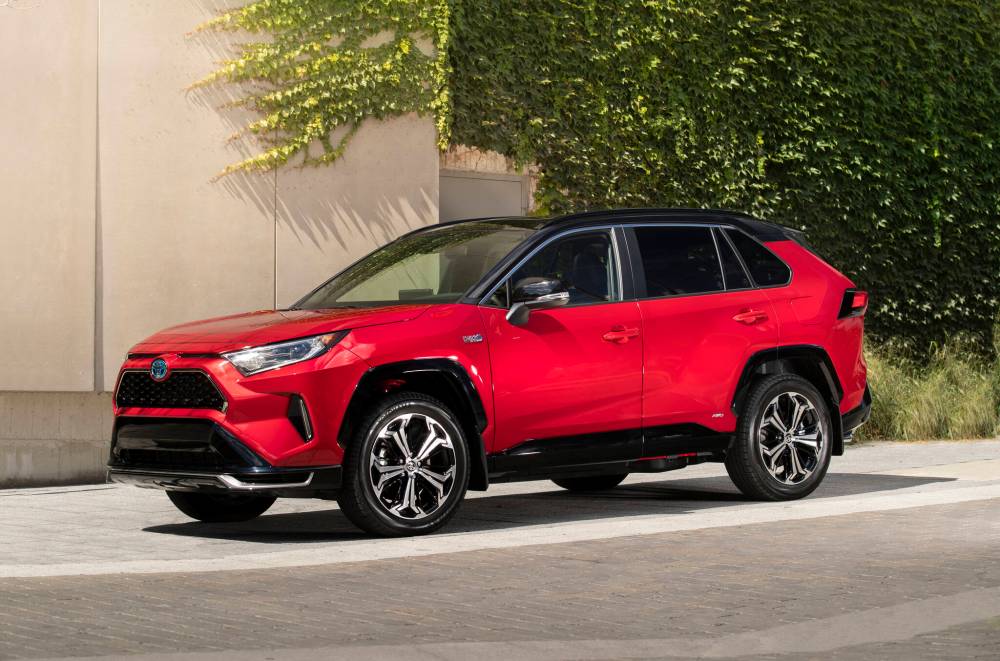
A vehicle in this class will satisfy 100 per cent of the driving needs of the owner. It will, for daily driving, typically only ever operate in EV mode. For example, a number of years ago, Honda sent the Clarity Plug-in Hybrid for two weeks split between myself and Free Press copy editor and automotive writer Willy Williamson. Between the two of us, over those two weeks, returning the vehicle with a full tank of gas required buying zero litres of fuel. Willy lives out of town, and we’d charge the car at our homes and at work. The gas engine did not fire up.
The advantage of a plug-in hybrid is that the gas motor is available on standby for longer trips. So even if you found no working charging stations along your journey, as long as you refilled the gas tank as needed, you wouldn’t be stranded.
Vehicles available in this class include the Mazda CX-70 PHEV ($58,750) and CX-90 PHEV ($54,900), Toyota Prius Prime ($43,053) and Volvo S60 Recharge ($58,615). Prices do not include federal or provincial rebates.
And charging?
Both battery electric and plug-in hybrid vehicles require charging, which is either done using standard electrical outlets or with Level 2 or Level 3 charging stations. Homeowners typically will only install Level 2 chargers.
Such stations will cost between $1,000 and $2,000, not including installation. Installation typically involves having an electrician run a 240-volt line to your garage or driveway.
The chargers that come standard with vehicles, and use regular outlets, will take a day or more to reach a full charge.
Hybrid electric vehicles
This is the category that started the electrification journey. The first was the 1999 Toyota Prius and current offerings include the Hyundai Sonata Hybrid, Honda Civic Hybrid and Mazda CX-70 and CX-90 models, including the latest iteration of the Prius, among others.
These vehicles use a much smaller drive battery than pure EVs, and typically always share propulsion duties between the battery and the gas tank. An electric motor is bolted either between the gas motor and transmission or to a second input of the transmission.
Some will have limited availability of EV-only mode: often, this is just enough to get out of the neighbourhood as quietly as possible. Then the gas engine fires up.
Some vehicles in this class are offered only as hybrids, such as the Toyota Venza. The above mentioned Mazdas are offered in two variations of hybrids: a mild hybrid at a lower price and a plug-in hybrid with a larger battery and more powerful gas engine.
Vehicles in this category include the Mazda CX-70 ($49,750), Toyota Venza ($46,114; Toyota has 20 vehicles that are either battery electric, fuel cell, hybrid or have a hybrid powertrain available) and Hyundai Santa Fe ($43,714), among many others.
Hybrids do not qualify for federal or Manitoba incentives. They also do not require charging.
Fuel cell electric vehicle (FCEV)
Fuel cells typically run on hydrogen, and they operate by passing the gas through a membrane that strips off each atom’s electron and feeds it into the electrical system. The electron returns to the fuel cell having done its job and the process of reuniting it and a proton involves oxygen. The resulting waste is two hydrogen atoms bound to one oxygen atom, also known as H2O, also known as… water.
As attractive as the option is, hydrogen availability worldwide is severely limited and there are no publicly available filling stations in Manitoba. Fuel cells are not a viable alternative in most of Canada.
Finding a green alternative
As you’ll see if you follow these links, an exhaustive list of hybrid, plug-in hybrid and battery electric vehicles would not be practical in these pages.
To find the list of vehicles eligible for federal incentives, visit http://wfp.to/CTS
To find the list of vehicles eligible for Manitoba incentives, visit http://wfp.to/CTN
kelly.taylor@winnipegfreepress.com
Kelly Taylor
Copy Editor, Autos Reporter
Kelly Taylor is a copy editor and award-winning automotive journalist, and he writes the Free Press‘s Business Weekly newsletter. Kelly got his start in journalism in 1988 at the Winnipeg Sun, straight out of the creative communications program at RRC Polytech (then Red River Community College). A detour to the Brandon Sun for eight months led to the Winnipeg Free Press in 1989. Read more about Kelly.
Every piece of reporting Kelly produces is reviewed by an editing team before it is posted online or published in print — part of the Free Press‘s tradition, since 1872, of producing reliable independent journalism. Read more about Free Press’s history and mandate, and learn how our newsroom operates.
Our newsroom depends on a growing audience of readers to power our journalism. If you are not a paid reader, please consider becoming a subscriber.
Our newsroom depends on its audience of readers to power our journalism. Thank you for your support.
Kelly Taylor
Copy Editor, Autos Reporter
Kelly Taylor is a copy editor and award-winning automotive journalist, and he writes the Free Press‘s Business Weekly newsletter. Kelly got his start in journalism in 1988 at the Winnipeg Sun, straight out of the creative communications program at RRC Polytech (then Red River Community College). A detour to the Brandon Sun for eight months led to the Winnipeg Free Press in 1989. Read more about Kelly.
Every piece of reporting Kelly produces is reviewed by an editing team before it is posted online or published in print — part of the Free Press‘s tradition, since 1872, of producing reliable independent journalism. Read more about Free Press’s history and mandate, and learn how our newsroom operates.
Our newsroom depends on a growing audience of readers to power our journalism. If you are not a paid reader, please consider becoming a subscriber.
Our newsroom depends on its audience of readers to power our journalism. Thank you for your support.
Related Articles
Peg City Co-op, Assiniboine Credit Union partner on pair of EV charging stations
Advertisement Advertise With Us
Advertisement Advertise With Us
History
Updated on Friday, August 16, 2024 10:25 AM CDT: Adds links