

Solid ‘slithery, splattery’ entry
Seventh Alien instalment holds its own

Advertisement
Read this article for free:
or
Already have an account? Log in here »
To continue reading, please subscribe:
Digital Subscription
One year of digital access for only $1.44 a week*
- Enjoy unlimited reading on winnipegfreepress.com
- Read the E-Edition, our digital replica newspaper
- Access News Break, our award-winning app
- Play interactive puzzles
*Billed as $5.77 plus GST every four weeks. After 52 weeks, price increases to the regular rate of $19.95 plus GST every four weeks. Offer available to new and qualified returning subscribers only. Cancel any time.
To continue reading, please subscribe:
Add Free Press access to your Brandon Sun subscription for only an additional
$1 for the first 4 weeks*
- Enjoy unlimited reading on winnipegfreepress.com
- Read the E-Edition, our digital replica newspaper
- Access News Break, our award-winning app
- Play interactive puzzles
*Your next Brandon Sun subscription payment will increase by $1.00 and you will be charged $17.95 plus GST for four weeks. After four weeks, your payment will increase to $24.95 plus GST every four weeks.
Read unlimited articles for free today:
or
Already have an account? Log in here »
Hey there, time traveller!
This article was published 16/08/2024 (674 days ago), so information in it may no longer be current.
Since its chest-bursting arrival in 1979, the Alien cinematic universe has encompassed everything from the lofty theological yearnings of the Prometheus and Covenant prequels to the B-movie side hustle of the Alien vs. Predator flicks. The latest instalment in the series throws out some clever callbacks to earlier entries while making its own slithery, splattery way forward.
Director Fede Alvarez, who co-scripts with Rodo Sayagues, has some experience with franchises — he’s helmed updates of The Evil Dead and The Texas Chainsaw Massacre. Here he works within Alien’s larger mythology, but he’s crafted a (mostly) tight, effective piece of stand-alone sci-fi horror.
Slotting into the franchise timeline between the events of the two classic instalments, Ridley Scott’s 1979 Alien and James Cameron’s 1986 Aliens, Alien: Romulus draws on both, combining a lot of Scott’s gothic murk with some of Cameron’s more straight-up, gun-toting action.
The story centres on Rain (Priscilla’s Cailee Spaeny) and Andy (David Jonnson from Industry and Murder is Easy), who live and work on a mining colony run by the Weyland-Yutani corporation. It’s a grim, gritty resource-extraction town, riven by pandemic disease and industrial accidents and ruled over by corporate callousness and greed.
Under Spaeny’s sweetly youthful visage — she recently played the 14-year-old Priscilla Beaulieu Presley — Rain is resourceful and tough. She looks out for the vulnerable Andy, who is actually a malfunctioning synthetic who was discarded by the corporation and salvaged by Rain’s late father.
Andy’s prime directive is to protect Rain, but his supplementary line of programming involves making dad jokes.
Rain and Andy are drawn into a plan with some teenage friends to boost a shuttle and break into an abandoned space station. They’re hoping to find the fuel and equipment that will get them off their dismal, oppressive corporate rock for good.
What they find instead is tentacles in jars and ominous holes in the metal floor. Soon they will encounter all the life stages of the alien xenomorphs — those “perfect organisms,” as one corporate asset describes them — that are so terrifyingly implacable in their drive to reproduce and survive.
Alvarez offers some gory body horror, which at one point morphs into gruesome sexual jokes. As with the original two Alien films, which kept the monsters in the shadows until the midway point, Alvarez uses a long lead time to amp up the tension.
When the creatures do show themselves, he relies mostly on old-school practical effects, with a combination of animatronics, puppetry and very tall guys in monster suits.
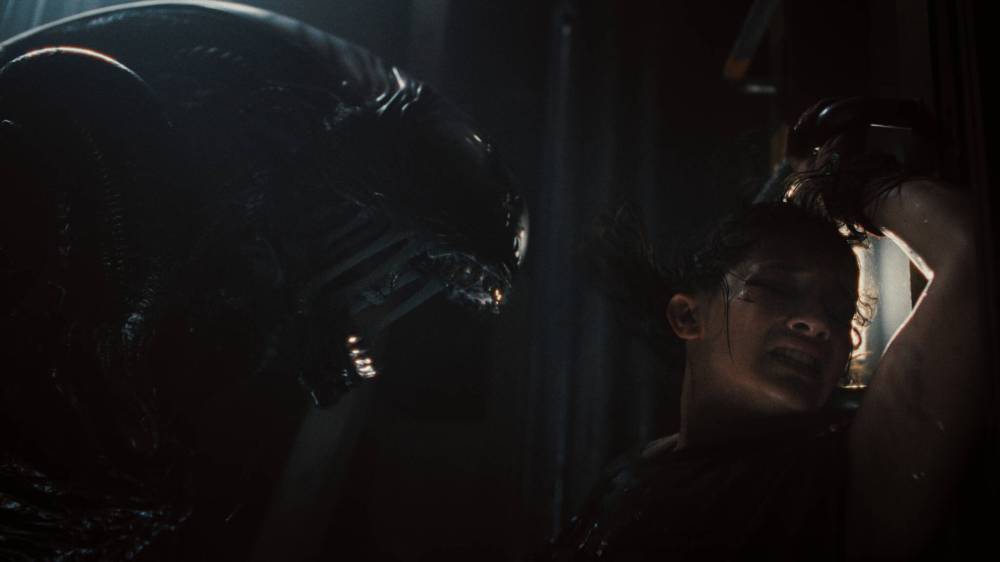
20TH CENTURY STUDIOS
Cailee Spaeny recently played the lead in Sofia Coppola’s 2023 biopic Priscilla.
There’s some detailed, deliberately retro worldbuilding — from the mention of the corporation’s canteen cornbread (still bad) to the very 1980s version of futuristic technology (big and bulky with glowing graphics).
Alvarez often channels Scott’s dark visuals, with the murkiness extending to the audio, which sometimes results in buried dialogue.
There are recurring ideas, with the script contrasting hardcore utilitarianism with the ethics of care. There are some life-and-death labour-vs.-management conflicts. In one scene, Andy is told his synthetic model formed “the backbone of the corporation’s colonial endeavours,” teasing some political dimensions that beg for a bit more followup.
And as always in the Alien franchise, there are motherhood issues, both figurative and — messily, horrifically — literal.

Rain will never be as iconic as Sigourney Weaver’s Ripley, but Spaeny holds her own as our protagonist. Jonsson delivers a canny performance as Andy, who has to shift over the course of the story as his programming gets rebooted.
The rest of the ensemble doesn’t really register, though, with the script veering more toward the tropes of the teen slasher flick in their rudimentary characterizations.
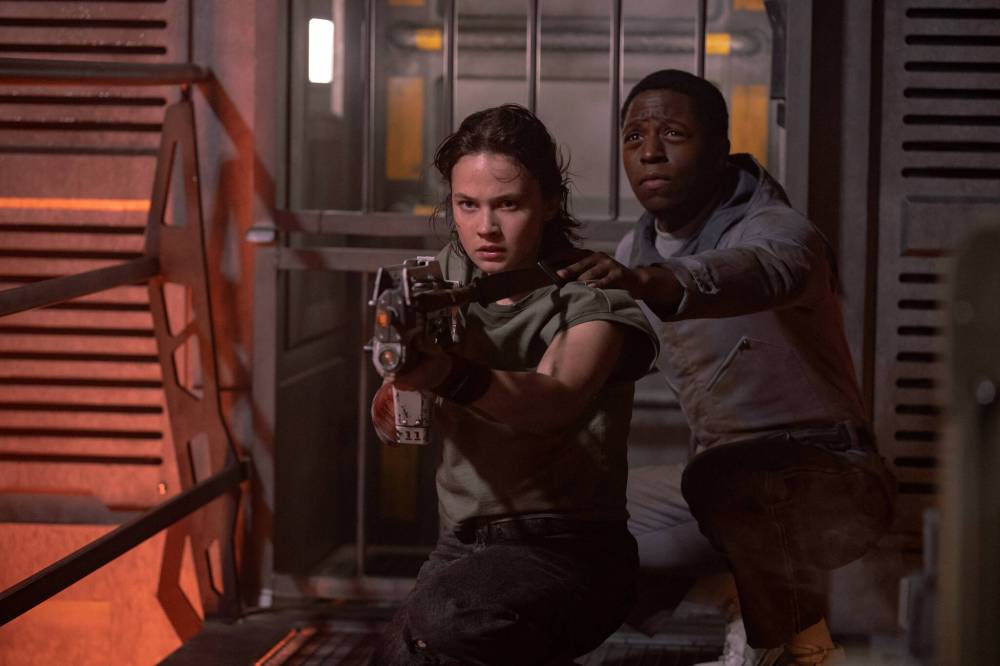
MURRAY CLOSE / 20TH CENTURY STUDIOS / TNS
Cailee Spaeny (left) as Rain and David Jonsson as Andy effectively helm the stand-alone flick, set in the franchise timeline between 1979’s Alien and 1986’s Aliens.
The story works well for most of its spatially contained, temporally compressed runtime. There’s a sudden fall-off in the flawed final quarter, but at least it’s due to a burst of kooky, ambitious overreach rather than franchise malaise.
This isn’t a faultless film, but then perfection is scary in the Alien films. The lethal xenomorphs, after all, are perfect. Human beings are defined by their stubborn strengths and inevitable fallibilities. Alien: Romulus showcases both.
alison.gillmor@freepress.mb.ca
Studying at the University of Winnipeg and later Toronto’s York University, Alison Gillmor planned to become an art historian. She ended up catching the journalism bug when she started as visual arts reviewer at the Winnipeg Free Press in 1992.
Our newsroom depends on a growing audience of readers to power our journalism. If you are not a paid reader, please consider becoming a subscriber.
Our newsroom depends on its audience of readers to power our journalism. Thank you for your support.
Movie review
Alien: Romulus
Starring Cailee Spaeny and David Jonsson
● Grant Park, Kildonan Park, McGillivray, Polo Park, St. Vital
● 119 minutes, 14A
★★★★ out of five
Other voices
Alien movie, Alien: Romulus, the seventh installment in this storied, apparently inexhaustible cycle of films, is perfectly adequate filler.
— Manohla Dargis, New York Times
To its credit, it’s a no-frills, straight-up genre piece built largely on the bones of the first two movies. All that’s missing are originality and a convincing final act, and, honestly, you could do worse for a Saturday night eek-a-thon.
— Ty Burr, Washington Post
It borrows the shabby-computer aesthetic of the ’79 flick while upping the ante with haunting grandeur.
— Johnny Oleksinski, New York Post
If Alvarez is aiming to attract “body horror” fans, he’s succeeded brilliantly. But if you were impressed by the moral arguments explored in Scott’s last two prequels and by the gravitas that Weaver brought to the original trilogy, you’re out of luck.
— Sandra Hall, Sydney Morning Herald
Alien: Romulus plays the hits, but crucially remembers the ingredients for what makes a good Alien film, and executes them with stunning craft and care. It is, officially, the third-best film in the series.
— John Nugent, Empire Magazine
Studying at the University of Winnipeg and later Toronto’s York University, Alison Gillmor planned to become an art historian. She ended up catching the journalism bug when she started as visual arts reviewer at the Winnipeg Free Press in 1992.
Our newsroom depends on a growing audience of readers to power our journalism. If you are not a paid reader, please consider becoming a subscriber.
Our newsroom depends on its audience of readers to power our journalism. Thank you for your support.
Advertisement Advertise With Us
Advertisement Advertise With Us