

Sounding the alarm on transit deficits
Advertisement
Read this article for free:
or
Already have an account? Log in here »
To continue reading, please subscribe:

Digital Subscription
One year of digital access for only $205*
- Enjoy unlimited reading on winnipegfreepress.com
- Read the E-Edition, our digital replica newspaper
- Access News Break, our award-winning app
- Play interactive puzzles
*First annual payment billed as $205.00 + GST for one year. This annual subscription will automatically renew at $233.00 + GST every 52 weeks (10% off the regular annual price of $259.35). Offer available to new and qualified returning subscribers only. Cancel any time.
To continue reading, please subscribe:
Add Free Press access to your Brandon Sun subscription for only an additional
$1 for the first 4 weeks*
- Enjoy unlimited reading on winnipegfreepress.com
- Read the E-Edition, our digital replica newspaper
- Access News Break, our award-winning app
- Play interactive puzzles
*Your next Brandon Sun subscription payment will increase by $1.00 and you will be charged $17.95 plus GST for four weeks. After four weeks, your payment will increase to $24.95 plus GST every four weeks.
Read unlimited articles for free today:
or
Already have an account? Log in here »
Hey there, time traveller!
This article was published 20/08/2024 (732 days ago), so information in it may no longer be current.
There are few strategies more important in the fight against climate change than a well-funded and effective public transit system.
Given that transportation makes up one of the largest components of human-induced greenhouse gas emissions, convincing people to embrace transit as a daily part of their lives — particularly in favour of reducing the numbers of single-occupancy vehicles — has never been more critical.
That’s why a new analysis warning that Canada’s public transit systems — including Winnipeg’s — are headed towards a “downward spiral” unless governments pump more resources into their operating budgets should be a wake-up call to all governments across the country.
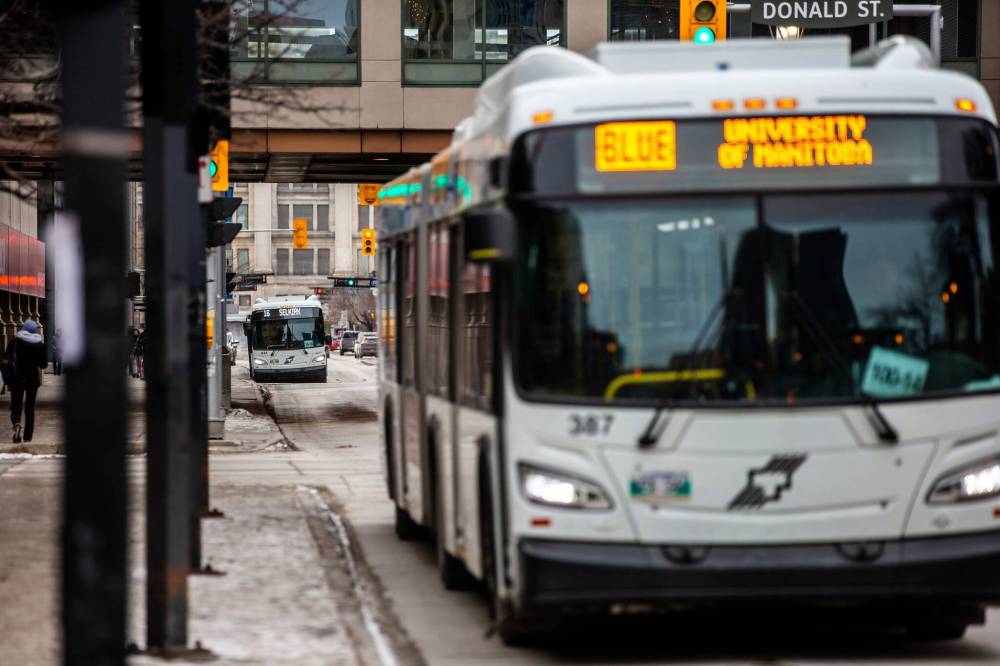
MIKAELA MACKENZIE / WINNIPEG FREE PRESS
Winnipeg Transit buses on Graham Avenue.
A report published earlier this year by Leading Mobility Canada studied transit systems in eight cities — Vancouver, Calgary, Edmonton, Winnipeg, Ottawa, Toronto, Montreal and Halifax — and found most are reporting shortfalls in their transit budgets.
Worse, with planned transit expansions in all cities, including bus rapid transit and subway extensions, all eight jurisdictions say the higher associated operating costs will far exceed what they can afford.
Most already have structural deficits. Under planned expansions, those deficits will become more acute unless governments increase transit subsidies.
In Winnipeg, while ridership is returning to pre-pandemic levels, it began to stagnate in the years leading up to 2020 when the novel coronavirus crippled transit systems across the country. While Winnipeg Transit is planning a major overhaul of its routes to improve services in a bid to attract more riders, like most Canadian cities, it continues to rely heavily on fares and property taxes to pay for operations. That is not sustainable.
It raises questions about whether Winnipeg, under the current funding model, can truly afford future expansions, such as plans to add a second bus rapid transit corridor on the east side of the city.
Federal and provincial governments are making limited contributions to transit systems across the country, but it’s not enough, the Leading Mobility study found. Much of the federal contributions are temporary, including one-time capital investments that help with expansions but do not support ongoing operating costs.
As a result, transit systems are often left with no choice but to cut services, a death knell that leads to reduced revenues and even more subsequent cuts, the study found. Ergo the “downward spiral.”
Leading Mobility recommends cities, working with provincial governments, should find new revenue sources, such as vehicle registration levies and congestion pricing that taxes vehicles in the busiest parts of cities, similar to what jurisdictions like London, England and New York City do.

It also recommends that Canada launch a national commission on transit operating funding to find ways of making the country’s public transit systems more sustainable.
What such a commission would likely find is that increased government funding for transit may not even be a net cost to taxpayers. Improved transit services and higher ridership would mean fewer vehicles on the road and less wear and tear on city infrastructure. It would also reduce the need for future roadway expansions, such as the planned widening of Route 90 in Winnipeg.
It is conceivable — likely, even — that savings in those areas could exceed the costs of putting the country’s transit systems on sound financial footing.
More importantly, it would go a long way towards reducing Canada’s greenhouse gas emissions and help reverse the damaging effects of climate change.
Finding solutions to the country’s underfunded transit systems should be a priority for all governments across Canada. Allowing this national crisis to fester is not an option.