Motoring right along
Toyota Canada turns 60, rolls out 11 millionth vehicle

Advertisement
Read this article for free:
or
Already have an account? Log in here »
To continue reading, please subscribe:

Digital Subscription
One year of digital access for only $205*
- Enjoy unlimited reading on winnipegfreepress.com
- Read the E-Edition, our digital replica newspaper
- Access News Break, our award-winning app
- Play interactive puzzles
*First annual payment billed as $205.00 + GST for one year. This annual subscription will automatically renew at $233.00 + GST every 52 weeks (10% off the regular annual price of $259.35). Offer available to new and qualified returning subscribers only. Cancel any time.
To continue reading, please subscribe:
Add Free Press access to your Brandon Sun subscription for only an additional
$1 for the first 4 weeks*
- Enjoy unlimited reading on winnipegfreepress.com
- Read the E-Edition, our digital replica newspaper
- Access News Break, our award-winning app
- Play interactive puzzles
*Your next Brandon Sun subscription payment will increase by $1.00 and you will be charged $17.95 plus GST for four weeks. After four weeks, your payment will increase to $24.95 plus GST every four weeks.
Read unlimited articles for free today:
or
Already have an account? Log in here »
Hey there, time traveller!
This article was published 23/08/2024 (708 days ago), so information in it may no longer be current.
CAMBRIDGE, Ont. — In the early days of Toyota’s entrance to the Canadian market, Japanese executives would visit facilities in Toronto and wonder why staff weren’t running through the parking lot to get to work and why employees would leave at quitting time.
It’s a story the late F. David Stone, who worked in public relations from those first days until his retirement in the early 2000s, would tell to illustrate the growing pains of two corporate cultures that merged in 1964. Sixty years later, the company is Canada’s largest automotive manufacturer and third best seller.
Lester B. Pearson was prime minister and Mary Poppins topped the movie charts when a group of Canadian and American investors founded Canadian Motor Industries (CMI) and secured a distribution agreement with Toyota Motor Corp. It was a humble beginning for a company that would go on to become Canada’s largest automotive manufacturer.
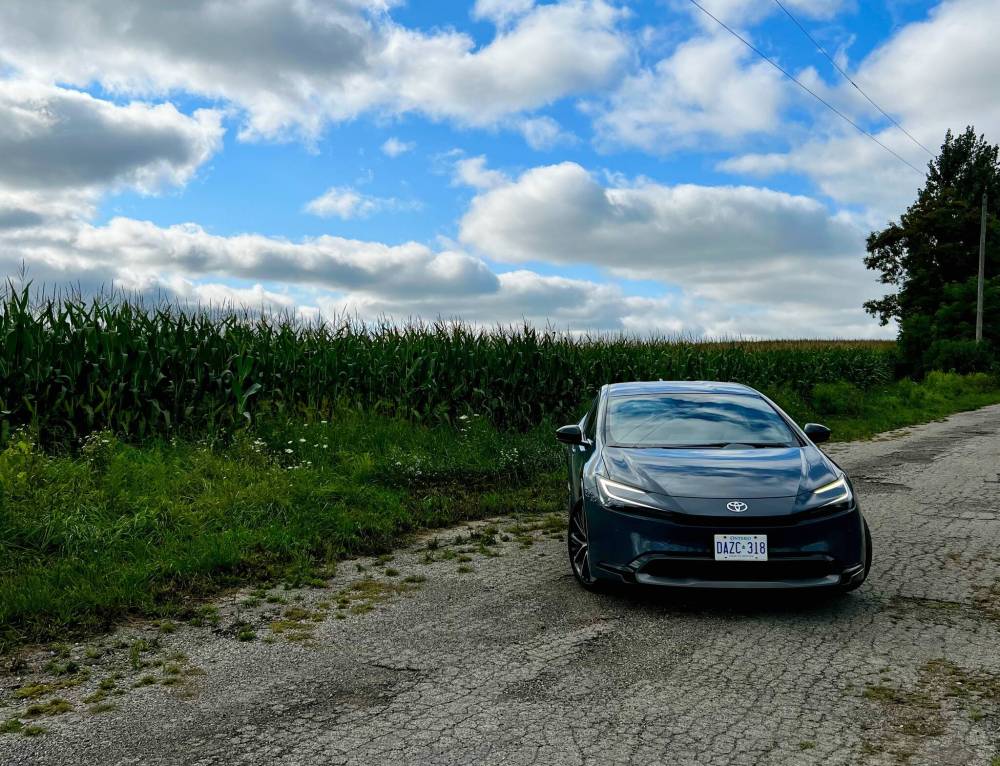
In 1965, the company’s first year of sales, it sold only 755 vehicles. Today, 60 years later, it sells almost that many every business day. Toyota in Canada is the No. 3 selling carmaker (227,460 sales in 2023 according to the Automotive News Data Center) and produces more than 500,000 vehicles a year at three assembly plants in Cambridge, Ont., and Woodbridge, Ont.
Those humble beginnings included Canada producing the first Japanese car made in North America, the Isuzu Bellett, produced at CMI’s plant in Point Edward, N.S. CMI was founded on the belief, according to a CMI advertisement from 1965, that Canadian manufacturing and quality control could rival the Japanese.
It’s a prediction the eventual Toyota Motor Manufacturing Canada (TMMC) would go on to realize.
The first plant, which opened in 1988, piled up the plant quality awards and went on to receive its highest commendation in 2000, when Toyota announced it would become the first plant outside Japan to build a Lexus vehicle, beginning with the 2003 RX crossover. Until then, assembling Lexus products was strictly reserved for Japanese factories.
Today, TMMC is one of two non-Japanese plants to build Lexus vehicles and the only one to build two, the RX and NX crossovers.
On April 1, 1980, Canadian Motor Industries became Toyota Canada Inc. The company is 51 per cent owned by Toyota Motor Corp. and 49 per cent by Mitsui and Co., a Japanese conglomerate with interests in steel and iron, mining and energy, among others.
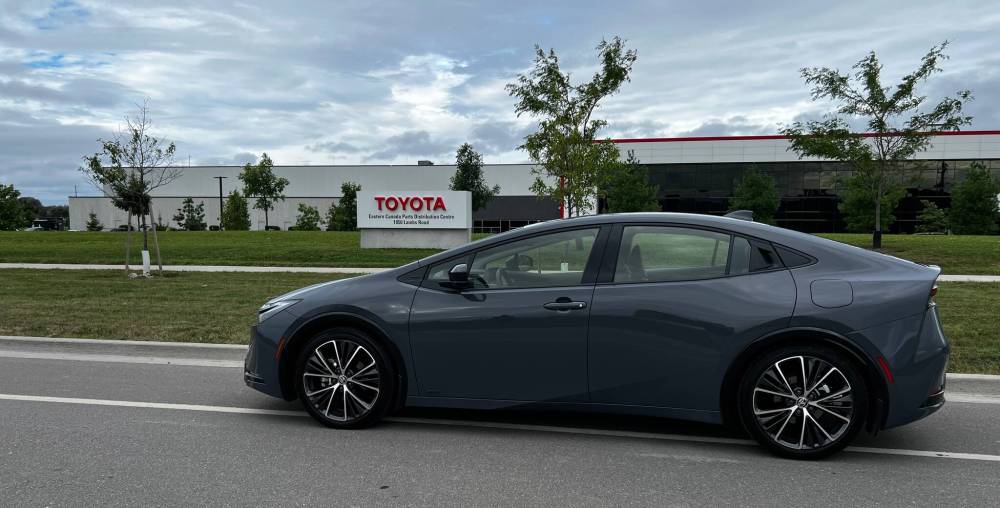
Kelly Taylor / Free Press
The Toyota Prius outside the Eastern Canada Parts Distribution Centre, both models of operating efficiency.
At 60, Toyota is still a relative newcomer: Ford Motor Co. of Canada was founded in 1904 and General Motors Canada in 1918. Nissan arrived in 1965 (as Datsun) and Honda in 1973.
Toyota Canada’s celebration of the anniversary — called kanreki in Japanese — is in the form of a cross-Canada drive, from St. John’s, N.L. to Victoria, B.C. Each group of eight automotive journalists will drive one of six legs: St. John’s to Halifax, Halifax to Montreal, Montreal to North Bay, Ont., North Bay to Winnipeg, Winnipeg to Calgary and Calgary to Victoria.
My leg began in Montreal, and on the way to North Bay, we stopped at the Canadian Museum of Science and Technology in Ottawa, Toyota’s Eastern Canada Parts Distribution Centre and Toyota Motor Manufacturing Canada. In Manitoba, journalists arriving today from North Bay will visit the centre of Canada marker near Steinbach before overnighting at the Alt Hotel. Those departing on the next wave will visit the Trans-Canada Trail in Headingley before departing for Saskatoon.
Analyzing how Toyota works would be a university thesis-level project, and is a product that Toyota sells, teaching other companies and non-profits how to implement the Toyota Production System in their businesses.
The Toyota Production System Support Centre’s clients include Canadian Blood Services, where Toyota’s pro-bono support of process improvements resulted in a 40 per cent reduction in the time needed to pack blood products, a 30 per cent increase in productivity and a 30 per cent reduction in steps taken by employees every day, said CBS spokesman Paolo Oliveros.
Operations at TMMC, which builds the Toyota RAV4, Lexus RX and Lexus NX, represent a study in steady: while a vehicle rolls off the line every minute, there’s no indication that any worker is frantically finishing a task.

Each task for each worker is meticulously planned, a process that begins during the development phase of a vehicle. During the launch of production of a new vehicle, the plant’s output might drop to as low as two vehicles per day: workers spend the time learning new processes and suggesting changes to improve flow. Then it slowly ramps back up to a vehicle per minute, said Scott MacKenzie, director of corporate and external affairs.
Workers are trained for four tasks in their group, and once trained, rotate through each of them each day. The rotation is for both their mental and physical well-being, MacKenzie said.
The first car rolled off the TMMC line in 1988, a 1988 Corolla. The eleven millionth vehicle rolled off the line earlier this month, a 2024 Toyota RAV4 Hybrid Woodland model. As an example of the expansion to three plants — two in Cambridge, Ont. and one in Woodstock, Ont. — as well as improvements to processes, it took 34 years to produce 10 million vehicles and only two more years to get to the eleven millionth.

The pace was similar at the Eastern Canada Parts Distribution Centre, where staff process up to 25,000 parts per day servicing dealers from Newfoundland to Manitoba. The ECPDC is a carbon-neutral facility, producing enough electricity from its solar panels it is a net seller to the Ontario electric grid and heats and cools the plant using geothermal.
Beatty said the key to success of the Toyota Production System is a commitment to the Toyota Way, a set of guiding principles some employers might see as soft. Consensus decision making, such that no one staff member wears a major mistake, second chances and seeing mistakes as teachable moments rather than firing offences builds loyalty and develops better staff, he said.
Toyota produces more vehicles in Canada than General Motors and Ford combined. Between dealers, headquarters, manufacturing and related parts suppliers, Toyota employs almost 36,000 Canadians.
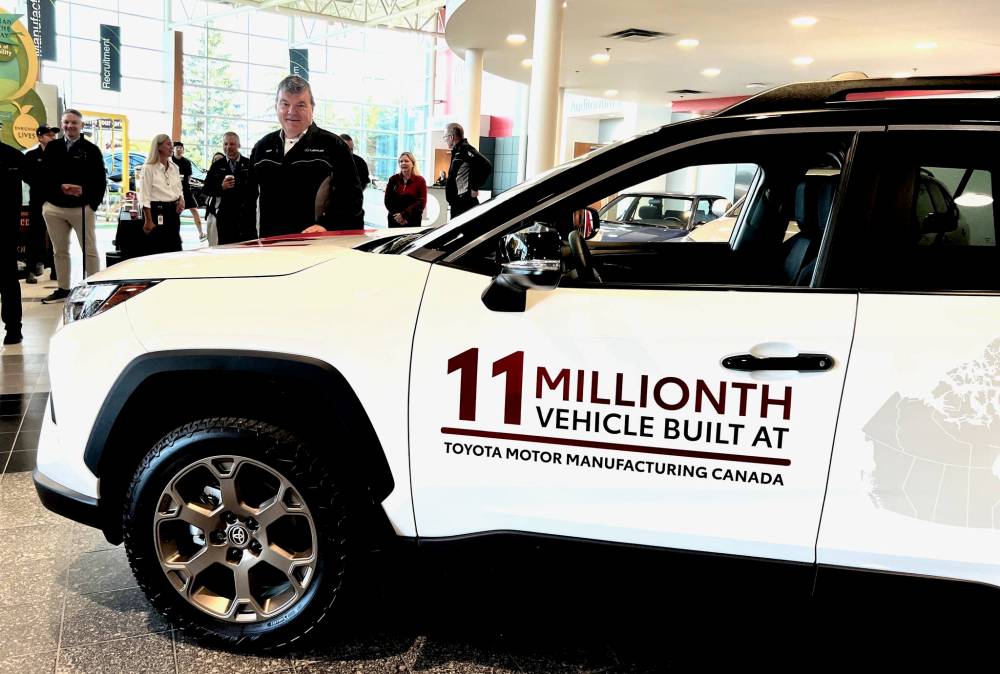
Kelly Taylor / Free Press
Frank Voss, president of Toyota Motor Manufacturing Canada, unveiled the eleven millionth vehicle Toyota has produced in Canada, a 2024 Toyota RAV4 Hybrid, at the company’s plant in Cambridge, Ont.
I’ll have more to say about the vehicles I drove — Crown Signia, GR Corolla, Prius and Land Cruiser — in the coming weeks.
kelly.taylor@winnipegfreepress.com
Kelly Taylor
Copy Editor, Autos Reporter
Kelly Taylor is a copy editor and award-winning automotive journalist, and he writes the Free Press‘s Business Weekly newsletter. Kelly got his start in journalism in 1988 at the Winnipeg Sun, straight out of the creative communications program at RRC Polytech (then Red River Community College). A detour to the Brandon Sun for eight months led to the Winnipeg Free Press in 1989. Read more about Kelly.
Every piece of reporting Kelly produces is reviewed by an editing team before it is posted online or published in print — part of the Free Press‘s tradition, since 1872, of producing reliable independent journalism. Read more about Free Press’s history and mandate, and learn how our newsroom operates.
Our newsroom depends on a growing audience of readers to power our journalism. If you are not a paid reader, please consider becoming a subscriber.
Our newsroom depends on its audience of readers to power our journalism. Thank you for your support.
Kelly Taylor
Copy Editor, Autos Reporter
Kelly Taylor is a copy editor and award-winning automotive journalist, and he writes the Free Press‘s Business Weekly newsletter. Kelly got his start in journalism in 1988 at the Winnipeg Sun, straight out of the creative communications program at RRC Polytech (then Red River Community College). A detour to the Brandon Sun for eight months led to the Winnipeg Free Press in 1989. Read more about Kelly.
Every piece of reporting Kelly produces is reviewed by an editing team before it is posted online or published in print — part of the Free Press‘s tradition, since 1872, of producing reliable independent journalism. Read more about Free Press’s history and mandate, and learn how our newsroom operates.
Our newsroom depends on a growing audience of readers to power our journalism. If you are not a paid reader, please consider becoming a subscriber.
Our newsroom depends on its audience of readers to power our journalism. Thank you for your support.
Advertisement Advertise With Us
Advertisement Advertise With Us