Good migrations The careful banding and measuring carried out at Oak Hammock Marsh are for the birds
Read this article for free:
or
Already have an account? Log in here »
To continue reading, please subscribe:

Digital Subscription
One year of digital access for only $205*
- Enjoy unlimited reading on winnipegfreepress.com
- Read the E-Edition, our digital replica newspaper
- Access News Break, our award-winning app
- Play interactive puzzles
*First annual payment billed as $205.00 + GST for one year. This annual subscription will automatically renew at $233.00 + GST every 52 weeks (10% off the regular annual price of $259.35). Offer available to new and qualified returning subscribers only. Cancel any time.
To continue reading, please subscribe:
Add Free Press access to your Brandon Sun subscription for only an additional
$1 for the first 4 weeks*
- Enjoy unlimited reading on winnipegfreepress.com
- Read the E-Edition, our digital replica newspaper
- Access News Break, our award-winning app
- Play interactive puzzles
*Your next Brandon Sun subscription payment will increase by $1.00 and you will be charged $17.95 plus GST for four weeks. After four weeks, your payment will increase to $24.95 plus GST every four weeks.
Read unlimited articles for free today:
or
Already have an account? Log in here »
Hey there, time traveller!
This article was published 23/08/2024 (765 days ago), so information in it may no longer be current.
A heady blend of grasses, moisture and sweet clover suffuses the air, while a chorus of songbirds — including clay- coloured sparrows, yellow warblers and song sparrows — serenades a group of bird-banding volunteers at Oak Hammock Marsh on a sunny, slightly breezy mid-July morning.
The 36-square-kilometre marsh — located 34 kilometres north of Winnipeg — is one of North America’s “birding hotspots,” and is a Class IV protected area under the International Union for the Conservation of Nature protected area management categories.
Wetlands are endangered habitat across Canada.
MIKE DEAL / FREE PRESS
Paula Grieef, resident naturalist at the Oak Hammock Marsh Interpretive Centre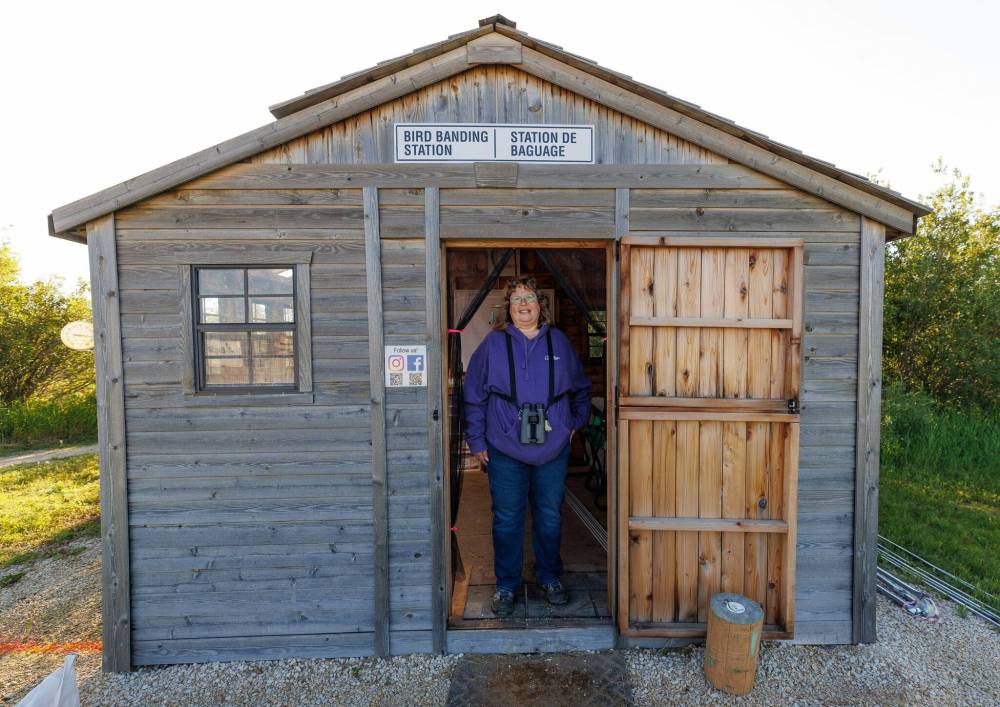
The four-person team — joined by a reporter and Free Press photographer — is being led by Paula Grieef, the resident naturalist at the Harry J. Enns Wetlands Discovery Centre and a volunteer for the Delta Marsh Bird Observatory.
“It’s a bit later in the morning, so there are not quite as many birds,” says Grieef, who has a master’s degree in zoology with a focus on birds.
A born birder
Paula Grieef, the resident naturalist at the Harry J. Enns Wetlands Discovery Centre at Oak Hammock Marsh, says her very first memory is of a bird.
It was a roseate spoonbill, a pink, medium-sized waterbird with a football-shaped body and long legs and a long bill that is flattened into a spoon shape.
Paula Grieef, the resident naturalist at the Harry J. Enns Wetlands Discovery Centre at Oak Hammock Marsh, says her very first memory is of a bird.
It was a roseate spoonbill, a pink, medium-sized waterbird with a football-shaped body and long legs and a long bill that is flattened into a spoon shape.
She was on holiday as a young child with her parents at the J.N. (Ding) Darling National Wildlife Refuge in Florida.
“I don’t remember a time when I couldn’t identify birds. It’s that mystery about what you’re going to come across. It could be something rare,” she says.
Grieef’s father, Gordon Grieef, now 84, started off as a hunter when he was young.
“Then he moved to Manitoba from Saskatchewan and dropped the rifle for a pair of binoculars and started birding,” she says. “I don’t remember a time ever when we were driving somewhere and not identifying the birds flying by or in a ditch. So, it was a hobby for him and profession for me.”
His daughter just wants to keep songbirds singing and flourishing for future generations. It’s a family tradition.
“They’re taking a coffee break.”
The other members of Grieef’s group are Meredith Stoesz, “the bander-in-charge” for Delta Marsh Bird Observatory; Jill, a student in wildlife biology from the University of Manitoba; and Parker, a Winnipeg high school student.
Grieef’s team has set up fine mist nets, made from nylon or polyester, at two separate spots in the marsh before sunrise.
The nets, which are 12 metres long and 2 1/2 metres tall and look like fishing nets, are specifically designed for songbirds and bats.
“We string them up between poles in the morning when it’s still dark out,” says Grieef, who first began netting and banding songbirds during her days as a master’s student 32 years ago.
“The birds fly along and can’t see them. Then they make a little pocket with their weight. We check the nets every half-hour — or more often, if it’s too hot or cold or windy or rainy, or if there’s a predator around, to see what we have.”
MIKE DEAL / FREE PRESS A previously banded cedar waxwing — caught in the soft netting at Oak Hammock Marsh used to safely capture birds and bats — has a brief stay at the bird banding station.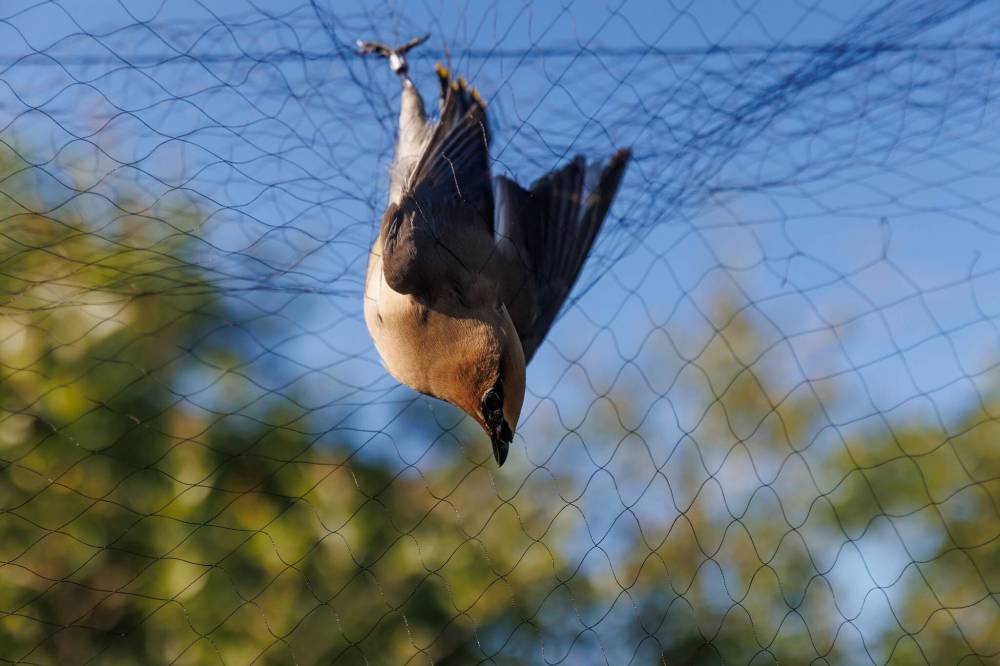
Assessing and banding
After the birds are gently extracted from the net, they are placed inside a soft cloth bag with a drawstring closure.
MIKE DEAL / FREE PRESS Paula Grieef measures the length of a swamp sparrow wing, which can help sort males from females (with males being slightly larger). 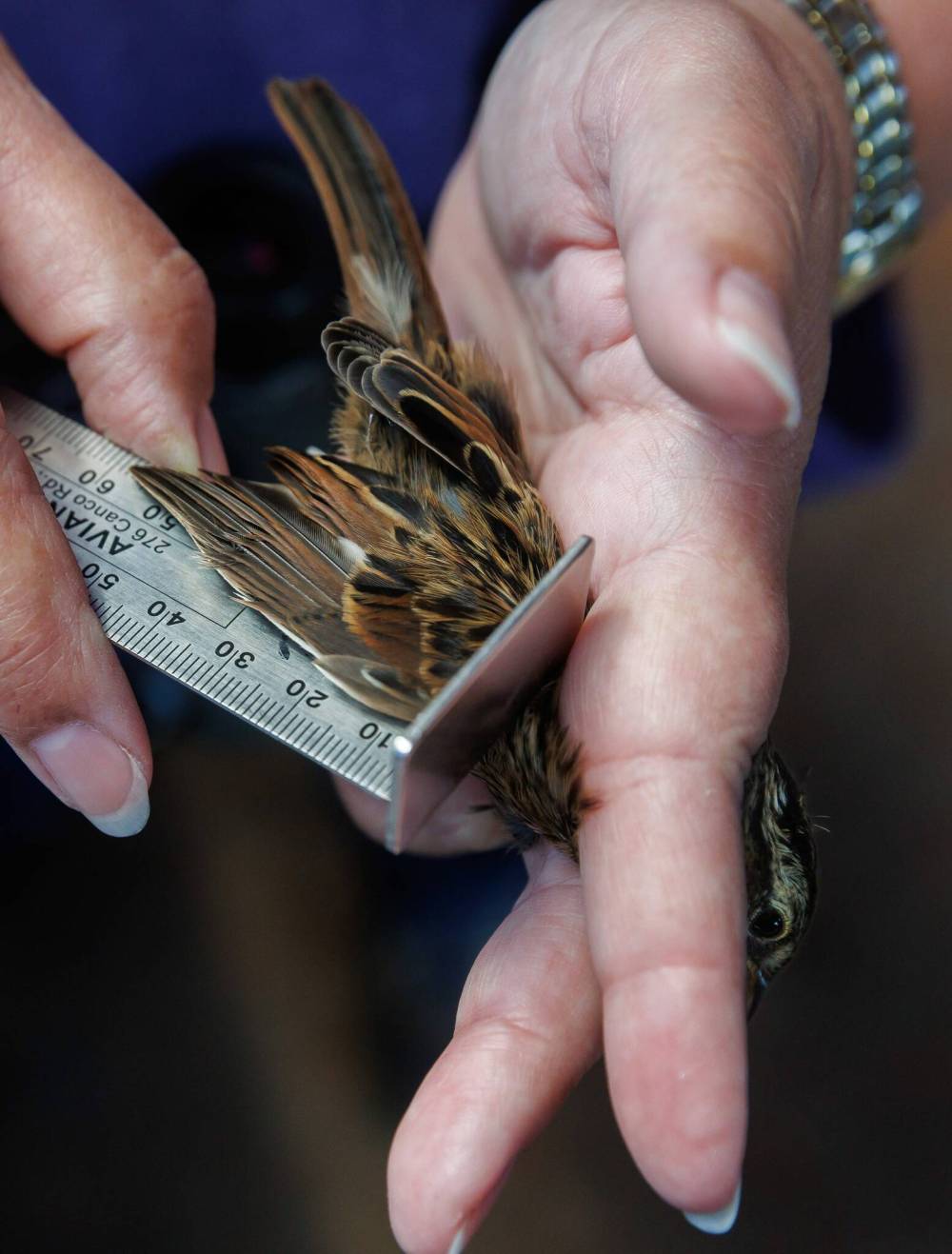
Grieef and her crew carry their precious bundles over to the nearby bird-banding station. The cedar shack was built by the Delta Marsh Bird Observatory in partnership with the discovery centre.
The garden-shed-sized station, which has a large skylight and large windows, contains banding equipment, spare parts and gifts of appreciation for the volunteers, most of which are packed into large plastic tubs.
Graphic posters are plastered on the walls, describing all of the tasks that Grieef and her crew do when measuring the birds before releasing them back into the wild.
“We use them as visual aids because we do so many public presentations that it’s hard for them to all gather around a bird and see what we’re talking about,” Grieef explains.
Among the measurements and other details recorded are weight, amount of fat, checking the brood patch (a featherless area that helps incubate eggs during the nesting season), age and the bird’s sex.
As she removes a song sparrow (Melospiza melodia) from a cloth bag, Grieef points out that this medium-sized New World sparrow has slightly bigger legs than all the other birds they’ve banded that morning.
MIKE DEAL / FREE PRESS Paula Grieef, resident naturalist at the Oak Hammock Marsh Interpretive Centre, examines the underside of a swamp sparrow’s wing for moult (feather replacement due to wear). 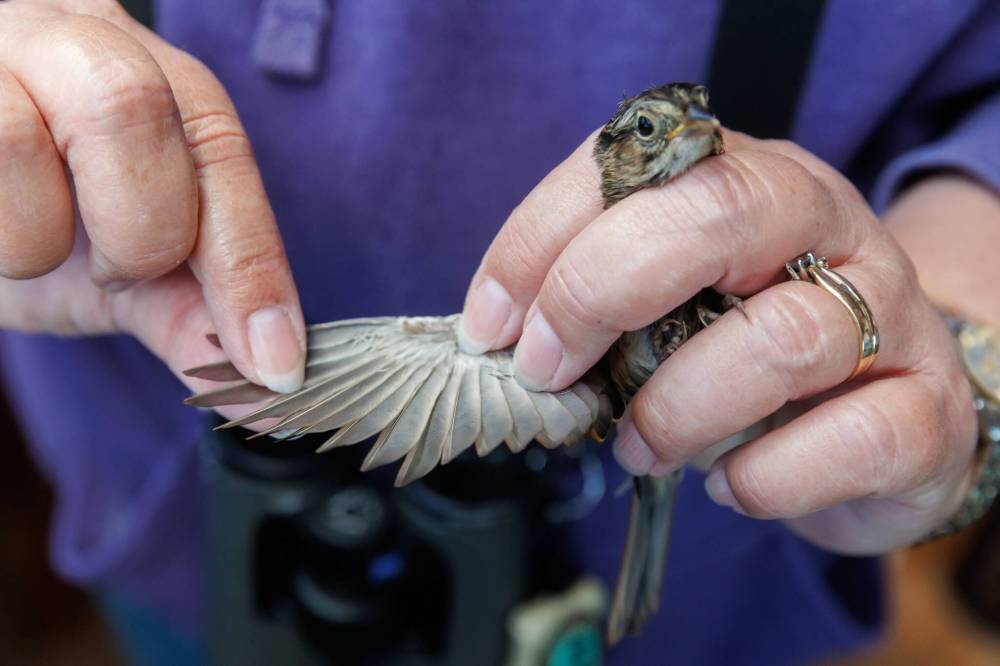
“So it takes a little bit bigger band,” she says, as she searches for the proper size in one of the small containers on a homemade plastic lazy Susan sitting close at hand on the long bench.
Using modified needlenose pliers, Grieef presses the aluminum band onto the bird’s slender right ankle.
The band has a nine-digit number, she explains.
“Each one is different. Our great hope is that we catch it again, or somebody else does; that will tell us more information about site fidelity — is it returning to the same place? — and how long it might live,” she says.
MIKE DEAL / FREE PRESS
A marsh wren gets a tiny metal ankle bracelet which may help scientists follow the bird’s migration routes.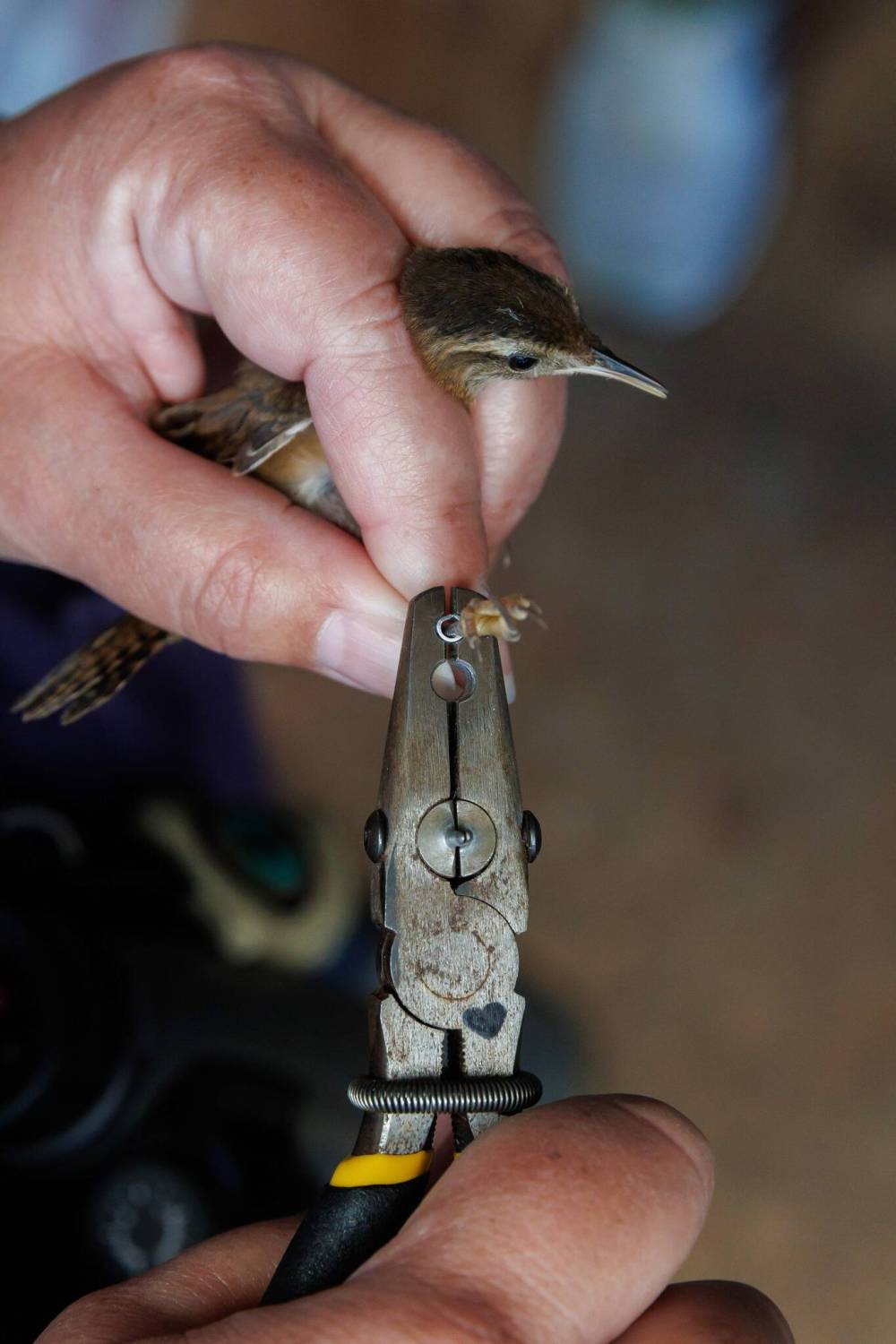
“If it’s caught somewhere else, then we have an idea of migration routes. For example, we have had common yellowthroats that have been caught and banded here and then caught in Vera Cruz, Mexico. That’s where Oak Hammock birds are wintering.”
Afterwards, Grieef blows on the bird’s breast feathers to see how much fat is underneath, checks on its brood patch and cloaca (the genital and excretory cavity at the end of the intestinal canal in birds), and measures the wing length a second time to “help us sex this bird, because you can’t tell just by looking at them.”
Parker marks down on special lined sheets of paper each measurement that Grieef calls out to her.
“This is a young one because you can see how loose and fluffy these feathers are here,” says Grieef.
“It also has a growth bar (cross-bands that denote 24-hour periods of growth) in the feathers. We also measure the tail feathers. Having all this good light in here is really important when we do this bird stuff.”
The entire process from banding to measurements takes no more than two minutes. Grieef then places the bird into a special paper envelope to weight it on a small scientific steel scale before carefully dumping the bird into her left palm and releasing it back to Mother Nature from the open window in front of her work station.
MIKE DEAL / FREE PRESS Blowing on a swamp sparrow’s belly, naturalist Paula Grieef looks for three pieces of information: fat versus muscle, whether a brood patch is present (indicating a female) and whether there’s a cloacal protruberance (indicating a male).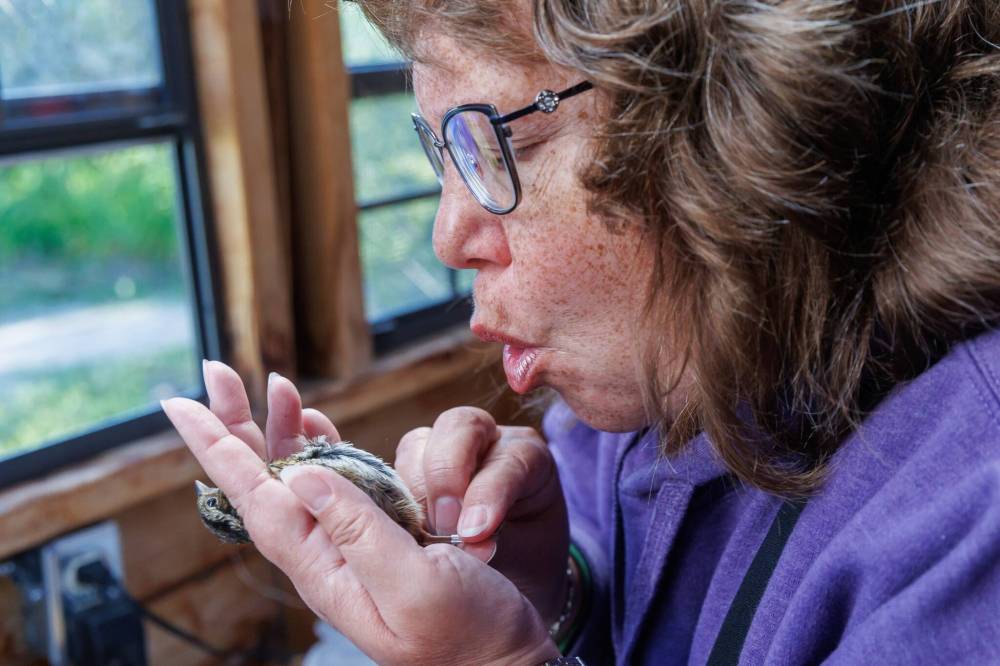
“You use this method of release into your hand because it lets the bird use your palm as a safe platform for taking off,” says Grieef, who has seen 751 different species of birds in 14 countries.
“They might be a little confused. So it lets them take off when they want to do so. It prevents them from plummeting to the ground if they have some kind of injury. It’s the safest way to let them go. Bird safety is our No. 1 priority.
“Whatever we’re doing, wherever we’re doing it, and however we’re doing it, bird safety is No. 1, so we’re not harming it in any way.”
MIKE DEAL / FREE PRESS A marsh wren goes on its merry way after being released from the bird banding station at Oak Hammock Marsh.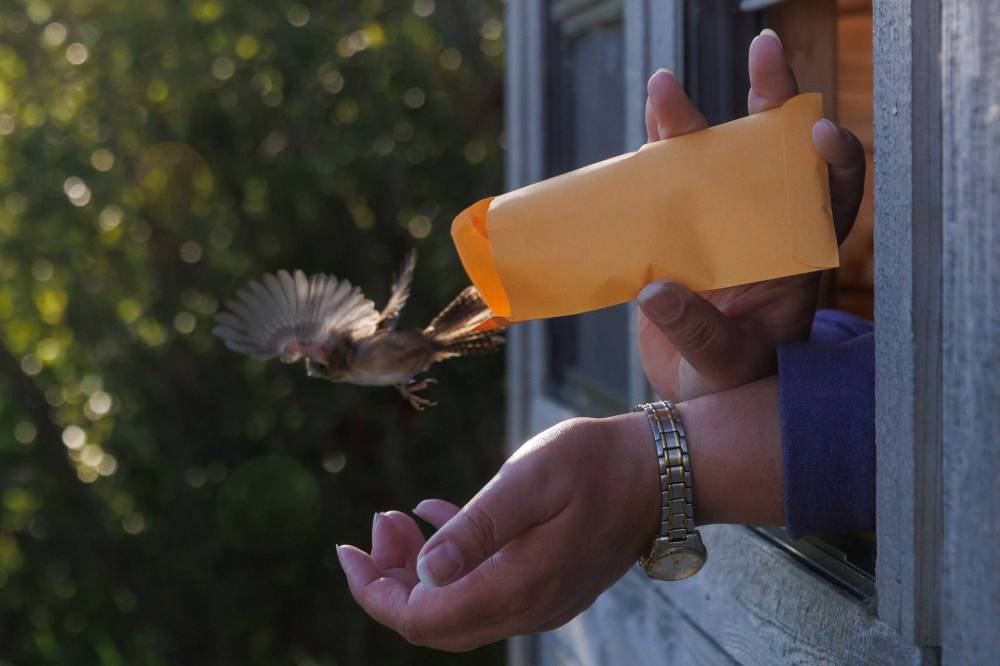
Canaries and coal mines
During a lull in the morning’s banding activities, Grieef enlightens a visitor on the main purpose of this multi-year North American wide scientific project.
Birds are excellent indicators of what’s happening in the environment, she says.
“Lots of birds that we catch during migration breed in the boreal forest, so they’re very inaccessible to people. One of the ways to learn about those birds — where they’re going, what routes they’re taking, how many males and females we have in a population, how many young are being produced in a year — is to catch them during migration at a migration monitoring station like this one,” she says, noting the marsh is a stopover site where birds refuel.
Avian information
● Birds are often described as living dinosaurs. Since 1983, hundreds of fossils — most of them from China — have reinforced the idea of warm-blooded, active, feathered dinos.
● The more than 10,000 known bird species come in an extraordinary variety and can be found literally everywhere.
● Birds are often described as living dinosaurs. Since 1983, hundreds of fossils — most of them from China — have reinforced the idea of warm-blooded, active, feathered dinos.
Many are as detailed in their perfect reproduction of feathers as the iconic Archaeopteryx. The new fossils have provided clues for reinterpreting older fossils, too: we can now see where complex feathers attached on the arm bones of theropods, the carnivorous bipedal dinosaurs that include T. rex and the velociraptors.
Still other fossils with feathers have been found in Mongolia.
● The more than 10,000 known bird species come in an extraordinary variety and can be found literally everywhere.
● Charles Darwin identified 13 finch species on the Galapagos Islands in 1835. They were primarily differentiated by beak size.
The finches share a common ancestor that arrived on the islands a few million years ago. What the great scientist found in finches led to the theory of evolution by natural selection.
● Bird watching teaches us patience and keeps us calm. The practice also supports the conservation of the rarest species.
Sources: Birds — The World’s Most Remarkable Creatures (Life magazine reissue of a special edition); What Birds Eat: How to Preserve the Natural Diet and Behaviour of North American Birds by Kim Long (Skipstone); Cornell Lab of Ornithology’s All About Birds (website)
“We’re learning about this information to study about the health of the bird populations, those are that inaccessible. I think this is a great public education opportunity to experience birds. Purple martins will nest in southern Manitoba, up to about Gimli, and fly all the way to Colombia, South America, for winter. Oak Hammock is an oasis in a landscape of agriculture. It’s an oasis for so many birds to feed.”
Fall migration starts in the middle of July, she says.
By mid-July, some of the early migrants have begun to move from the north; some will visit Oak Hammock and moult there.
“They’ll lose their feathers to get nice, new, fresh feathers,” Grieef says.
They will continue banding until the end of September, at which time, though the birds are still migrating through, the weather is too cold, wet and windy to continue.
Oak Hammock Marsh follows a specific protocol that is part of the Canadian Migration Monitoring Network, Grieef says.
“It’s (designed) to follow migration all across Canada. Let’s say we have forest fires in one province: does that kill all the birds or push all the birds into other provinces? The only way we know is if we have these networks of stations across Canada. So, if we have fires, it means the birds have moved location and it’s not just local weather conditions that are changing the numbers,” she says.
It’s all done in the name of science, public education and a love of birds.
fparts@freepress.mb.ca
Related Articles
Birding a low-stakes pastime to get out in nature