

Prime Ontario agricultural land to be protected amid energy expansion, minister says
Advertisement
Read this article for free:
or
Already have an account? Log in here »
To continue reading, please subscribe:
Monthly Digital Subscription
$0 for the first 4 weeks*
- Enjoy unlimited reading on winnipegfreepress.com
- Read the E-Edition, our digital replica newspaper
- Access News Break, our award-winning app
- Play interactive puzzles
*No charge for 4 weeks then price increases to the regular rate of $19.00 plus GST every four weeks. Offer available to new and qualified returning subscribers only. Cancel any time.
Monthly Digital Subscription
$4.75/week*
- Enjoy unlimited reading on winnipegfreepress.com
- Read the E-Edition, our digital replica newspaper
- Access News Break, our award-winning app
- Play interactive puzzles
*Billed as $19 plus GST every four weeks. Cancel any time.
To continue reading, please subscribe:
Add Free Press access to your Brandon Sun subscription for only an additional
$1 for the first 4 weeks*
*Your next subscription payment will increase by $1.00 and you will be charged $16.99 plus GST for four weeks. After four weeks, your payment will increase to $23.99 plus GST every four weeks.
Read unlimited articles for free today:
or
Already have an account? Log in here »
Hey there, time traveller!
This article was published 28/08/2024 (462 days ago), so information in it may no longer be current.
Certain solar farms will be banned on prime agricultural land in Ontario as the province expands energy production to meet demand in the coming decades, Energy Minister Stephen Lecce said Wednesday.
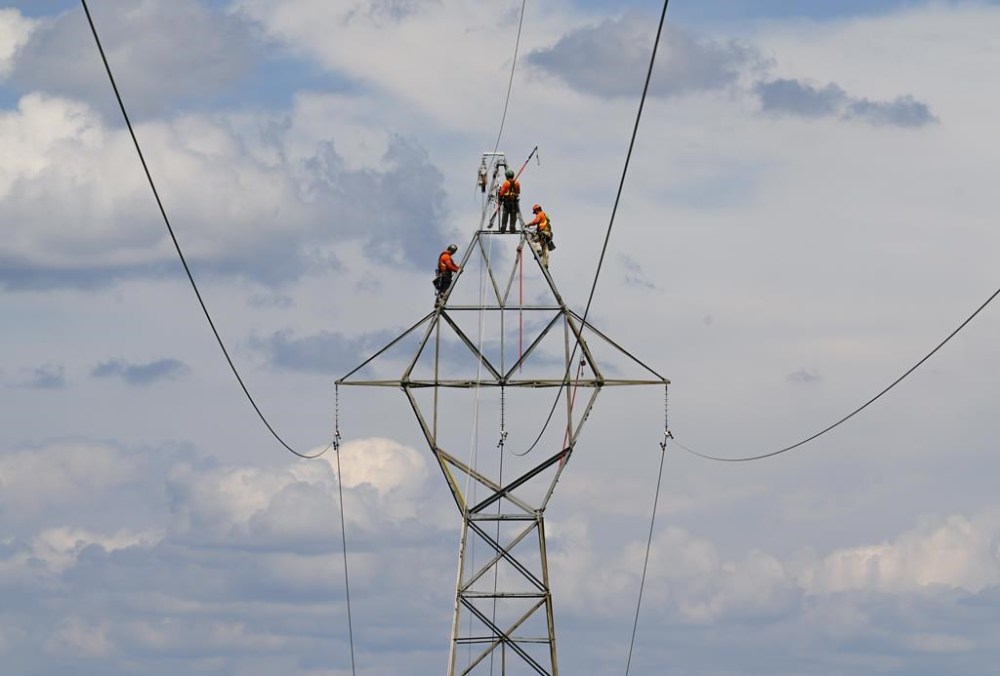
Ontario is looking to add some 5,000 megawatts of energy to the grid, with Lecce directing the Independent Electricity System Operator to secure “technology agnostic” energy resources. That means the province will use a mix of natural gas, hydroelectric, renewables, nuclear and biomass energy sources, he said.
But the province is making efforts to protect key agricultural areas in the process, the minister said.
Ground-mounted solar panels will be prohibited on prime agricultural farmland, said Lecce, who pledged the province would “never misuse” those lands.
“Our farmers need more energy more than ever,” Lecce said.
“They need access to to affordable energy and so we made a commitment to work with them on a policy that ultimately will respect prime agricultural land.”
Other energy products being considered on prime agricultural land will now require an impact assessment before proceeding.
The province is also giving power to municipalities to decide if they want a particular energy project.
“Long gone are the days where Queen’s Park imposes projects on unwilling communities, undermining those agricultural areas,” Lecce said.
The news is welcome to farmers, said Drew Spoelstra, the president of the Ontario Federation of Agriculture.
“The new energy procurement framework is a major step forward for Ontario,” he said.
“Reliable and affordable energy is incredibly important to the growth of the Ontario economy, including food production, food processing and the agri-food sector.”
Farmers and Premier Doug Ford’s government have had an up-and-down relationship in recent years in light of the Greenbelt scandal.
The province had said they were going to build 50,000 homes on the protected Greenbelt, which includes prime agricultural land. But several investigations by provincial bodies found the process was flawed as it favoured some developers with ties to the government over others.
Farmers did not like the possible encroachment onto farmland and joined the chorus to denounce the Greenbelt move. Last summer, amid mounting public pressure to reverse course, Ford walked back those Greenbelt plans.
Lecce’s announcement Wednesday comes as the province’s electricity demand is expected to grow by about two per cent each year, although that could be even higher depending on electrification within the broader economy.
The IESO has said the province will need at least 60 per cent more energy by 2050.
Ontario has also recently been adding electricity storage projects, with an eye to about 2,500 megawatts, and the IESO said the province’s emerging battery fleet will pair well with wind and solar, so that the power generated by those methods can be stored and injected into the grid when needed.
Ford cancelled 750 renewable energy contracts shortly after his Progressive Conservatives formed government in 2018, after the former Liberal government faced widespread anger over the long-term contracts with clean power producers at above-market rates.
Continuing with natural gas is not a long-term solution for Ontarians, said Green Party Leader Mike Schreiner.

“While I’m glad to see that the Ford government has finally reversed its archaic, ideological anti-renewables stance, it has a lot further to go if it wants to undo the years of damage its fossil gas obsession has caused,” Schreiner said.
“Renewables are cheaper, cleaner and make far more economic sense than fossil gas.”
The province is also moving ahead with nuclear energy expansion, including seeking to refurbish units at the Pickering nuclear plant, build small modular reactors at the Darlington nuclear plant and exploring a new, large-scale plant at Bruce Power.
In 2021, the electricity system was 94 per cent emissions free, but that is now down to 87 per cent as it uses natural gas to meet demand.
This report by The Canadian Press was first published Aug. 28, 2024.