Book Review: ‘Category Five’ examines superstorms amid compelling personal memoir

Advertisement

Advertise with us

I graduated from Middlebury College with Porter Fox just over 30 years ago. We weren’t friends, but it was a small campus and everyone knew something about everybody else. I knew he sailed and wore L.L. Bean like a native Mainer. I didn’t know that he’d spend a good chunk of his career as a journalist documenting the effects of climate change.

Read this article for free:


or

Already have an account? Log in here »

To continue reading, please subscribe:

Subscribe and receive a limited-edition Free Press branded hat or tote.

Digital Subscription

One year of digital access for only $205*

  • Enjoy unlimited reading on winnipegfreepress.com
  • Read the E-Edition, our digital replica newspaper
  • Access News Break, our award-winning app
  • Play interactive puzzles

*First annual payment billed as $205.00 + GST for one year. This annual subscription will automatically renew at $233.00 + GST every 52 weeks (10% off the regular annual price of $259.35). Offer available to new and qualified returning subscribers only. Cancel any time.

To continue reading, please subscribe:

Add Free Press access to your Brandon Sun subscription for only an additional

$1 for the first 4 weeks*

  • Enjoy unlimited reading on winnipegfreepress.com
  • Read the E-Edition, our digital replica newspaper
  • Access News Break, our award-winning app
  • Play interactive puzzles
Start now

*Your next Brandon Sun subscription payment will increase by $1.00 and you will be charged $17.95 plus GST for four weeks. After four weeks, your payment will increase to $24.95 plus GST every four weeks.

Hey there, time traveller!
This article was published 09/09/2024 (729 days ago), so information in it may no longer be current.

I graduated from Middlebury College with Porter Fox just over 30 years ago. We weren’t friends, but it was a small campus and everyone knew something about everybody else. I knew he sailed and wore L.L. Bean like a native Mainer. I didn’t know that he’d spend a good chunk of his career as a journalist documenting the effects of climate change.

“Category Five: Superstorms and the Warming Oceans That Feed Them” is a mouthful of a title, but there’s a lot packed into its 254 pages. Part memoir, part travelogue and part scientific reportage, it’s stuffed with statistics that the cynical will say add up to one conclusion: This planet’s doomed. But while the numbers don’t lie and humanity is certainly going to exceed its self-imposed temperature targets to halt global warming, Fox has written a book that doesn’t read like the sky is falling.

That’s because he weaves all the science talk into a personal narrative, telling his own story about growing up on an island halfway up the Maine coast with a father who built sailboats for a living. “The sea was an enchanted forest when we were kids,” he writes. “We built shelters out of driftwood on a tiny island in the middle of the harbor, planted a flag, and declared it ours.” Fox opens the book with a prologue about being caught in a storm while sailing as a young man. “I did indeed grow up working on boats, but I never learned about storms, how to avoid them, or how to sail through them. They haunted me for most of my young life.”
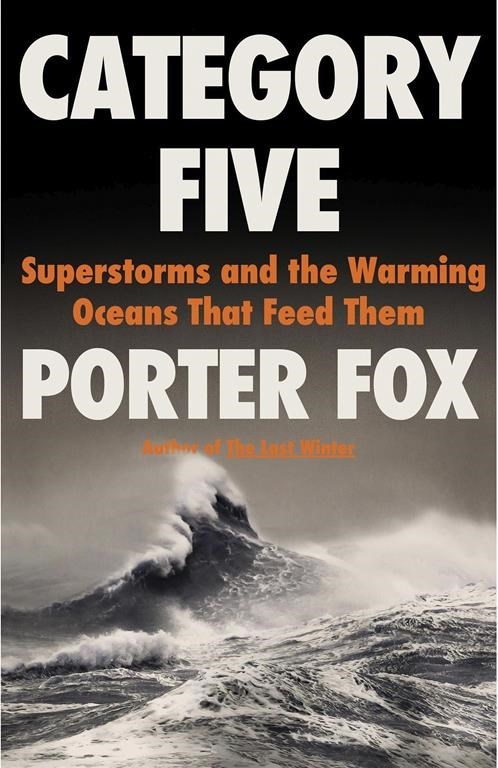
This cover image released by Little, Brown and Company shows
This cover image released by Little, Brown and Company shows "Category Five: Superstorms and the Warming Oceans That Feed From Them" by Porter Fox. (Little, Brown and Company via AP)

The book then introduces readers to a variety of “salty mariners” who share with Fox their lessons learned about navigating storms, their research into what causes them, and their predictions for the future of the climate. The jargon may sometimes have non-weather and boating enthusiasts Googling things like “katabatic squalls,” “violent sirocco” or “mizzen,” but Fox grounds his writing with good stories, either from his own life, or told to him by the experts he interviews. “I will always live by the sea,” he recalls his father telling him when he was just a boy, then rhapsodizes about “the blank slate that the ocean represents, the lack of rules and obligation,” that calls to men and women who spend their lives on the water.

In the end, Fox argues, it’s water that might actually save us, if the world would just start listening to oceanographers. The world’s oceans contain “95% of livable space on Earth,” and while their warming waters wreak all sorts of havoc on this planet’s weather, they are also the “largest carbon sink on the planet.” It’s that sense of possibility, the “mystery of the deep,” that will give some hope. And it’s books like Fox’s — climate science wrapped in a compelling narrative — that can hopefully change habits, one reader at a time.

___

AP book reviews: https://apnews.com/hub/book-reviews
Report Error Submit a Tip

More Stories

The first day of school is a promise

ann Evangelista 6 minute read Preview

The first day of school is a promise

ann Evangelista 6 minute read 2:00 AM CDT

This week, thousands of Manitoba students will walk through school doors carrying backpacks filled with new supplies, new hopes and, for some, new worries.

For parents and caregivers, this may be a familiar September routine — shopping for school supplies, adjusting schedules, preparing lunches and getting children ready for another year of learning.

For educators and school staff, it is the beginning of another demanding year.

But for Manitoba, this week should mean something more. It should be a renewal of our promise to every child.

Read
2:00 AM CDT

Parts of River Heights hammered by storm

Melissa Martin 5 minute read Preview

Parts of River Heights hammered by storm

Melissa Martin 5 minute read Yesterday at 5:54 PM CDT

A powerful storm cut a swath of destruction through River Heights on Sunday, leaving much of the area without power.

Nobody was hurt in the storm.

By the time it subsided, parts of the quiet neighbourhood, especially Borebank and Lindsay streets between Grant and Taylor, had been ravaged: power lines downed, Manitoba Hydro poles toppled, trees splintered and crashed down on vehicles and homes.

In one case, a vehicle was flipped into a yard and sat under a partially downed tree. Shingles were stripped from roofs. Some residents described looking out during the storm and seeing power lines ablaze and the blue glow of electricity arcing over their backyards.

Read
Yesterday at 5:54 PM CDT

NDP minister needs lesson in political civility

Dan Lett 5 minute read Preview

NDP minister needs lesson in political civility

Dan Lett 5 minute read Friday, Sep. 4, 2026

Families Minister Nahanni Fontaine’s decision to intercede in Winnipeg’s mayoral election may be surprising to some political observers. To others, however, it is entirely on brand.

On Tuesday, Fontaine posted a video on social media in which she expressed concern that former city councillor and Progressive Conservative cabinet minister Kevin Klein was entering the race to challenge incumbent Mayor Scott Gillingham.

The caption on the video was blunt: “I mean, really, who chooses to work for Count Dracula?”

“Kevin Klein once worked for Peter Nygard. Peter Nygard is Canada’s equivalent to (American sex offender) Jeffrey Epstein — had his own little island, did unspeakable, disgusting things to women and girls … anyways, I just thought that Winnipeggers would want to know that Kevin Klein, at one point, worked for Peter Nygard,” she says in the video.

Read
Friday, Sep. 4, 2026

Canadians do not want to sacrifice nature for development

Emily McMillan and Akaash Maharaj 4 minute read 2:00 AM CDT

Prime Minister Mark Carney’s pledge to build faster — “Build, baby, build” — helped propel the Liberals to victory, but his government’s push to fast-track major development projects by cutting environmental oversight is sharply out of step with Canadians’ priorities.

It is a political miscalculation that could come back to haunt the Liberals at the ballot box.

New polling, commissioned by Nature Canada and conducted by EKOS Research Associates, shows strong support among Canadians for protecting nature and endangered species while building the economy.

Canadians soundly reject the notion that they must sacrifice conservation protections for economic development.

Fanning takes aim at Canadian title on home course

Mike McIntyre 4 minute read Preview

Fanning takes aim at Canadian title on home course

Mike McIntyre 4 minute read 2:00 AM CDT

Todd Fanning would love to make this a September to remember.

The decorated Manitoba golfer — who added a second straight provincial senior men’s championship to his impressive resumé earlier this summer — is now laser-focused on trying for a national title.

Fanning, 58, is one of the favourites as the Canadian senior men’s championship begins today at Niakwa Country Club, which just so happens to be his home course.

“Anyone who thinks they’re going to come out and see a bunch of old guys just whacking it around (is mistaken),” Fanning recently told the Free Press. “It’s going to be a heck of a week.”

Read
2:00 AM CDT

Fund full-day kindergarten for all

Catherine-Laura Dunnington and Molly McCracken 4 minute read 2:00 AM CDT

Children entering kindergarten are starting school this fall. While the 2.5-hour kindergarten day commonly found in Manitoba schools sounds like a pleasant transition to the school system, in truth it remains one of the biggest missing pieces of the child-care puzzle.

Province-wide, families face a stressful dilemma — if they are lucky enough to have child care, they have to leave work at lunch and shuttle a child from school to child care; if they don’t, they must reduce hours, or forgo working or education, because they don’t have child care for their kindergartener.

The Government of Manitoba has made progress on making child care more affordable and accessible. But we have largely left one enormous piece untouched — part-day kindergarten. Why is publicly funded education for kindergarten still only 2.5 hours a day? To date, British Columbia, Ontario, Quebec, New Brunswick, Newfoundland and Labrador, Nova Scotia, and Prince Edward Island have all implemented full-day, publicly funded kindergarten. The Manitoba School Boards Association passed a resolution in 2025 to implement full-day kindergarten programming, but the province has not provided sufficient funding to implement it province-wide.

There are currently 13,600 children in kindergarten in Manitoba. With a coverage rate for licensed child care of 32.3 per cent, roughly 5,000 families with kindergarteners lack access to licensed child care during the part of the day when their child is not in school. That is a precarious position to put any family in.