

The tipping point — a line is being crossed
Advertisement
Read this article for free:
or
Already have an account? Log in here »
To continue reading, please subscribe:

Digital Subscription
One year of digital access for only $205*
- Enjoy unlimited reading on winnipegfreepress.com
- Read the E-Edition, our digital replica newspaper
- Access News Break, our award-winning app
- Play interactive puzzles
*First annual payment billed as $205.00 + GST for one year. This annual subscription will automatically renew at $233.00 + GST every 52 weeks (10% off the regular annual price of $259.35). Offer available to new and qualified returning subscribers only. Cancel any time.
To continue reading, please subscribe:
Add Free Press access to your Brandon Sun subscription for only an additional
$1 for the first 4 weeks*
- Enjoy unlimited reading on winnipegfreepress.com
- Read the E-Edition, our digital replica newspaper
- Access News Break, our award-winning app
- Play interactive puzzles
*Your next Brandon Sun subscription payment will increase by $1.00 and you will be charged $17.95 plus GST for four weeks. After four weeks, your payment will increase to $24.95 plus GST every four weeks.
Read unlimited articles for free today:
or
Already have an account? Log in here »
Hey there, time traveller!
This article was published 20/09/2024 (729 days ago), so information in it may no longer be current.
How much is enough? And how much is too much to ask?
Eighteen? Twenty? Twenty-five? More? Or less?
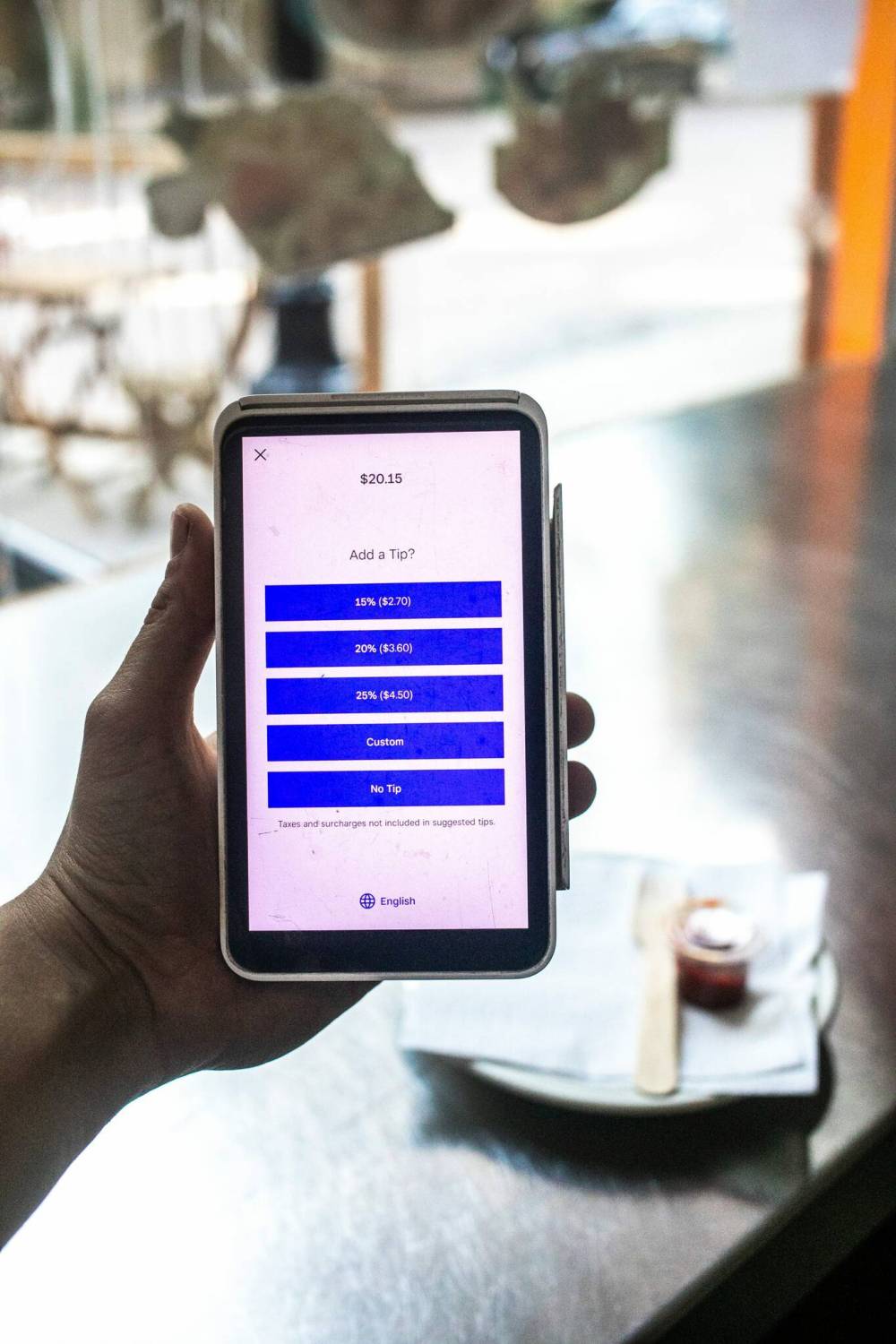
These are the questions — and the escalating industry-prescribed percentages — with which Canadians are confronted in an increasingly broad spectrum of commercial-transaction situations. Tipping, these days, is expected — and strongly suggested, with preferred calculations built into the screen prompts on digital payment terminals through which debit- and credit-card transactions are processed — in more venues and interactions than ever before.
MIKAELA MACKENZIE / WINNIPEG FREE PRESS
The tipping prompt screen on a debit machine.
The shift is sufficiently pronounced that there have been terms created to describe it: “tip creep” and “tipflation.”
And, it seems, there’s something else growing alongside the upward-inclined expectations related to gratuities — and that’s public unease with the evolving trend.
In a recent Probe Research poll, fully two-thirds of respondents were unhappy about tip creep, the term used to describe requests for gratuities in places not typically associated with tipping — often with the digital-terminal solicitation appearing before any service has been performed.
And 80 per cent of the survey’s respondents expressed frustration at tipflation, whereby the suggested discretionary top-up amounts — often 20, 25 and even 30 per cent — are markedly higher than what had previously been considered standard tipping rates.
Where tipping used to be customary in so-called service-industry situations — full-service restaurants, most notably — as a reflection of customer satisfaction with the quality of service provided (by employees who typically were being paid minimum wage or slightly above), gratuities are now being requested in situations in which routine tasks are being performed and opportunities for incentivized exemplary service are nonexistent.

And instead of tipping being a choice made discreetly by the customer at the end of a meal or other service-provided experience, the prompt appears up-front, forcing patrons to decide on a gratuity amount before the task is performed, usually while the employee who will be performing the task is watching. By bringing guilt into the equation, the onus to “perform” is placed on the customer instead, with many feeling pressured to augment their payment so as not to offend the staff person who hovers while the digital transaction is being completed.
“This is throwing people off … you’re being asked to tip before you receive the service,” tipping-culture expert Prof. Bruce McAdams of the University of Guelph told CBC Radio’s The Current. “That has pretty much ruined the idea that tipping is about good service and your experience. It’s reiterating to consumers that tipping is not about rewarding good service; it’s about subsidizing low wages.”
The government of Quebec recently took action to address public unease at the shift in tipping expectations, by introducing a bill that would regulate the manner in which merchants calculate suggested gratuity amounts. The proposed law would require suggested tips to be based on the pre-tax amount, which was the accepted practice back when customers added tips after a meal or other service, rather than the after-tax total, which quietly became the norm with the advent of digital-payment terminals and up-front tip requests.
It’s an idea that might be worth considering in other Canadian jurisdictions, as an apparent majority of inflation-fatigued consumers grows ever more dissatisfied with the trend toward tip creep and tipflation. And in the meantime, it’s worth remembering that despite what the screen on the digital terminal you’ve just been handed implores, the addition of a gratuity remains a personal choice that consumers should make for whatever reason motivates them to do so.
The bottom line on the bottom line: tipping should be a decision inspired by human interaction, not one driven by computerized coercion.