

Look at beauty only skin deep
Film shallow examination of shallowness

Advertisement
Read this article for free:
or
Already have an account? Log in here »
To continue reading, please subscribe:
Monthly Digital Subscription
$1 per week for 24 weeks*
- Enjoy unlimited reading on winnipegfreepress.com
- Read the E-Edition, our digital replica newspaper
- Access News Break, our award-winning app
- Play interactive puzzles
*Billed as $4.00 plus GST every four weeks. After 24 weeks, price increases to the regular rate of $19.95 plus GST every four weeks. Offer available to new and qualified returning subscribers only. Cancel any time.
Monthly Digital Subscription
$4.99/week*
- Enjoy unlimited reading on winnipegfreepress.com
- Read the E-Edition, our digital replica newspaper
- Access News Break, our award-winning app
- Play interactive puzzles
*Billed as $19.95 plus GST every four weeks. Cancel any time.
To continue reading, please subscribe:
Add Free Press access to your Brandon Sun subscription for only an additional
$1 for the first 4 weeks*
*Your next subscription payment will increase by $1.00 and you will be charged $16.99 plus GST for four weeks. After four weeks, your payment will increase to $23.99 plus GST every four weeks.
Read unlimited articles for free today:
or
Already have an account? Log in here »
Hey there, time traveller!
This article was published 20/09/2024 (583 days ago), so information in it may no longer be current.
Deliberately obvious, gleefully trashy, this deranged feminist fable from French filmmaker Coralie Fargeat (Revenge) is flawed. But as befits a slash-and-burn critique of impossible female beauty standards, it really works those flaws.
The Substance may not be perfect, but it’s something, all right.
In an alternative universe where cloning technology is going gangbusters but network daytime TV still matters, Elisabeth Sparkle (Demi Moore), a one-time Hollywood star who’s now host of a long-running aerobics show, has just turned 50.

MUBI
Elisabeth turns to the black market to stay young and relevant.
Her toned, taut, severe beauty is a matter of iron discipline, unceasing labour and some subtle cosmetic procedures. Still, she is 50 — Moore, in fact, is 61 — and her obnoxious male boss, Harvey (Dennis Quaid), wants her out. He’s already looking for a replacement.
“We need her young, we need her hot, and we need her now,” he barks into his phone.
Leaving the studio, Elisabeth is so distracted by the sight of her L.A. billboard being unceremoniously ripped down she gets into a car accident.
While she’s recovering at a hospital, a preternaturally handsome young man slips her some information about a mysterious black-market product that promises to change her life.
“The Substance,” as it’s called, promises to generate another you — “younger, more beautiful, more perfect.” The catch is you have to share time — one week for the original self, one week for the other self. You also need to remember that “You Are One.”
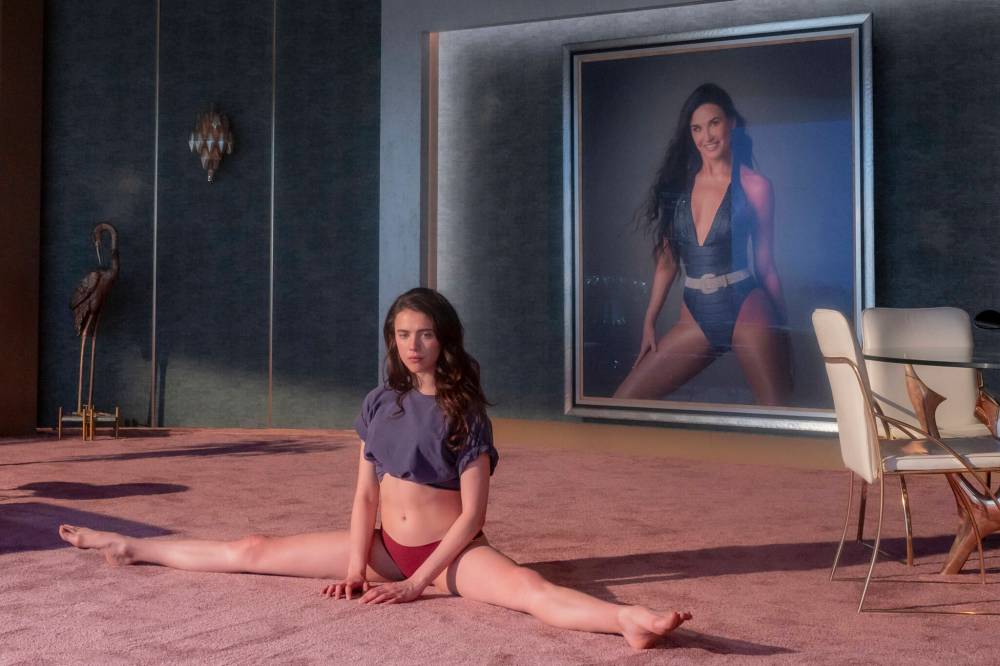
MUBI
Margaret Qualley plays Elisabeth’s younger alter-ego, Sue.
In dark fairy-tale fashion, this is the warning that Elisabeth ignores, to her peril.
Following a gory, grotesque parody of birth, Elisabeth’s other self (Margaret Qualley of Once Upon a Time… in Hollywood) comes into the world, an unmarked, smooth-skinned avatar of young female perfection. She calls herself Sue and immediately sets off to audition for Elisabeth’s old job.
Soon these two versions of womanhood are sabotaging each other, stealing time from each other and leaving messes for the other to clean up.
Fargeat is showing how narrow ideals of female beauty can set women against each other and even against themselves. Instead of facing a common enemy — that would be the cartoonishly odious Harvey and everything he represents — the two generations of women compare and compete. They are poisoned by envy (Elisabeth looking at Sue), by contempt (Sue looking at Elisabeth) and — saddest of all — by self-loathing (Elisabeth looking at Elisabeth).
These dynamics are intensified by Hollywood’s ruthless forms of female fame, which exploit the young and discard the middle-aged.

MUBI
Dennis Quaid is cartoonishly odious.
The film punches these points with unbelievably squishy, oozy, bloody body horror, achieved mostly through practical effects and prosthetics.
It can be gross — avert-your-eyes levels of gross — but it tends to skew grotesquely funny rather than scary.

Fargeat digs into a grab-bag of film and book references — Dr. Jekyll and Mr. Hyde, The Fly, The Stepford Wives, The Beauty Myth. She has the longest carpeted halls and most over-lit red bathrooms since Stanley Kubrick’s The Shining, the bloodiest explosion of repressed female rage since Brian De Palma’s Carrie.
As you can probably tell, The Substance is esthetically garish, which is fun. It’s also thematically garish, which is not as fun. Though it won Best Screenplay at Cannes, the film’s writing is its weakest aspect. The narrative is overlong and so metaphor-heavy that the mechanics don’t really make any sense. Ultimately, this is a shallow examination of shallowness.
Moore was one of the most famous and best paid actresses in Hollywood in the 1990s before being somewhat sidelined by an industry that doesn’t really know what to do with over-40 women. She presents an absolutely fascinating surface here, which Fargeat’s camera hungrily explores, but one wishes the script got more under her skin, where an even more naked performance seems to lie in wait.
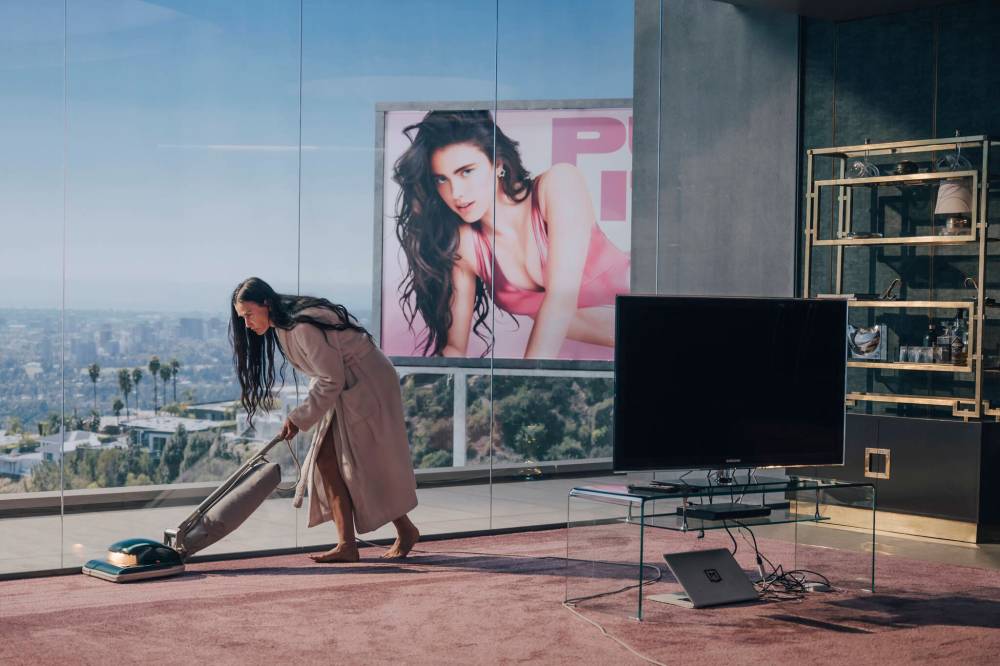
MUBI
Demi Moore tackles Hollywood’s obsession with female beauty ideals.
Even with these problems, though, Moore’s work and the movie as a whole remain angry, urgent, potent and squelchy. Very squelchy.
alison.gillmor@freepress.mb.ca
Studying at the University of Winnipeg and later Toronto’s York University, Alison Gillmor planned to become an art historian. She ended up catching the journalism bug when she started as visual arts reviewer at the Winnipeg Free Press in 1992.
Our newsroom depends on a growing audience of readers to power our journalism. If you are not a paid reader, please consider becoming a subscriber.
Our newsroom depends on its audience of readers to power our journalism. Thank you for your support.
MOVIE REIVEW
The Substance
Starring Demi Moore, Margaret Qualley, Dennis Quaid
● Grant, McGillivray, Polo, St. Vital
● 141 minutes, 18A
★★★½ stars
Fargeat’s no-holds-barred, wholly beyond your wildest expectations approach with The Substance will leave genre fans kicking their feet up in glee.
— Sarah-Tai Black, Globe and Mail
With wit, style and ruthlessness, Fargeat has made a movie that’s an example of the soulless pop-culture object she’s spoofing.
— Ty Burr, Washington Post
Fargeat approaches her material with a hatchet, hacking methodically away but rarely sculpting with any nuance.
— Dana Stevens, Slate
Studying at the University of Winnipeg and later Toronto’s York University, Alison Gillmor planned to become an art historian. She ended up catching the journalism bug when she started as visual arts reviewer at the Winnipeg Free Press in 1992.
Our newsroom depends on a growing audience of readers to power our journalism. If you are not a paid reader, please consider becoming a subscriber.
Our newsroom depends on its audience of readers to power our journalism. Thank you for your support.
Advertisement Advertise With Us
Advertisement Advertise With Us