Crime, disorder take centre stage in B.C. election, but statistics tell complex story
Advertisement
Read this article for free:
or
Already have an account? Log in here »
To continue reading, please subscribe:

Digital Subscription
One year of digital access for only $205*
- Enjoy unlimited reading on winnipegfreepress.com
- Read the E-Edition, our digital replica newspaper
- Access News Break, our award-winning app
- Play interactive puzzles
*First annual payment billed as $205.00 + GST for one year. This annual subscription will automatically renew at $233.00 + GST every 52 weeks (10% off the regular annual price of $259.35). Offer available to new and qualified returning subscribers only. Cancel any time.
To continue reading, please subscribe:
Add Free Press access to your Brandon Sun subscription for only an additional
$1 for the first 4 weeks*
- Enjoy unlimited reading on winnipegfreepress.com
- Read the E-Edition, our digital replica newspaper
- Access News Break, our award-winning app
- Play interactive puzzles
*Your next Brandon Sun subscription payment will increase by $1.00 and you will be charged $17.95 plus GST for four weeks. After four weeks, your payment will increase to $24.95 plus GST every four weeks.
Read unlimited articles for free today:
or
Already have an account? Log in here »
Hey there, time traveller!
This article was published 23/09/2024 (726 days ago), so information in it may no longer be current.
David Screech doesn’t mince words when asked about street disorder and crime around his business in downtown Victoria.
He described vehicle break-ins, people defecating on or near his store property, and someone pulling a knife on an employee in the store’s parking lot.
Screech, a former mayor of the Victoria-area community of View Royal, has worked at Greggs Furniture & Upholstery since 1981 and has owned the business since 2000.
But the iconic store is slated to close later this year, and Screech said deteriorating safety around the business was “the tipping point.”
“I think we would have hung in there for a little while longer if those issues hadn’t become so difficult in the last little while,” Screech said.
“One of the most frightening (things) is that we’ve had in the last 18 months fires set at our back door four or five times. And it’s only just by some divine intervention that the whole building hasn’t gone up.”
Business groups and others have raised concerns about crime and disorder ahead of the Oct. 19 provincial election, while police, including Vancouver Chief Const. Adam Palmer, have decried what he called a “revolving door” justice system for repeat and violent offenders.
The conversation has been punctuated by a series of violent events over the past year or so in B.C.
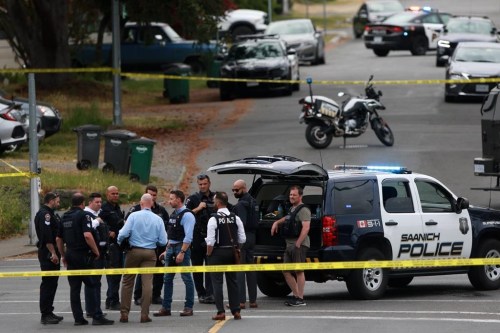
They include a triple stabbing at a street festival in Vancouver’s Chinatown, a swarming attack on paramedics in Victoria, and stabbings near the White Rock pier. On Sept. 4, one man was killed and another’s hand was cut off in a pair of gruesome attacks in downtown Vancouver — police say the suspect was on probation at the time and has had 60 previous interactions with officers.
How to improve public safety was one of 10 questions posed by a coalition of B.C. business groups to party leaders on Sept. 10, saying the violent crime rate had increased “by 30 per cent since 2018” with many businesses reporting higher levels of concern around employee and customer safety.
“Last week’s tragic situation highlighted where we are at and the need for all levels of government to come together,” said Greater Vancouver Board of Trade president Bridgitte Anderson, referring to the Sept. 4 attacks at a news conference announcing the group’s concerns.
“Simply, what we’re doing right now doesn’t work,” Anderson said.
Statistics Canada data show the overall per capita crime rate, based on police reports, is down in B.C. by about 3 per cent since 2018. The violent crime rate cited by business leaders is up by more than 32 per cent, having spiked sharply in 2019 and it has been mostly unchanged since then.
Vancouver and Victoria have both seen a 9 per cent rise in violent crime, per capita, since 2018.
Martin Andresen, professor at Simon Fraser University’s School of Criminology, said while many people — himself included — are seeing evidence of “in-your-face” public disorder, official statistics do not back up claims that crime and public disorder are worsening overall.
He noted that while there have been a number of high-profile crimes in B.C. in the past year, people should consider how these incidents are portrayed in the media and public discourse, and also look at hard numbers.
“I see it myself when I walk down the street,” Andresen said. “There are a lot more people out. … We seem to have a lot of people who are desperate, and there’s more panhandling everywhere I go. Violence appears to be, at least, a lot more in-your-face.
“It’s not out of control,” he said. “Can it go down? Of course it can. We’re still having these events, and they are negative events.”
Andresen said the Statistics Canada data shows most crimes in B.C. cities are down.
Notable categories where crime rates are up include uttering threats, property crimes, such as theft under $5,000, shoplifting, and mischief. But Andresen said rates of most other crime were “down or relatively steady.”
“Based on the data, in some cases, yes, there are things on the increase,” he said. “Also, maybe just the nature of some of these crimes have become more in-our-face than ever before.”
Downtown Victoria Business Association CEO Jeff Bray said he had heard the argument that statistics do not back up claims of rising crime and disorder in B.C., but that didn’t not mean it wasn’t happening.
“Part of it is businesses just don’t bother reporting,” said Bray, a former BC Liberal MLA who’s also president of the Business Improvement Areas of B.C.
Bray said he has heard from downtown businesses across B.C. that disorder was increasing in many communities outside the major centres of Vancouver and Victoria.
“As a society, we’ve kind of accepted some behaviours now that we would never have accepted 10 years ago,” Bray said. “As a result, we’re seeing behaviours get more aggressive, we’re seeing people become more brazen, and we’re seeing less of a response to these things.”
A recent survey conducted his group showed that 82 per cent of the roughly 500 business owners and operators asked “have increased fear and anxiety” due to crime and disorder in their neighbourhoods.
Both Bray and Screech said the situation around B.C.’s downtowns has deteriorated so severely that there was pressure for drastic steps.
“There are people in our community who are incapable of functioning without being a harm to themselves or others,” Bray said. “And so, involuntary care has to be, I think, part of the policy mix.
“We have people now with permanent brain injuries as a result of the toxic drug supply, … and all we’re offering right now is low-barrier supportive housing … where they continue to be able to use drugs, to be exploited by the criminal element. These things are not working.”
Before the election began, BC NDP Leader David Eby pledged his government would open facilities to provide involuntary care, specifically for those suffering from a combination of severe addictions, mental illness and brain injuries.
Crime and public safety have also been one of the B.C. Conservatives talking points, promising to increase funding to police, applying “zero tolerance” for violent repeat offenders and appointing judges that prioritize victims’ rights.
Andresen said such tough measures or boosting police resources are unlikely to yield results.
He said solutions need to be based on the opinions of health experts. Housing and support programs are the first key steps, Andresen said.

“Locking up people for longer isn’t going to solve the problem,” he said. “What’s being described in a lot of these policies is criminalizing poverty, criminalizing marginalized populations. And that’s not the solution to our problem.”
Screech disagreed.
“I think it’s a bipartisan issue, and I think what we’ve done in trying to be a caring, empathetic society and government, we’ve crossed the line … into facilitating a lifestyle. And I think all the parties have to look at that with a clear lens,” he said.
“We want to offer treatment and we want to help people, but we don’t want to facilitate a lifestyle that nobody is prepared to change.”
This report by The Canadian Press was first published Sept. 23, 2024.