WEATHER ALERT

Reconciliation about moving forward by looking back, not about guilt or shame

One of the most frequent questions I get when writing about Indigenous issues is: why do we have to keep talking about the harm inflicted on First Nations, Métis and Inuit people? Does it solve anything? Is it merely an exercise in collective guilt?

Read this article for free:

or

Already have an account? Log in here »

To continue reading, please subscribe:

Subscribe and receive a limited-edition Free Press branded hat or tote.

Digital Subscription

One year of digital access for only $205*

  • Enjoy unlimited reading on winnipegfreepress.com
  • Read the E-Edition, our digital replica newspaper
  • Access News Break, our award-winning app
  • Play interactive puzzles

*First annual payment billed as $205.00 + GST for one year. This annual subscription will automatically renew at $233.00 + GST every 52 weeks (10% off the regular annual price of $259.35). Offer available to new and qualified returning subscribers only. Cancel any time.

To continue reading, please subscribe:

Add Free Press access to your Brandon Sun subscription for only an additional

$1 for the first 4 weeks*

  • Enjoy unlimited reading on winnipegfreepress.com
  • Read the E-Edition, our digital replica newspaper
  • Access News Break, our award-winning app
  • Play interactive puzzles
Start now

*Your next Brandon Sun subscription payment will increase by $1.00 and you will be charged $17.95 plus GST for four weeks. After four weeks, your payment will increase to $24.95 plus GST every four weeks.

Opinion

Hey there, time traveller!
This article was published 26/09/2024 (668 days ago), so information in it may no longer be current.

One of the most frequent questions I get when writing about Indigenous issues is: why do we have to keep talking about the harm inflicted on First Nations, Métis and Inuit people? Does it solve anything? Is it merely an exercise in collective guilt?

Those questions are usually based on a misunderstanding of what reconciliation means. Many Canadians often don’t understand why a specific day, week or month is set aside to acknowledge and reflect on Canada’s mistreatment of Indigenous people, such as Orange Shirt Day (also known as the National Day for Truth and Reconciliation), which takes place Monday. They often think those commemorative dates, or reconciliation generally, is about shaming non-Indigenous people.

It isn’t.
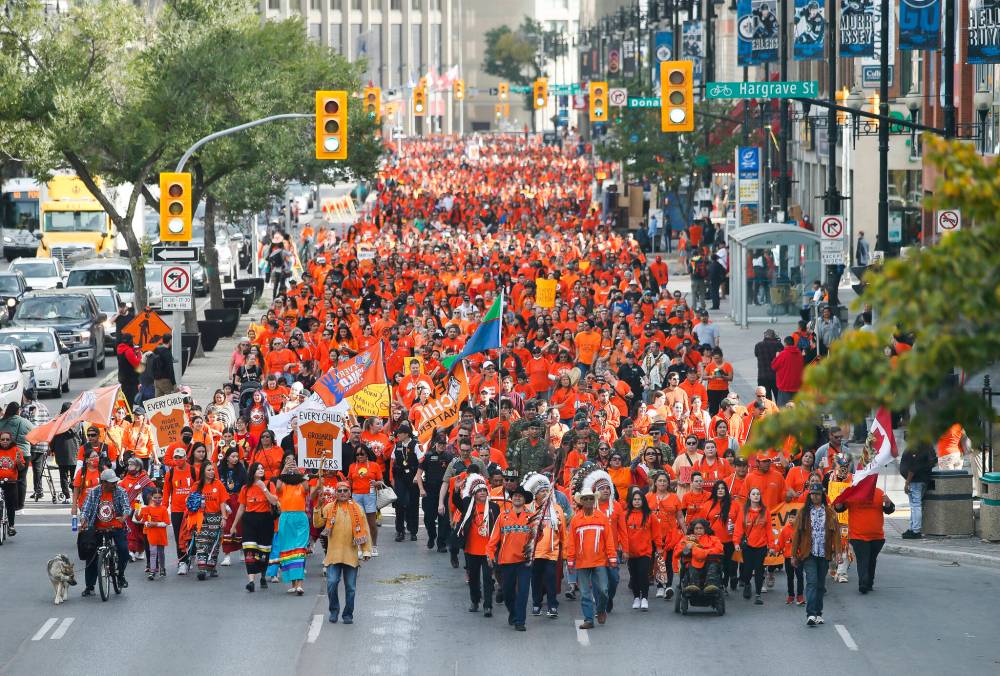
JOHN WOODS / THE CANADIAN PRESS FILES
                                September 30 marks the National Day for Truth and Reconciliation.

JOHN WOODS / THE CANADIAN PRESS FILES

September 30 marks the National Day for Truth and Reconciliation.

Reconciliation is not about guilt. It’s about trying to find a more positive path forward, one that allows Indigenous and non-Indigenous people to live together in a spirit of mutual respect. It’s about having a better understanding of how past and current harms inflicted on Indigenous people have shaped the social and economic inequities that exist today. That is not always well understood in Canada. As a country, we need to do a better job of explaining it.

Perhaps the Truth and Reconciliation Commission said it best in its 2015 report:

“Reconciliation is about establishing and maintaining a mutually respectful relationship between Aboriginal and non-Aboriginal peoples in this country. In order for that to happen, there has to be awareness of the past, acknowledgement of the harm that has been inflicted, atonement for the causes, and action to change behaviour.”

That’s not a shaming exercise. It’s a positive one that ultimately seeks solutions to improve the lives of Indigenous people who have been marginalized and mistreated for decades, including through residential schools, which attempted to assimilate Indigenous people into white society against their will.

“Too many Canadians know little or nothing about the deep historical roots of these conflicts,” the commission wrote. “This lack of historical knowledge has serious consequences for First Nations, Inuit, and Métis peoples, and for Canada as a whole. In government circles, it makes for poor public policy decisions. In the public realm, it reinforces racist attitudes and fuels civic distrust between Aboriginal peoples and other Canadians.”

So we need to learn, reflect and learn some more, not just on Monday but every day. That’s why we keep writing and talking about it.

We also need to become more aware of the positive impacts Indigenous people have had on Canada and how they, as distinct groups of people, have shaped the country we now live in. That includes the negotiation of historic and modern-day treaties and the role the Red River Métis played in Manitoba’s entry into Canada.

“We need to learn, reflect and learn some more, not just on Monday but every day.”

“Too many Canadians still do not know the history of Aboriginal peoples’ contributions to Canada, or understand that by virtue of the historical and modern treaties negotiated by our government, we are all treaty people,” the commission wrote. “History plays an important role in reconciliation; to build for the future, Canadians must look to and learn from the past.”

We are all treaty people because all Canadians, Indigenous and non-Indigenous, are party to those constitutionally protected agreements, which have the force of law today.

Most Canadians are just beginning to learn about those issues and how the historical and present-day harms inflicted on Indigenous people have shaped, and continue to influence, the society we live in today.

It’s a learning process and its purpose is to effect positive change and to generate concrete solutions (such as returning sovereignty and economic control to Indigenous communities, which they never agreed to relinquish in the first place). That will take time, indeed generations.

“Reconciliation must support Aboriginal peoples as they heal from the destructive legacies of colonization that have wreaked such havoc in their lives,” the commission wrote. “But it must do even more. Reconciliation must inspire Aboriginal and non-Aboriginal peoples to transform Canadian society so that our children and grandchildren can live together in dignity, peace, and prosperity on these lands we now share.”

That was supposed to be the objective a century-and-a-half ago when the first numbered treaties were negotiated between First Nations and the Crown in the late 1800s, and when the Red River Métis negotiated the terms of the Manitoba Act with the federal government in 1870.

Instead, colonial governments largely reneged on the terms and spirit of those agreements and attempted to eliminate Indigenous people as a distinct group within Canada. Today we are dealing with the fallout from that.
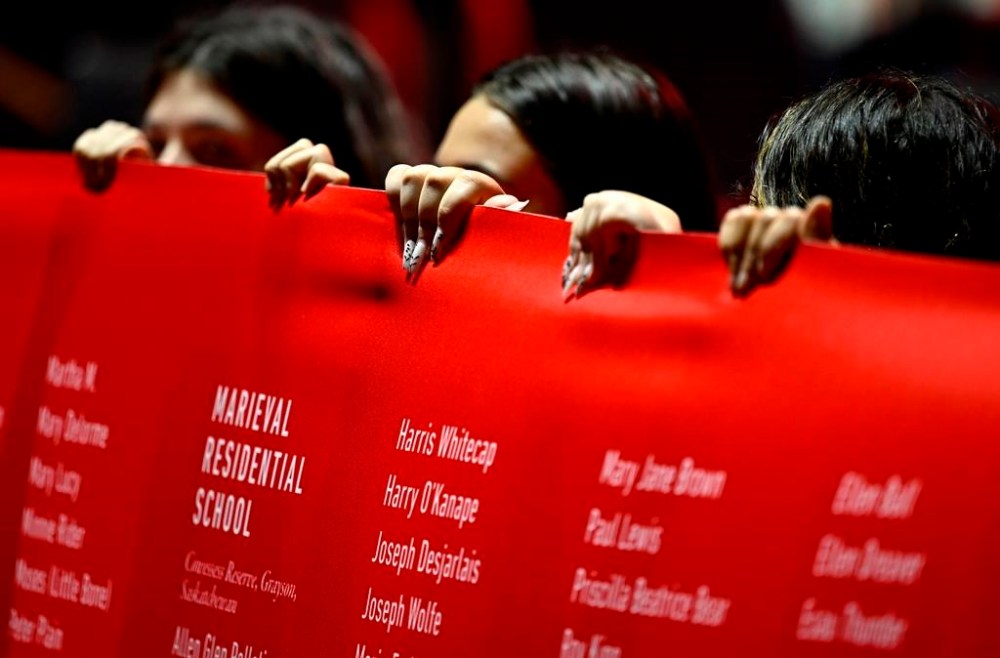
JUSTIN TANG / THE CANADIAN PRESS FILES 
During Truth and Reconciliation events in Ottawa in September 2023, students carried a ceremonial cloth with the names of children who died in residential schools. It's important to learn from that history every day, not just on Sept. 30, Tom Brodbeck writes.
JUSTIN TANG / THE CANADIAN PRESS FILES

During Truth and Reconciliation events in Ottawa in September 2023, students carried a ceremonial cloth with the names of children who died in residential schools. It's important to learn from that history every day, not just on Sept. 30, Tom Brodbeck writes.

As the Truth and Reconciliation Commission has said, though, that can change and must change. Canadians — Indigenous and non-Indigenous — have the power, the compassion and the willingness to do the heavy lifting required to transform the society we live in.

That’s why we keep writing and talking about it. And it’s why a day like Monday is set aside to reflect on all of those issues and to remind ourselves of the momentous tasks ahead.

tom.brodbeck@freepress.mb.ca

Tom Brodbeck

Tom Brodbeck
Columnist

Tom Brodbeck is an award-winning author and columnist with over 30 years experience in print media. He joined the Free Press in 2019. Born and raised in Montreal, Tom graduated from the University of Manitoba in 1993 with a Bachelor of Arts degree in economics and commerce. Read more about Tom.

Tom provides commentary and analysis on political and related issues at the municipal, provincial and federal level. His columns are built on research and coverage of local events. The Free Press’s editing team reviews Tom’s columns before they are posted online or published in print – part of the Free Press’s tradition, since 1872, of producing reliable independent journalism. Read more about Free Press’s history and mandate, and learn how our newsroom operates.

Our newsroom depends on a growing audience of readers to power our journalism. If you are not a paid reader, please consider becoming a subscriber.

Our newsroom depends on its audience of readers to power our journalism. Thank you for your support.


Report Error Submit a Tip

More Stories

Dropping the gloves to make the point

Editorial 4 minute read Preview

Dropping the gloves to make the point

Editorial 4 minute read Yesterday at 2:01 AM CDT

In hockey parlance, it’s called “shedding,” the moment in a game when you are forced to deal with an instigator by dropping (shedding) your gloves for an all-out brawl.

That term is a deep cut from hockey culture that Prime Minister Mark Carney — he of the “elbows up” phenomenon — may need to not only embrace but practise more often in the face of yet another round of overly punitive tariffs imposed by United States President Donald Trump.

To be fair, under Carney’s leadership, Canada has not exactly rolled over in the face of Trump’s bully-boy tactics.

Yes, Canada has made concessions to placate Trump to further a new continental trade agreement: investing more money to combat the cross-border flow of fentanyl that isn’t actually happening, stalling efforts to tax streaming companies as most European countries already do, and — most recently — giving Trump a cut of profits from the Canadian-made, Canadian-paid Gordie Howe bridge between Windsor and Detroit.

Read
Yesterday at 2:01 AM CDT

Former Tory cabinet minister runs for Brandon trustee

Abiola Odutola 4 minute read Preview

Former Tory cabinet minister runs for Brandon trustee

Abiola Odutola 4 minute read Yesterday at 2:01 AM CDT

BRANDON — Jim McCrae, a former attorney general of Manitoba, has registered to run for a seat on the Brandon School Division board of trustees.

McCrae, 77, had a long political career as a Tory cabinet minister and before that, a Brandon city councillor.

He said his decades of public service and education experience have prepared him to contribute to the governance of the school division.

“My last cabinet position was as minister of education and training. I travelled extensively in Manitoba and met with many teachers and others involved with the education of our children,” McCrae told the Brandon Sun.

Read
Yesterday at 2:01 AM CDT

Automation reaches new heights on farm

Laura Rance-Unger 4 minute read Preview

Automation reaches new heights on farm

Laura Rance-Unger 4 minute read Yesterday at 2:01 AM CDT

LANGHAM, Sask. — The thousands of farmers from across the Prairies who flock to the annual Ag in Motion show every July seem oblivious to the possibility the technology on display could one day replace many of them.

Families with children in tow, Hutterite colony workers, grandparents and young couples just starting out roamed through the 600 or more exhibitor displays, amazed at how everything about farming just keeps getting bigger, more efficient and increasingly more automated.

It’s now possible to seed using a 100-foot-wide drill — a 12-foot jump over the widest available a few years ago — provided the farmer can afford a tractor with enough horsepower to pull it. Those sell for around $850,000 and up.

Granted, the number of farms with enough acres to justify that kind of width and drawing power is still relatively small, but farms continue to grow. And it’s no secret the number of people who have the interest, skills and financial wherewithal to run them continues to shrink.

Read
Yesterday at 2:01 AM CDT

For unique Menno-centric take on Free Press, satirist mines her jibes between the lines

David Sanderson 8 minute read Preview

For unique Menno-centric take on Free Press, satirist mines her jibes between the lines

David Sanderson 8 minute read Yesterday at 10:40 AM CDT

Free Press readers of a certain vintage may remember when tuning into a local radio station to hear a pair of disc jockeys perusing a section of the Saturday edition was appointment listening.

On Sunday mornings from 1962 until the mid-1980s, CKRC 630 personalities Bob Washington and Tom Ashmore — better known as Wash and Ash — entertained Winnipeggers of all ages by impersonating the likes of Dennis the Menace, Beetle Bailey and Archie Andrews, as they lent their voices to that weekend’s multi-page, colour comic insert.

In a 1984 interview, Washington, who died in 2016 at the age of 82, attributed the weekly program’s longevity to audiences enjoying the antics of “two middle-aged guys in 24 dialects, giving their version of what Dagwood is saying to Blondie, or what Hägar the Horrible is bragging about.”

More than 40 years later, another Winnipegger is turning to the Free Press for her material. Only instead of reading the paper’s funnies, Lori Klassen, a mother of three and grandmother of two, is funnily reading the paper.

Read
Yesterday at 10:40 AM CDT

Up to the challenge

Zoe Pierce 3 minute read Preview

Up to the challenge

Zoe Pierce 3 minute read Yesterday at 6:13 PM CDT

There may not be another restaurant in Manitoba that can say it has welcomed visitors from as many communities across the province and beyond as the Somerset Food Bar & Lounge has this summer.

In just over a two week span, visitors from more than 100 towns have come out to the family-owned restaurant tucked away in Somerset, a community of roughly 450 people in the Pembina Valley 130 kilometres southwest of Winnipeg.

It started as a challenge, “60 Towns in 60 Days,” where the restaurant wanted to document how many different places they could reach, as it often sees people travelling across Canada stop at the restaurant. The goal was also to encourage people to make a drive they normally wouldn’t.

“The more we started sharing, the more people really started getting behind it, and it turned into this really big thing fairly quickly,” said Jay Friesen, restaurant manager.

Read
Yesterday at 6:13 PM CDT

Ref ‘dominates’ game in Sea Bears loss to Honey Badgers, says coach

Joshua Frey-Sam 7 minute read Preview

Ref ‘dominates’ game in Sea Bears loss to Honey Badgers, says coach

Joshua Frey-Sam 7 minute read Yesterday at 7:40 PM CDT

Following a festive Christmas-in-July-themed Saturday afternoon inside Canada Life Centre, Winnipeg Sea Bears head coach Mike Raimbault didn’t mince words about who he thought was the Grinch in a hard-fought 88-86 loss to the visiting Brampton Honey Badgers that ended in controversy.

As the Sea Bears owned a one-point lead in Target Score Time, Brampton guard Sean East II was awarded three free throws — all of which he converted — after a questionable foul called on Teddy Allen by official Perry Stothart.

Raimbault, who has been known to bite his tongue on such topics, left nothing to the imagination about where he stood on the game-deciding judgment made in a game that had major post-season implications.

“I just felt like it was a fitting ending to the game where Perry Stothart had dominated the flow of the game from the start,” he said. “For him to call a bit of a guess foul and end the game on the foul, I felt like it’s disappointing that he can come in and dictate how the game’s going to be played and flow, and (that) continues to be a bit of an M.O. for him. So I think we’re disappointed with the fact that the league continues to let that happen.”

Read
Yesterday at 7:40 PM CDT