How was my week? Satisfyingly orange, thanks
Read this article for free:
or
Already have an account? Log in here »
To continue reading, please subscribe:

Digital Subscription
One year of digital access for only $205*
- Enjoy unlimited reading on winnipegfreepress.com
- Read the E-Edition, our digital replica newspaper
- Access News Break, our award-winning app
- Play interactive puzzles
*First annual payment billed as $205.00 + GST for one year. This annual subscription will automatically renew at $233.00 + GST every 52 weeks (10% off the regular annual price of $259.35). Offer available to new and qualified returning subscribers only. Cancel any time.
To continue reading, please subscribe:
Add Free Press access to your Brandon Sun subscription for only an additional
$1 for the first 4 weeks*
- Enjoy unlimited reading on winnipegfreepress.com
- Read the E-Edition, our digital replica newspaper
- Access News Break, our award-winning app
- Play interactive puzzles
*Your next Brandon Sun subscription payment will increase by $1.00 and you will be charged $17.95 plus GST for four weeks. After four weeks, your payment will increase to $24.95 plus GST every four weeks.
Read unlimited articles for free today:
or
Already have an account? Log in here »
Hey there, time traveller!
This article was published 27/09/2024 (667 days ago), so information in it may no longer be current.
It has been an intensely orange-coloured week for me.
It began for me last Sunday, speaking at a church in my neighbourhood, presenting on residential school history, modern Indigenous and Canadian relationships and reconciliation on the fourth “official” National Day of Truth and Reconciliation.
I travelled to Swan River, Selkirk and Winkler during the week and worked online with schools and communities in Ontario, British Columbia and the Yukon.
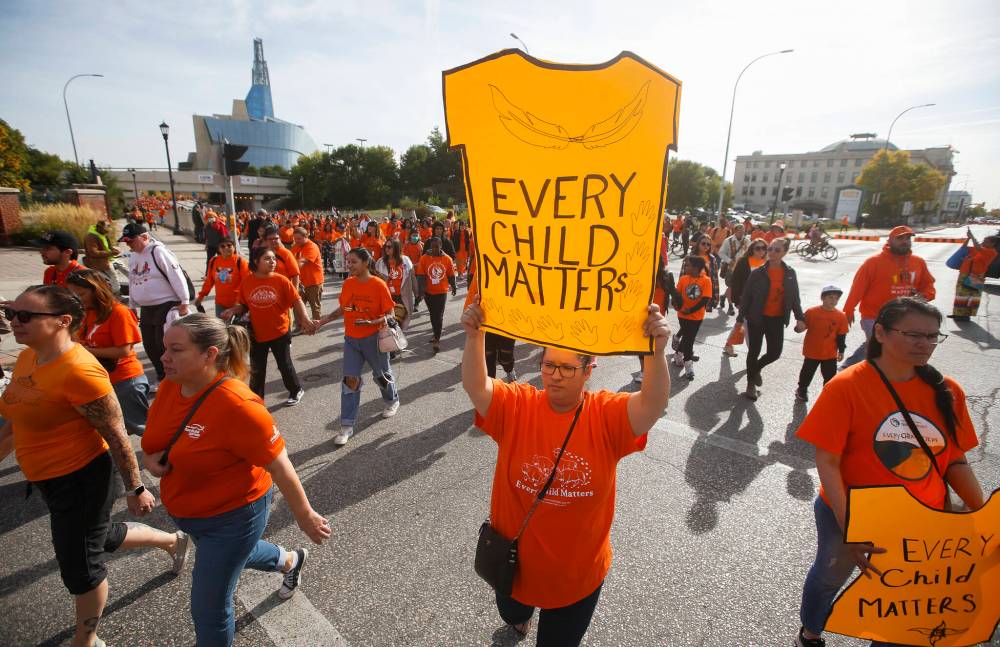
THE CANADIAN PRESS FILES
People march past the Canadian Museum for Human Rights during the second annual Orange Shirt Day walk in Winnipeg in 2022.
I trained employees at a national insurance company and the Winnipeg Blue Bombers, and taught Indigenous studies classes at the University of Manitoba.
One highlight was Wednesday’s opening of the Linwood Street monument, honouring the lives of eight residential school students from Bunibonibee Cree Nation and their pilot, who perished in Winnipeg’s worst aviation disaster in June 1972.
It’s just a sample of the thousands of orange-themed events taking place right now.
The work, of course, will continue beyond Monday’s national day of observance, which is also the first Orange Shirt Day — a statutory holiday — in Manitoba.
For teachers, writers, leaders and others who do public work, truth and reconciliation is an everyday, never-ending call to action that also includes the people revitalizing Indigenous languages, struggling for rights and helping to heal lives.
It’s no coincidence that some of the greatest Métis thinkers and writers gathered in Winnipeg this week for Mawachihitotaak: the Métis Studies Symposium.
For Canadians, wearing orange is an invitation by Indigenous peoples to share in the work of reconciliation for every day, for the rest of our lives.
The process of building relationships, sharing land and resources and rebuilding a country into a place of justice after a century-and-a-half of injustice needs all of us.
Reconciliation is a marathon, not a sprint. The work requires formal events and systemic interventions, but evidence of our success exists in the everyday, informal way citizens act, interact and live our lives.
Which brings me to Morris.
On Wednesday night, I was invited back to Morris — the place where, a decade ago, I decided to visit after the publisher of the Morris Mirror newspaper printed a racist editorial calling Indigenous peoples “terrorists” who “want it all but corruption and laziness prevent some of them from working for it.”
Just starting out as a university professor, I decided to offer this fellow citizen a cup of coffee and a doughnut in an effort to inspire a conversation about how name-calling divides us, and the origin of the town’s name.
Alexander Morris served in the cabinet of John A. Macdonald, Canada’s first prime minister, and he went on to become Manitoba’s first chief justice and the province’s second lieutenant-governor. He negotiated and oversaw treaties that enabled Indigenous peoples and the growing population of European settlers to share the land.
“The work (toward reconciliation) requires formal events and systemic interventions, but evidence of our success exists in the everyday, informal way citizens act, interact and live our lives.”
Unfortunately, the newspaper publisher refused to meet with me – but many others in Morris did.
On that day I had inspiring conversations with the town’s mayor, a school principal and more than a dozen community members working to make Morris a place where treaty is not forgotten.
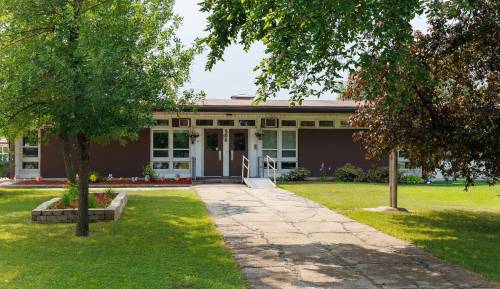
I returned this week at the invitation of the town’s truth and reconciliation committee.
There was, of course, coffee waiting for me when I arrived, along with some carrot cake.
It was a packed house and a beautiful night that began with a prayer and song from a local elder.
I spoke for an hour, followed by a very brave and emotional speech by Morris Mayor Scott Crick about his own truth and reconciliation journey.
The committee then invited community members to speak.
An elderly man stood up, introduced himself and went into a long list of concerns that sounded very much like the editorial published in the Morris Mirror a decade ago.
He spoke at length about how Indigenous peoples need to “get over their problems” and “get off welfare.” He also registered his opposition — emphatically — to efforts involved in changing Indigenous-themed team names and mascots, even though the subject hadn’t been raised during the earlier discussion.
Used to these kinds of comments, I gently identified that violence in Canada isn’t an Indigenous problem but something for everyone to solve, no Indigenous person has ever dreamed of a life on welfare and if sports teams declare they are for everyone, they shouldn’t wear racist images.
But that isn’t the point of bringing up his comments.
Sitting next to him was a close friend I’ll call Jeremy — not his real name — someone I hadn’t seen since he left Winnipeg to work on his family’s Morris-area farm years ago.
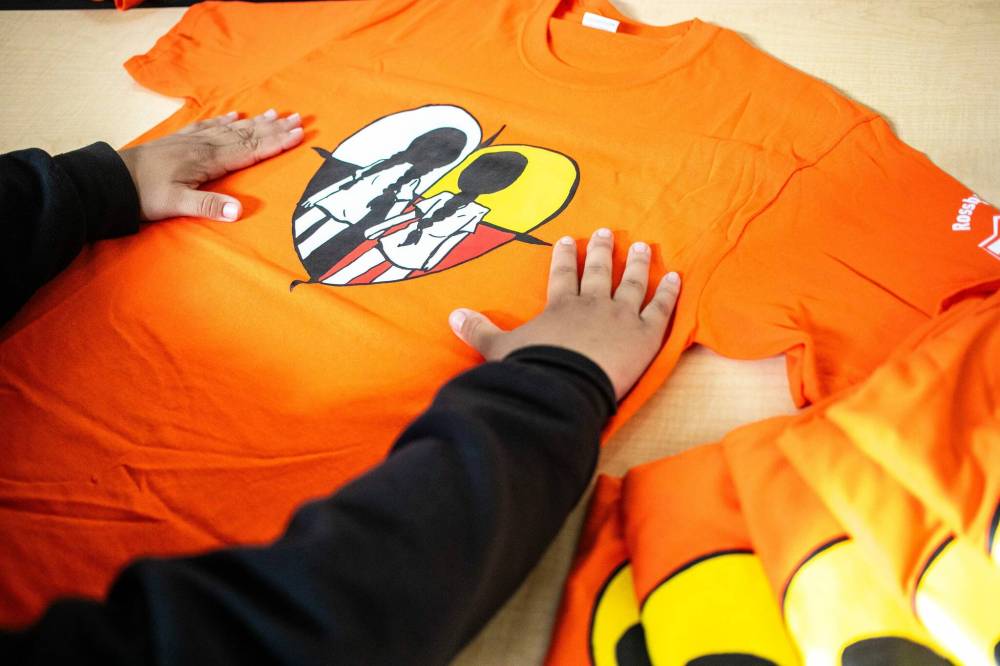
MIKAELA MACKENZIE / FREE PRESS FILES
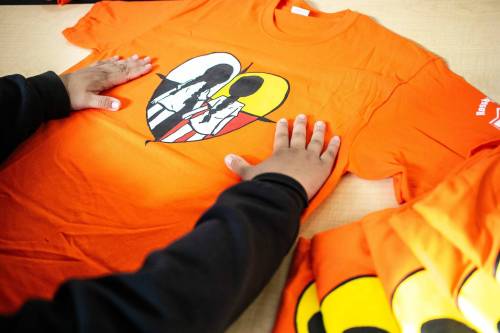
Breanna Mink designed these Orange Shirt Day T-shirts that Rossbrook House is selling to raise charitible funds. For Canadians, Niigaan Sinclair writes, wearing orange is an invitation by Indigenous peoples to share in the work of reconciliation for every day, for the rest of our lives.
I’ve known Jeremy for 15 years. We’ve laughed together, been involved in a few struggles together and he became a real brother to me.
“I’m sorry for my dad,” Jeremy said, embracing me. “He has some old views.”
“Can I meet him?” I asked.
As I met Jeremy’s dad, I shook his hand and could feel him stiffening. I think he thought I was going to confront him.

“You raised a great son,” I told him. “He’s someone who I’ve learned a lot from.”
The man softened. “Thanks,” he said.
It’s been quite a week of orange.
Let’s make it always.
niigaan.sinclair@freepress.mb.ca

Niigaan Sinclair is Anishinaabe from Peguis First Nation and a professor in the Department of Indigenous Studies at the University of Manitoba. He’s been a columnist for the Free Press since 2018. Read more about Niigaan.
Every piece of writing Niigaan produces is reviewed by an editing team before it is posted online or published in print — part of the Free Press‘s tradition, since 1872, of producing reliable independent journalism. Read more about Free Press’s history and mandate, and learn how our newsroom operates.
Our newsroom depends on a growing audience of readers to power our journalism. If you are not a paid reader, please consider becoming a subscriber.
Our newsroom depends on its audience of readers to power our journalism. Thank you for your support.
Related Articles
Four Indigenous women share their plans for Orange Shirt Day



History
Updated on Friday, September 27, 2024 2:34 PM CDT: Formatting