Brewing a cold beer on a warming planet is hard. Germany uses education to fight climate change
Advertisement
Read this article for free:
or
Already have an account? Log in here »
To continue reading, please subscribe:

Digital Subscription
One year of digital access for only $205*
- Enjoy unlimited reading on winnipegfreepress.com
- Read the E-Edition, our digital replica newspaper
- Access News Break, our award-winning app
- Play interactive puzzles
*First annual payment billed as $205.00 + GST for one year. This annual subscription will automatically renew at $233.00 + GST every 52 weeks (10% off the regular annual price of $259.35). Offer available to new and qualified returning subscribers only. Cancel any time.
To continue reading, please subscribe:
Add Free Press access to your Brandon Sun subscription for only an additional
$1 for the first 4 weeks*
- Enjoy unlimited reading on winnipegfreepress.com
- Read the E-Edition, our digital replica newspaper
- Access News Break, our award-winning app
- Play interactive puzzles
*Your next Brandon Sun subscription payment will increase by $1.00 and you will be charged $17.95 plus GST for four weeks. After four weeks, your payment will increase to $24.95 plus GST every four weeks.
Read unlimited articles for free today:
or
Already have an account? Log in here »
Hey there, time traveller!
This article was published 26/09/2024 (745 days ago), so information in it may no longer be current.
MUNICH (AP) — The keys to combating the climate change that’s wreaking havoc on Germany’s beer industry could lie inside a plant nursery — nicknamed “our kindergarten” — at the Society of Hop Research north of Munich.
The 7,000 seedlings there are a mix of new varieties that sprouted from research, education and centuries-old German traditions in hops farming and beer brewing. The hope is that the plants will grow to be seven to eight meters (23 to 26 feet) tall and strong enough to withstand a multitude of diseases and disasters thrown at them — like rising temperatures, drought and the dreaded powdery mildew that can wipe out entire crops.
At every stage, the plants will be incorporated into education in university and vocational school classrooms, breweries and farms across Germany. Generations of professional farmers and brewers, as well as the students who seek to join their ranks, will learn much from the growing plants: Which new varieties should be added to decrease the risk of a bad year wiping out a farm’s entire harvest, whether the latest breeds offer a new taste for the market, and if a specific type is particularly resistant to disease.
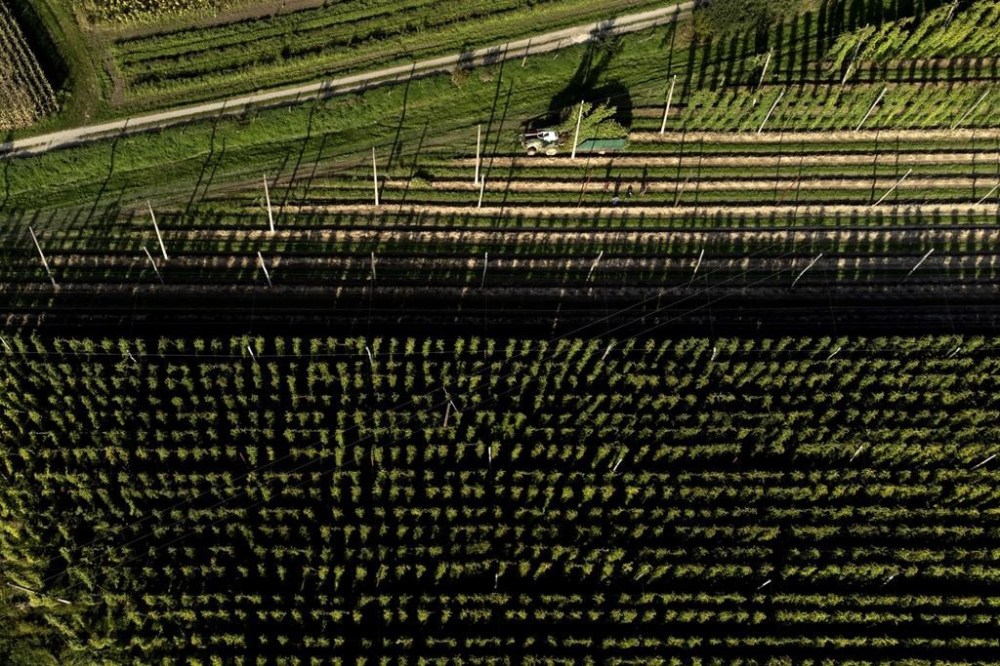
The seedlings’ successes — or failures — could determine the fate of the country’s famed Hallertau region, the world’s largest hops-growing area where most of the farms’ crops will end up in beer.
If the hops stay alive and thrive, the vines will graduate next year to trellises in trial fields in the heart of Bavaria. Researchers hope the specially bred hops will grow to become climate change-resistant and commercially viable varieties that will ultimately be brewed into beers served around the world — and at future Oktoberfests, celebrated an hour’s drive south of the research society.
“The new varieties give our farmers the chance to have income, to have a living for the next generation,” Walter König, the society’s managing director, told The Associated Press last week from the small farming town of Hüll. “It gives our brewers the varieties that they need now and in the future.”
Human-caused climate change has made the world hotter, and increased the likelihood of both long droughts and intense bursts of rainfall. It has affected farmers and their practices worldwide, including in this beer-making region of Bavaria — where the art and craft of hops-farming and beer-brewing dates back more than a thousand years. The history is honored at every Oktoberfest, which began Saturday for the 189th time.
Education and research are crucial components of Germany’s beer industry, from the Society of Hop Research to apprenticeships, a hops-cultivation vocational program and the vaunted Master Brewer diploma.
König, for example, gives lectures to brewers and farmers around Germany and inside the research center’s dedicated classroom, spreading the society’s latest knowledge into drought-tolerant farming techniques, pesticide reduction and efforts to enhance plant biodiversity. The society in recent years has bred hops varieties for farmers that take climate change into account: The new plants need less water and have deeper roots to withstand the drier weather.
Experts say this education and information-sharing is becoming ever more important to maintaining the traditional tastes of your favorite German lagers and ales.
“Climate change is taking place. This is true, you cannot doubt this,” said Thomas Becker, a professor and chair of brewing technology at the Technical University of Munich.
Becker, who oversees the university’s research brewery, said he teaches the 400 to 500 students in his program to think about how climate change affects the entire beer industry, from the soil to the bottle that will be sold on the commercial market.
The farmers’ yields are rapidly shrinking, and what’s left has become “totally different,” Becker said, forcing brewers to change their recipes in order to achieve the historic tastes. The professor also challenges his students to minimize energy consumption during their brewing and finish with a product that has a longer shelf-life to limit waste.
The students quickly learn that it’s increasingly difficult to brew a crisp, cold beer on a warming planet — and it could get even harder, according to a study published last year in the journal Nature Communications. Researchers forecasted a four to 18% decrease in hop yields across growing regions in Europe by 2050 if farmers don’t adapt to the changing climate.
It’s already happening in the Hallertau. The region’s raw materials — hops and barley — have faced higher temperatures and less rainfall during the spring and summer growing months for several years.
Andreas Widmann, a 32-year-old fourth-generation hops farmer in the Hallertau, lost 20 to 30% of his yields in recent years after hot, dry summers. In addition to his degree in agricultural business administration, Widmann took specialized classes in hop cultivation at the only technical school in Bavaria to offer such courses.
Widmann’s experience comes both from classrooms and time spent with his own crops in Germany and during a three-month internship at two hops farms in the United States. He learned about climate change in school, like new soil treatments, but says creativity also comes into play in the fields.
Now, he’s transitioned from student to teacher: He works with his farm’s apprentices to figure out the best way to water sustainably with irrigation, use fertilizer efficiently and plant new varieties that can handle climate change and still be marketable to brewers who want to keep the classic taste.
“Looking into the future of hop growing is always a very difficult thing,” Widmann said last week as the vines were harvested around him. “Because on the one hand it depends on supply and demand. What kind of hops do brewers want? On the other hand, we say ‘yes, we need climate-tolerant varieties to be grown.’”
König says Widmann and Becker’s students are among a wave of future farmers and brewers who are ready and willing to tackle climate change.
“We often have maybe settled old brewmasters. They say, ‘I don’t change my recipe, it’s good like I do it. I don’t want to use a new recipe or a new variety,’” König said. “But we want to teach the new generation what the problems are, what solutions we have.”
It’s a delicate balance for the German beer industry to maintain the country’s hops and brewing tastes and traditions while also adapting for the future. To ensure the Hallertau remains the world’s largest hops-growing area for centuries to come, Becker says climate change must continue to have its own seat in the classroom.
“It’s really always into our mind when we are educating our people,” he said.
__
Pietro De Cristofaro contributed to this report.
__
Associated Press climate and environmental coverage receives support from several private foundations. See more about AP’s climate initiative here. The AP is solely responsible for all content.