How many smoke-related deaths from wildfires are linked to climate change every year?
Advertisement
Read this article for free:
or
Already have an account? Log in here »
To continue reading, please subscribe:

Digital Subscription
One year of digital access for only $205*
- Enjoy unlimited reading on winnipegfreepress.com
- Read the E-Edition, our digital replica newspaper
- Access News Break, our award-winning app
- Play interactive puzzles
*First annual payment billed as $205.00 + GST for one year. This annual subscription will automatically renew at $233.00 + GST every 52 weeks (10% off the regular annual price of $259.35). Offer available to new and qualified returning subscribers only. Cancel any time.
To continue reading, please subscribe:
Add Free Press access to your Brandon Sun subscription for only an additional
$1 for the first 4 weeks*
- Enjoy unlimited reading on winnipegfreepress.com
- Read the E-Edition, our digital replica newspaper
- Access News Break, our award-winning app
- Play interactive puzzles
*Your next Brandon Sun subscription payment will increase by $1.00 and you will be charged $17.95 plus GST for four weeks. After four weeks, your payment will increase to $24.95 plus GST every four weeks.
Read unlimited articles for free today:
or
Already have an account? Log in here »
Hey there, time traveller!
This article was published 21/10/2024 (693 days ago), so information in it may no longer be current.
Climate change may be contributing to thousands more wildfire smoke-related deaths every year than in previous decades, a new study suggests — results a Canadian co-author says underline the urgency of reducing planet-warming emissions.
The international study published Monday is one of the most rigorous yet in determining just how much climate change can be linked to wildfire smoke deaths around the world, said Sian Kou-Giesbrecht, an assistant professor at Dalhousie University.
“What stands out to me is that this proportion is increasing just so much. I think that it really kind of attests to just how much we need to take targeted action to reducing greenhouse-gas emissions,” she said in an interview.
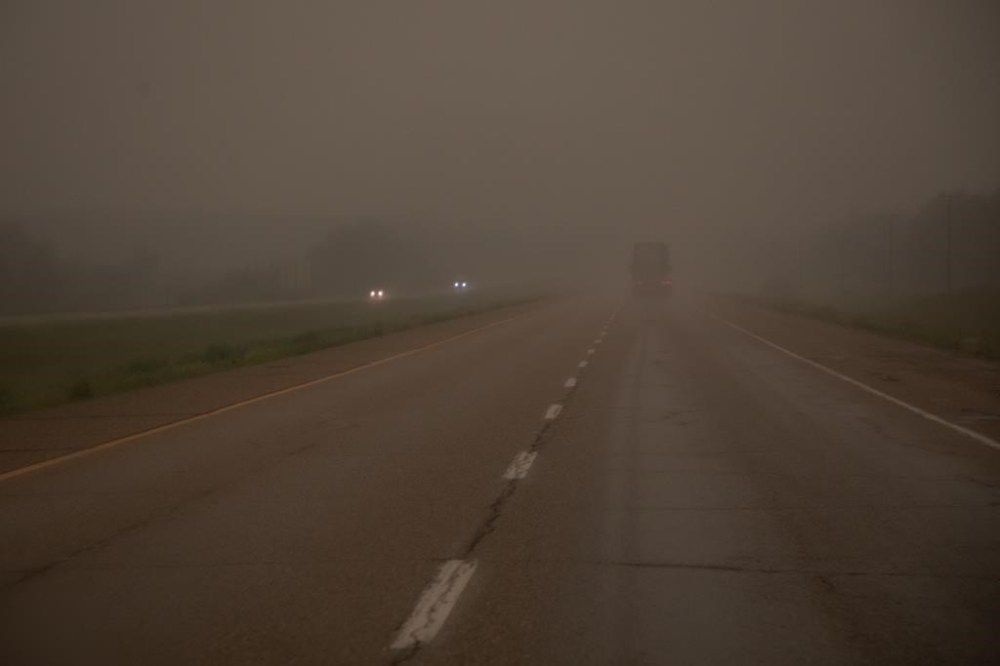
The study estimates, using mathematical modeling, that about 12,566 annual wildfire smoke-related deaths in the 2010s were linked to climate change, up from about 669 in the 1960s, when far less carbon dioxide was concentrated in the atmosphere.
Translated to a proportion of wildfire smoke mortality overall, the study estimates about 13 per cent of estimated excessdeaths in the 2010s were linked to climate change, compared to about 1.2 per cent in the 1960s.
“Adapting to the critical health impacts of fires is required,” read the study, published in the peer-reviewed journal Nature Climate Change.
While wildfires are a natural part of the boreal forest ecosystem, a growing number of studies have documented how climate change, driven by the burning of fossil fuels, is making them larger and more intense — and contributing more to air pollution.
The same research group is behind another study published in the same journal Monday that suggests climate change increased the global area burned by wildfire by about 16 per cent from 2003 to 2019.
Those climate-fuelled fires then churn out more fine particle pollution, known as PM2.5, that’s tiny enough to get deep into the lungs — and in the long run can have serious health effects.
The study that estimated the scale of those effects is based on modeling, not historical data about reported deaths from air pollution.
Researchers used established public-health metrics for when pollution is thought to contribute to mortality, then figured out the extent to which wildfire smoke may have played a role in that overall exposure to arrive at the estimates.
Meanwhile, Health Canada estimates that between 2013 and 2018, up to 240 Canadians died every year due to short-term exposure to wildfire air pollution.
Kou-Giesbrecht said Monday’s study did not find that climate change had a major influence on the number of smoke-related deaths from Canada’s boreal wildfires.
She suggested that’s likely due to the country’s relatively small population size, and how tricky it is to model forest fires in the region, given its unique mix of shrubs and peat.
But she also noted that a stretch of devastating Canadian wildfire seasons over the past several years was not captured in the study, and she expects future research could find a bigger increase in deaths and public-health problems linked to climate change.
The most affected regions in the study were South America, Australia and Europe.
Kou-Giesbrecht said the more studies that uncover the link between climate change and disasters as “tangible” as wildfires, the more the case for “drastic climate action” will be bolstered.
“I think that the more and more evidence that we have to support the role of climate change in shaping the past 100 years, and knowing that it will continue to shape the next 100 years, is really important,” she said.
“And I find that personally interesting, albeit scary.”

The study used three highly complex models to estimate the relationship between climate change, land use and fire.
The models, which each contain thousands upon thousands of equations, compare what wildfires look like in the current climate to what they may have looked like in pre-industrial times, before humans started to burn vast amounts of fossil fuels.
The researchers used the models to calculate gas and aerosol emissions from wildfires between 1960 and 2019, and then make estimates about annual smoke-related deaths.
The type of methodology used by Monday’s studies, known as attribution science, is considered one of the fastest-growing fields of climate science. It is bolstered in part by major strides in computing power.
This report by The Canadian Press was first published Oct. 21, 2024.