Drilling down Getting to the root of dentistry
Read this article for free:
or
Already have an account? Log in here »
To continue reading, please subscribe:
Digital Subscription
One year of digital access for only $1.44 a week*
- Enjoy unlimited reading on winnipegfreepress.com
- Read the E-Edition, our digital replica newspaper
- Access News Break, our award-winning app
- Play interactive puzzles
*Billed as $5.77 plus GST every four weeks. After 52 weeks, price increases to the regular rate of $19.95 plus GST every four weeks. Offer available to new and qualified returning subscribers only. Cancel any time.
To continue reading, please subscribe:
Add Free Press access to your Brandon Sun subscription for only an additional
$1 for the first 4 weeks*
- Enjoy unlimited reading on winnipegfreepress.com
- Read the E-Edition, our digital replica newspaper
- Access News Break, our award-winning app
- Play interactive puzzles
*Your next Brandon Sun subscription payment will increase by $1.00 and you will be charged $17.95 plus GST for four weeks. After four weeks, your payment will increase to $24.95 plus GST every four weeks.
Read unlimited articles for free today:
or
Already have an account? Log in here »
Hey there, time traveller!
This article was published 04/11/2024 (722 days ago), so information in it may no longer be current.
Dr. Carolyn Robertson, 42, has been practising dentistry for 17 years. She is a part-time clinical instructor at the University of Manitoba’s college of dentistry on Bannatyne Avenue, and the managing partner and general practitioner dentist at Harte Dental on Roblin Boulevard.
I wasn’t scared of going to the dentist as a child. I didn’t completely know what I was getting into (when it comes to) how scared people are with what dentists do.
When I first graduated I would say, ‘Oh no, it’s not going to hurt.’ Now I don’t promise anyone it’s not going to hurt, per se, because there can be some pinching moments or uncomfortable moments.

MIKAELA MACKENZIE / FREE PRESS
Dentist Carolyn Robertson (left) and dental assistant Kaylen Wallbridge demonstrate their craft on administrator Mameet Kaur.
People are scared of pain and unfortunately, for anesthetics we have to use needles and that invokes a certain amount of fear from people. The fear gets so big that they’ve avoided coming to the dentist because they are so anxious about it.
People often say ‘Eww, gross, you’re touching mouths.’ Well, I do get to wear gloves but I personally would rather deal with someone’s smile than the other end of things.
Teeth can give things away. You can tell a lot about people from their teeth. You can tell about their upbringing, whether they had care when they were younger or if they were a little bit more impoverished. There is a lot of emotion we carry in our mouth.
I am not looking at people’s teeth all the time. I try to leave work at work. Sometimes people don’t want to talk to you at parties because they are nervous you are looking at their teeth and judging them.
About one-third of our teeth show in our mouth. Two-thirds of a tooth is root anchored in the bone to hold the tooth in place.
Teeth have layers and there is actually space in the middle of the tooth. The innermost layer in the middle is the pulp, which has nerves, connective tissue and blood vessels. The next layer is dentin. On the root surface is cementum and finally enamel, which is the hard layer of the visible tooth.
The most common mistake people make is not flossing. My line, which I took from someone else, is to floss the teeth you want to keep. So basically all of them. Floss once a day, and brush twice a day.
I can tell if someone who hasn’t flossed for a long time has done it just before they came to see me. The giveaway is usually a lot of inflammation in the gum. The gum looks angry.
Some people are scared of getting in trouble with their dentists. I think people don’t want to be told they are doing something wrong, but we are genuinely here to help.
Before bedtime is the most important time to brush teeth. That is when I recommend flossing as well. Once we are asleep, we have less saliva production and less saliva flow so bacteria will have a party in our mouth.
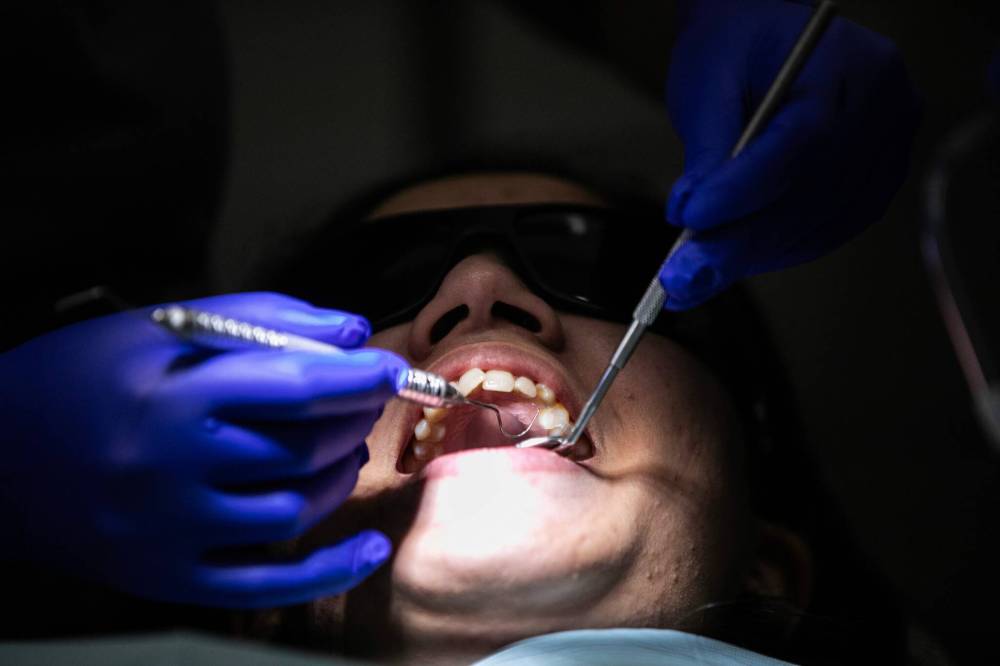
MIKAELA MACKENZIE / FREE PRESS
Brush your teeth at least twice a day, especially before bedtime, says dentist Carolyn Robertson.
Everyone has bacteria in their mouths and when bacteria mixes with certain foods, plaque forms. If plaque sits in our mouth for a long time and saliva touches it — there are minerals in our saliva — the plaque hardens onto our teeth. Brushing and flossing disrupts and removes the plaque.
The most important part of brushing and flossing is getting plaque off the teeth. It doesn’t take a lot of pressure or force to do that. We want to remove plaque before it hardens to our teeth as tartar (calculus) and before the bacteria and acids in plaque cause tooth decay (caries). You can’t get rid of tartar by brushing; you have to see a dental hygienist and have your teeth professionally cleaned.
Tooth health is absolutely important to overall health. Poor oral health is linked to cardiovascular disease: heart disease and stroke. Our mouth is very vascular; there are lots of arteries and veins in there. The tissue is thin, so a lot of bleeding can happen easily in our mouth. If we have a lot of bacteria that enters that bloodstream, it can travel to other parts of our body. Bacteria in our bloodstream and in our heart can cause heart disease.
The first sign there is a problem is when gums start bleeding from brushing and flossing. That’s called gingivitis.
It’s expensive to take care of teeth but prevention can help. If we can brush and floss, even if we are only going to brush once a day, then do it before bedtime.
Dentists are all about prevention. We are actively trying to prevent ourselves from doing work. Honestly, I am happy when my patients don’t need to see me again; it’s good for them.
But often times we are limited because we are privatized health care and not public health care. There is a cost that comes with it. If people don’t have insurance through work, they don’t necessarily put their teeth first when they have groceries or gas to buy or children’s sports or whatever life is throwing at them.
Dentistry costs so much money because our materials and equipment cost quite a bit. A lot of our costs are actually overhead costs to run what we are doing. We do so many different things, so we need a lot of equipment and material. We also have numerous staff members we need to help us do our job. And materials have always been expensive.
Access to care can be a huge problem and sometimes teeth are the least of people’s worries. We have made complete dentures for very young people in their 20s even. We have removed all of their teeth and made complete false teeth for them.
We work with people who don’t have insurance. We work with people who have private insurance, and we work with some government-assisted programs (see box for details).
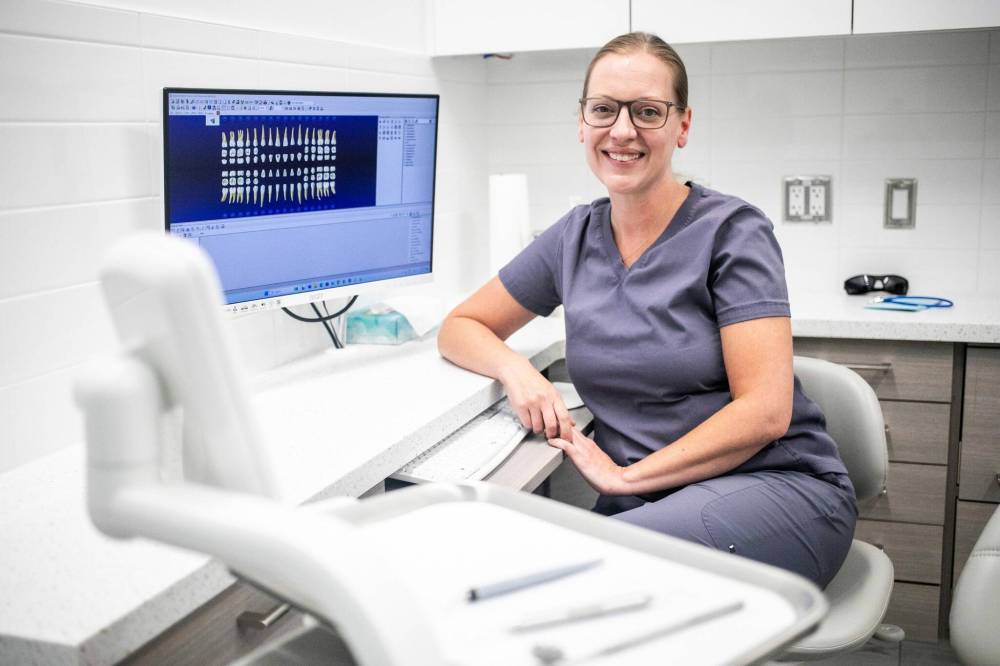
MIKAELA MACKENZIE / FREE PRESS
Robertson has practising dentistry for 17 years.
The clinic at the dentistry college is open to the general public. They charge lower fees than the Manitoba Dental Association fee guide, so it costs generally 50 per cent less than private-practice dentistry. They also accept insurance. It’s mostly third- and fouth-year dental students who see patients.

The best thing about my job is seeing someone smile when you help them. It’s a wonderful feeling to know you’ve helped them feel better.
You need to have a strong stomach to do this job. It is not glamorous. I didn’t have a strong stomach. As a dental student, when I saw the first bit of blood during surgery, I almost passed out. I had to go sit in the hallway. But you toughen up and now I am completely fine with doing surgery.
Well, I am completely fine with blood in the mouth, but I don’t want to see your knee surgery.
Answers have been edited for length and clarity.
av.kitching@freepress.mb.ca
Government-assisted programs
to access dental care
EIA — Employment and Income Assistance is available for people who qualify for provincial income assistance, as well as those who qualify for disability.
NIHB — Non-insured health benefits are available for people with Treaty status.
MMF — The Manitoba Métis Federation provides some dental coverage for people with Métis Status.
IFHP — The Interim Federal Health Program offers some limited, temporary dental coverage for refugees.
CDCP — The Canadian Dental Care Program is the newest government program. This plan is currently for those younger than 18 and older than 65 with no access to dental insurance and a household income less than $90,000.

AV Kitching is an arts and life writer at the Free Press. She has been a journalist for more than two decades and has worked across three continents writing about people, travel, food, and fashion. Read more about AV.
Every piece of reporting AV produces is reviewed by an editing team before it is posted online or published in print — part of the Free Press‘s tradition, since 1872, of producing reliable independent journalism. Read more about Free Press’s history and mandate, and learn how our newsroom operates.
Our newsroom depends on a growing audience of readers to power our journalism. If you are not a paid reader, please consider becoming a subscriber.
Our newsroom depends on its audience of readers to power our journalism. Thank you for your support.