Was it all a joke? How stand-up comedy helped reelect Trump
Advertisement
Read this article for free:
or
Already have an account? Log in here »
To continue reading, please subscribe:

Digital Subscription
One year of digital access for only $205*
- Enjoy unlimited reading on winnipegfreepress.com
- Read the E-Edition, our digital replica newspaper
- Access News Break, our award-winning app
- Play interactive puzzles
*First annual payment billed as $205.00 + GST for one year. This annual subscription will automatically renew at $233.00 + GST every 52 weeks (10% off the regular annual price of $259.35). Offer available to new and qualified returning subscribers only. Cancel any time.
To continue reading, please subscribe:
Add Free Press access to your Brandon Sun subscription for only an additional
$1 for the first 4 weeks*
- Enjoy unlimited reading on winnipegfreepress.com
- Read the E-Edition, our digital replica newspaper
- Access News Break, our award-winning app
- Play interactive puzzles
*Your next Brandon Sun subscription payment will increase by $1.00 and you will be charged $17.95 plus GST for four weeks. After four weeks, your payment will increase to $24.95 plus GST every four weeks.
Read unlimited articles for free today:
or
Already have an account? Log in here »
Hey there, time traveller!
This article was published 21/11/2024 (685 days ago), so information in it may no longer be current.
Did stand-up comedians help reelect Donald Trump?
Not a joke, as outgoing President Joe Biden might say.
Trump has been the butt of countless late-night monologues and “Saturday Night Live” sketches for the better part of a decade, as much of Hollywood tracked the highs and lows of his political career with revulsion and ridicule.
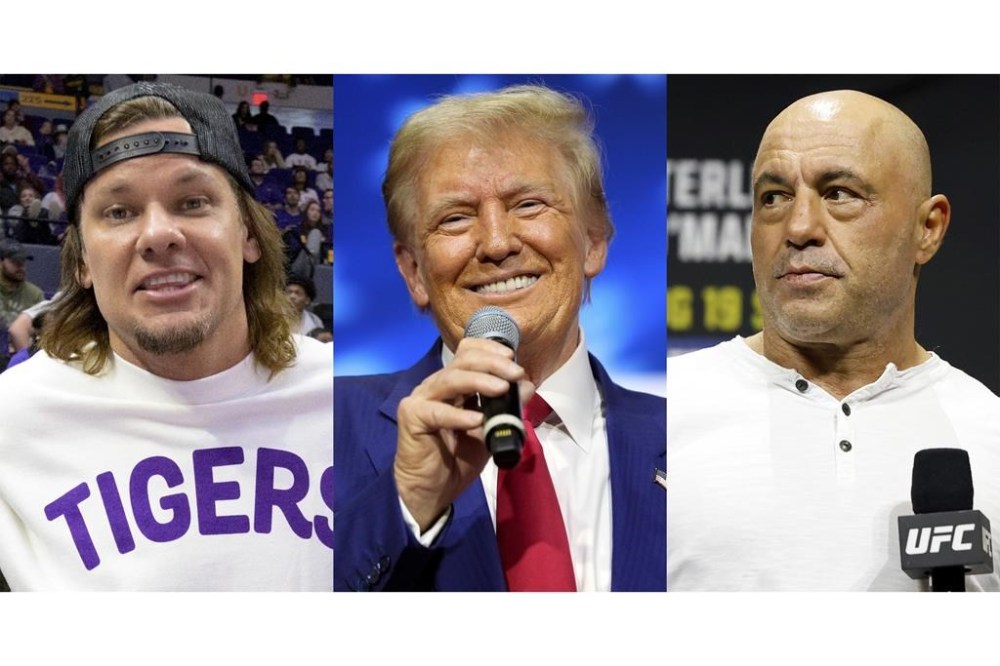
But in the weeks leading up to Election Day, he sat for interviews with podcasting comedians who occupy an increasingly popular space where political discourse is mediated through roast-style insults, right-leaning conspiracy theories and mockery of the left.
“They’re all sort of simultaneously entertainers and influencers and pundits and — I’ve argued, propagandists — who have massive, loyal fanbases,” said Seth Simons, a journalist who writes a newsletter about the comedy industry’s darker side.
The Trump era has coincided with the rise of the hourlong Netflix special and comedy podcast. And while the world of stand-up is as diverse as the nation itself, some of its hottest acts have punched left.
Dave Chappelle has repeatedly courted controversy by mocking transgender activists. Bill Burr has roasted feminists with relish, most recently in his post-election “SNL” monologue (“All right, ladies, you’re 0-2 against this guy”). Even Michelle Wolf, who famously roasted Trump at the 2018 White House Correspondents Dinner, has an extended riff in her 2022 special critiquing #MeToo, calling it “the worst-run movement I’ve ever seen.”
None of these comics publicly supported Trump, but nonetheless trained their fire on the so-called woke left, a bogeyman of Trump’s campaign.
Trump got a warm welcome — but not everyone was amused
That’s what seems to have brought Trump, a veteran TV entertainer himself, into the studios of Joe Rogan, the nation’s most listened-to podcaster, and other comedians.
He discussed addiction and the opioid crisis with Theo Von, who told the past and future president that “cocaine will turn you into a damn owl, homie.” On another podcast, Andrew Schulz and Akaash Singh laughed out loud as Trump went through his nicknames for political rivals — like “Comrade Kamala” Harris — and recounted his near-assassination.
Politicians have long sought to reach voters on alternative platforms. Former President Barack Obama slow jammed the news with Jimmy Fallon, who ruffled Trump’s hair in 2016. Both Obama and Hillary Clinton appeared on Zach Galifianakis’ web series “Between Two Ferns.” Harris appeared on “SNL” days before the election and sat with an array of more earnest podcasters, with less evident success.
For Trump, the podcasts were part of a larger effort to reach young male voters — a tactic he says his son Barron, 18, suggested. More than half of male voters ages 18-44 supported Trump, and 45% supported Harris, although Biden won this group in 2020, according to AP VoteCast, a survey of more than 120,000 voters.
While politicians’ late-night appearances tend to be carefully scripted affairs, Rogan interviewed Trump for a whopping three hours in a conversation that veered from false claims about the 2020 election to speculation about UFOs and John F. Kennedy’s assassination. Rogan, who supported Bernie Sanders in 2020, subsequently endorsed Trump this cycle.
Trump’s interviewers aren’t political comedians; they’re just as likely to chat about internet curiosities, mixed martial arts or weightlifting. Their views seem primarily rooted in suspicion of the establishment, devotion to free speech and openness to alternative — and often unfounded — theories about things like vaccines and immigration.
That may have led them to see Trump as a kindred spirit.
“The rebels are Republicans now. You want to be a rebel, you want to be punk rock, you want to like buck the system, you’re a conservative now,” Rogan said during the interview, which has nearly 50 million views on YouTube.
Simons says Rogan and his acolytes, consciously or not, have shifted what’s acceptable in comedy rightward.
“The relationship that people have with these roast comics, these comics who tell racist jokes or sexist jokes, is that they don’t mean what they say, it’s just funny,” Simons said.
Marc Maron, whose podcast “WTF” helped birth the genre, called out his fellow comics in a blog post after the Rogan interview.
“The anti-woke flank of the new fascism is being driven almost exclusively by comics, my peers,” Maron wrote. “When comedians with podcasts have shameless, self-proclaimed white supremacists and fascists on their show to joke around like they are just entertainers or even just politicians, all it does is humanize and normalize fascism.”
A fractured media landscape
It wasn’t always like this.
Johnny Carson, the king of late night for three decades until his 1992 retirement, steered clear of political controversies to cultivate a mass audience. This was also when most Americans got their news from the “Big Three” television networks.
Fast forward to today: Left-leaning hosts of comedy shows across many channels deliver nightly polemics interspersed with news clips. To their critics, comedians like Jon Stewart, Stephen Colbert and John Oliver are indistinguishable from MSNBC commentators.
Comedian Wayne Federman, the author of a history of stand-up, says these hosts can only draw a fraction of Carson’s viewers, removing the economic incentive to appeal widely.
“As most late-night hosts seemed openly aligned with (the Democratic National Committee), a market niche opened in the podcast space. Enter Joe Rogan,” he said.
Rogan’s show, for which he landed an estimated $250 million deal with Spotify, has become a springboard for up-and-coming comics.
“For a lot of comedians right now, following in Joe Rogan’s footsteps and trying to be in his world and emulate him is a smart career move,” Simons said. “I think that’s partly why there are so many Andrew Schulzes and Theo Vons.”
Presidential candidate or insult comic?
Beyond his podcast appearances, Trump may have benefited more subtly from stand-up’s proliferation.
Much was made of Trump’s extemporaneous speaking style — what he referred to as “the weave” — in which his hourlong speeches meandered through stories, digressions, movie references and obscenities.
As political speech, it was unconventional, but it bore many of stand-up’s hallmarks: deliberate provocations, trademark punchlines and callbacks eventually wrapping it all together.
“Because some of the things he says seem like they’re so off-center, people take it as a joke,” said Shilpa Davé, a University of Virginia professor of media studies. “The kind of comedy that he’s doing doesn’t come off as threatening, it comes off as acceptable.”

It also posed problems for journalists covering his speeches: When he said he would be a dictator for a day, or inveighed against “enemies from within,” or promised to round up and deport millions of immigrants in the U.S. without authorization, was he laying out policies or joking around?
“You can first denounce what journalists do by having called everything they say ‘fake news,’ and then you can denounce what they expose by saying they just don’t get it — the stand-up comedy defense,” said Robert Thompson, a professor of television and popular culture at Syracuse University.
There were times when the jokes didn’t land — but they weren’t his. Trump faced outrage after Tony Hinchcliffe, another comedian with a roast-style podcast, referred to Puerto Rico as a “floating island of garbage” and made other racist jokes at a rally. The campaign distanced itself from Hinchcliffe as Puerto Rican celebrities backed Harris and commentators wondered if it would turn off Latino voters.
“Imagine bombing so hard you save america from fascism,” comedian Zack Bornstein posted on X.
But barely a week later, it was Trump who brought the house down.