Lebanon’s Shiite Muslims pay high price in war between Israel and Hezbollah
Advertisement
Read this article for free:
or
Already have an account? Log in here »
To continue reading, please subscribe:
Digital Subscription
One year of digital access for only $1.44 a week*
- Enjoy unlimited reading on winnipegfreepress.com
- Read the E-Edition, our digital replica newspaper
- Access News Break, our award-winning app
- Play interactive puzzles
*Billed as $5.77 plus GST every four weeks. After 52 weeks, price increases to the regular rate of $19.95 plus GST every four weeks. Offer available to new and qualified returning subscribers only. Cancel any time.
To continue reading, please subscribe:
Add Free Press access to your Brandon Sun subscription for only an additional
$1 for the first 4 weeks*
- Enjoy unlimited reading on winnipegfreepress.com
- Read the E-Edition, our digital replica newspaper
- Access News Break, our award-winning app
- Play interactive puzzles
*Your next Brandon Sun subscription payment will increase by $1.00 and you will be charged $17.95 plus GST for four weeks. After four weeks, your payment will increase to $24.95 plus GST every four weeks.
Read unlimited articles for free today:
or
Already have an account? Log in here »
Hey there, time traveller!
This article was published 24/11/2024 (698 days ago), so information in it may no longer be current.
BEIRUT (AP) — The Lebanese civilians most devastated by the Israel- Hezbollah war are Shiite Muslims, and many of them believe they are being unfairly punished because they share a religious identity with Hezbollah militants and often live in the same areas.
“This is clear,” said Wael Murtada, a young Shiite man who anxiously watched paramedics search rubble after a recent Israeli airstrike destroyed his uncle’s two-story home and killed 10 people. “Who else is being attacked?”
Israel has concentrated its attacks on villages in southern and northeastern Lebanon and neighborhoods south of Beirut. This is where many Hezbollah militants operate from, and their families live side by side with large numbers of Shiites who aren’t members of the group.
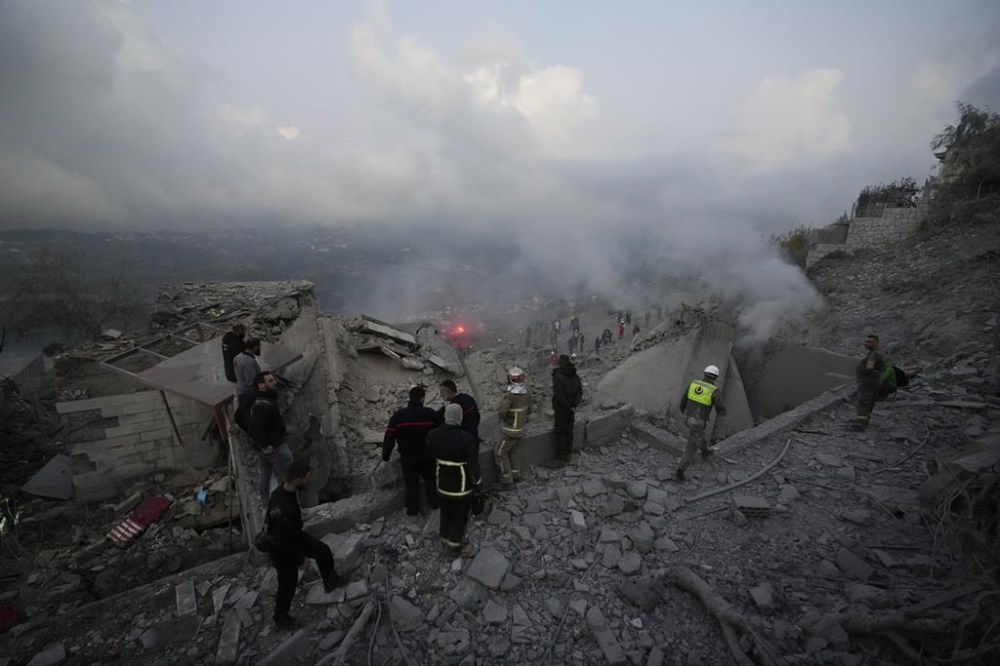
Israel insists its war is with Hezbollah and not the Lebanese people – or the Shiite faith. It says it only targets members of the Iran-backed militant group to try to end their yearlong campaign of firing rockets over the border. But Israel’s stated objectives mean little to people like Murtada as growing numbers of Shiite civilians also die in a war that escalated sharply in recent months.
Shiites don’t just measure the suffering of their community in deaths and injuries. Entire blocks of the coastal city of Tyre have been flattened. Large parts of the historic market in the city of Nabatiyeh, which dates to the Ottoman era, have been destroyed. And in Baalbek, an airstrike damaged the city’s famed Hotel Palmyra, which opened in the late 19th century, and a home that dates to the Ottoman era.
“Lebanese Shias are being collectively punished. Their urban areas are being destroyed, and their cultural monuments and building are being destroyed,” said Mohanad Hage Ali, a senior fellow at the Carnegie Middle East Center in Beirut.
As Shiites flee their war-torn villages and neighborhoods, the conflict is increasingly following them to other parts of Lebanon, and this is fueling tensions.
Scores of people have been killed by Israeli airstrikes on Christian, Sunni and Druze areas where displaced Shiites had taken refuge. Many residents in these areas now think twice before providing shelter to displaced people out of fear they may have links to Hezbollah.
“The Israelis are targeting all of Lebanon,” said Wassef Harakeh, a lawyer from Beirut’s southern suburbs who in 2022 ran against Hezbollah in the country’s parliamentary elections and whose office was recently demolished by an Israeli airstrike. He believes part of Israel’s goal is to exacerbate frictions within the small Mediterranean country, which has a long history of sectarian fighting even though diverse groups live together peacefully these days.
Some Shiites say statements from the Israeli military over the years have only reinforced suspicions that their wider community is being targeted as a means to put pressure on Hezbollah.
One commonly cited example is the so-called Dahiyeh doctrine, which was first espoused by Israeli generals during the 2006 Israel-Hezbollah war. It is a reference to the southern suburbs of Beirut where Hezbollah is headquartered and where entire residential blocks, bridges and shopping compounds were destroyed in both wars. Israel says Hezbollah hides weapons and fighters in such areas, turning them into legitimate military targets.
A video released by the Israeli military last month has been interpreted by Shiites as further proof that little distinction is being made between Hezbollah fighters and Shiite civilians.
Speaking from a southern Lebanese village he did not name, Israeli military spokesman Daniel Hagari called it “a terror base. This is a Lebanese village, a Shiite village built by Hezbollah.” As he toured a house and showed stocks of hand grenades, rifles, night-vision goggles and other military equipment, Hagari said: “Every house is a terror base.”
Another army spokesperson disputed the notion that Israel tries to blur the line between combatants and civilians. “Our war is with the terror group Hezbollah and not with the Lebanese population, whatever its origin,” said Lt. Col. Nadav Shoshani. He denied that Israel was intentionally trying to disrupt the social fabric of Lebanon, and pointed to Israel’s evacuation warnings to civilians ahead of airstrikes as a step it takes to mitigate harm.
Many Lebanese, including some Shiites, blame Hezbollah for their suffering, while also decrying Israel’s bombardments. Hezbollah began firing rockets into Israel last year the day after Hamas attacked Israel and started the war in Gaza; this went against the group’s promises to use its weapons only to defend Lebanon.
Since last October, more than 3,500 people have been killed in Lebanon, and women and children accounted for more than 900 of the dead, according to the Health Ministry. More than 1 million people have been displaced from their homes. Shiites, who make up a third of Lebanon’s 5 million people, have borne the brunt of this suffering. Israel says it has killed well over 2,000 Hezbollah members in the past year.
The death and destruction in Lebanon ramped up significantly in mid-September, when Israeli airstrikes began targeting Hezbollah’s leaders, and once again in early October, when Israeli ground troops invaded.
Early in the war, Israeli airstrikes killed about 500 Hezbollah members but caused very little collateral damage. But since late September, airstrikes have destroyed entire buildings and homes, and in some cases killed dozens of civilians when the intended target was one Hezbollah member or official.
On one particularly bloody day, Sept. 23, Israeli airstrikes killed almost 500 people and prompted hundreds of thousands of people – again, mostly Shiites — to flee their homes in panic.
Murtada’s relatives fled from Beirut’s southern suburbs in late September after entire blocks had been wiped out by airstrikes. They moved 22 kilometers (about 14 miles) east of the city, to the predominantly Druze mountain village of Baalchmay to stay in the home of Murtada’s uncle.
Then, on Nov. 12, the home where they sought refuge was destroyed without warning. The airstrike killed nine relatives — three men, three women and three children — and a domestic worker, Murtada said.
The Israeli army said the home was being used by Hezbollah. Murtada, who lost a grandmother and an aunt in the strike, said nobody in the home was connected to the militant group.
Hezbollah has long boasted about its ability to deter Israel, but the latest war has proven otherwise and taken a severe toll on its leadership.

Some Shiites fear the weakening of Hezbollah will lead to the entire community being sidelined politically once the war is over. But others believe it could offer a political opening for more diverse Shiite voices.
Cease-fire negotiations to end the Israel-Hezbollah appear to have gained momentum over the past week. Some critics of Hezbollah say the group could have accepted months ago the conditions currently under consideration.
This would have spared Lebanon “destruction, martyrs and losses worth billions (of dollars),” Lebanese legislator Waddah Sadek, who is Sunni Muslim, wrote on X.
_____
Associated Press writer Tia Goldenberg contributed to this report from Tel Aviv, Israel.
Related Articles
Israel and Lebanon's Hezbollah start a ceasefire after nearly 14 months of fighting
Advertisement Advertise With Us
Advertisement Advertise With Us
The Free Press acknowledges the financial support it receives from members of the city’s faith community, which makes our coverage of religion possible.