WEATHER ALERT

European satellites launched to create artificial solar eclipses in a tech demo

Advertisement

Advertise with us

CAPE CANAVERAL, Fla. (AP) — A pair of European satellites rocketed into orbit Thursday on the first mission to create artificial solar eclipses through fancy formation flying in space.

Read this article for free:

or

Already have an account? Log in here »

To continue reading, please subscribe:

Subscribe and receive a limited-edition Free Press branded hat or tote.

Digital Subscription

One year of digital access for only $205*

  • Enjoy unlimited reading on winnipegfreepress.com
  • Read the E-Edition, our digital replica newspaper
  • Access News Break, our award-winning app
  • Play interactive puzzles

*First annual payment billed as $205.00 + GST for one year. This annual subscription will automatically renew at $233.00 + GST every 52 weeks (10% off the regular annual price of $259.35). Offer available to new and qualified returning subscribers only. Cancel any time.

To continue reading, please subscribe:

Add Free Press access to your Brandon Sun subscription for only an additional

$1 for the first 4 weeks*

  • Enjoy unlimited reading on winnipegfreepress.com
  • Read the E-Edition, our digital replica newspaper
  • Access News Break, our award-winning app
  • Play interactive puzzles
Start now

*Your next Brandon Sun subscription payment will increase by $1.00 and you will be charged $17.95 plus GST for four weeks. After four weeks, your payment will increase to $24.95 plus GST every four weeks.

Hey there, time traveller!
This article was published 05/12/2024 (610 days ago), so information in it may no longer be current.

CAPE CANAVERAL, Fla. (AP) — A pair of European satellites rocketed into orbit Thursday on the first mission to create artificial solar eclipses through fancy formation flying in space.

Each fake eclipse should last six hours once operations begin next year. That’s considerably longer than the few minutes of totality offered by a natural eclipse here on Earth, allowing for prolonged study of the sun’s corona, or outer atmosphere.

The launch took place from India.

This image provided by the European Space Agency shows a pair of probes creating an artificial total solar eclipse through formation flying. (European Space Agency via AP)

“We are a very happy science team here” in India, the European Space Agency’s mission scientist Joe Zender said via email.

Billed as a tech demo, the two satellites will separate in a month or so and fly 492 feet (150 meters) apart once reaching their destination high above Earth, lining up with the sun so that one spacecraft casts a shadow on the other.

This will require extreme precision, within just one millimeter, equivalent to a fingernail’s thickness, according to the European Space Agency. To maintain their position, the satellites will rely on GPS, star trackers, lasers and radio links, flying autonomously.

Each cube-shaped spacecraft is less than 5 feet (1.5 meters) across. The shadow-casting satellite holds a disk to block the sun from the telescope on the other satellite. This disk will mimic the moon in a natural total solar eclipse, with the darkened satellite posing as Earth.

“This has a huge scientific relevance” in addition to testing high-precision formation flying,” said the European Space Agency’s technology and engineering director Dietmar Pilz.

Scientists need the glaring face of the sun completely blocked in order to scrutinize the wispy crown-like corona encircling it, getting an especially good look close to the solar rim on this mission. They’re particularly interested to learn why the corona is hotter than the surface of the sun, and also want to better understand coronal mass ejections, eruptions of billions of tons of plasma with magnetic fields out into space.

The resulting geomagnetic storms can disrupt power and communication on Earth and in orbit. Such outbursts can also produce stunning auroras in unexpected places.

With a lopsided orbit stretching from 370 miles (600 kilometers) to 37,000 miles (60,000 kilometers) away, the satellites will take nearly 20 hours to circle the world. Six of those hours — at the farther end of certain orbits — will be spent generating an eclipse. Other orbits will be strictly for formation flying experiments, according to the European Space Agency.

The first eclipse results should be available in March, following checkout of both craft.
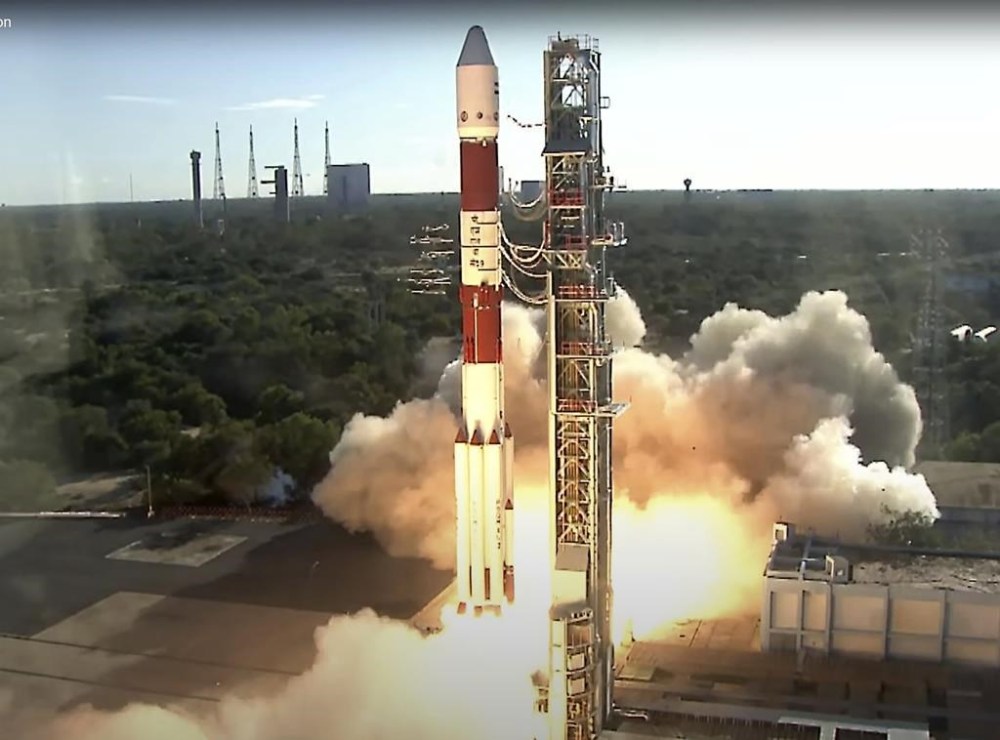
This image taken from video provided by the European Space Agency shows the launching of a rocket from the Satish Dhawan Space Centre in Sriharikota, India on Thursday, Dec. 5, 2024. A pair of European satellites rocketed into orbit Thursday on the first mission to create artificial solar eclipses through fancy formation flying in space. (European Space Agency via AP)

Zender said eclipses will be created at least twice a week, with six hours of totality each time for corona observations. The frequency will depend on solar activity, he noted, and prove a boon for scientists who now must travel across the world for a mere three to five minutes of totality during the occasional eclipse.

The $210 million mission, dubbed Proba-3, is aiming for at least 1,000 hours of “on demand” totality during its two-year operation. Once their job is done, both satellites will gradually drop lower until they burn up in the atmosphere, likely within five years.

Liftoff was delayed a day by a last-minute issue with the backup propulsion system of one of the satellites, crucial for precision formation flying. The European Space Agency said engineers relied on a computer software fix.

___

The Associated Press Health and Science Department receives support from the Howard Hughes Medical Institute’s Science and Educational Media Group. The AP is solely responsible for all content.

Report Error Submit a Tip

More Stories

Gilbert Plains Country Club closes for remainder of season due to flood damage

Ken Wiebe 6 minute read Preview

Gilbert Plains Country Club closes for remainder of season due to flood damage

Ken Wiebe 6 minute read 5:50 PM CDT

Scott McCallum has made the trek to the Gilbert Plains Country Club clubhouse countless times.

But this was the first time the golf professional and general manager of the course required hip waders to get to his office.

Walking hand in hand with his wife Lindsay, McCallum didn’t need much time to see the devastation caused by the flash flooding in the Parkland region in late June.

“We’re on a river and it’s a beautiful golf course, but anytime you’re on a body of water you know that you’re taking a chance of events like this happening,” McCallum said in a telephone interview. “To this magnitude, we’ve never seen anything like it before. So, this is new to us.

Read
5:50 PM CDT

Asian supermarket T&T to open at Polo Park

Gabrielle Piché 5 minute read Preview

Asian supermarket T&T to open at Polo Park

Gabrielle Piché 5 minute read Updated: 4:30 PM CDT

Live seafood, more than 150 varieties of baked bread and rows of Asian produce are being promised for CF Polo Park — in two years time.

Read
Updated: 4:30 PM CDT

Canad Inns puts Portage Avenue hotel, MET, office building ‘connected campus’ up for sale

Gabrielle Piché 4 minute read Preview

Canad Inns puts Portage Avenue hotel, MET, office building ‘connected campus’ up for sale

Gabrielle Piché 4 minute read Yesterday at 5:57 PM CDT

Downtown entrepreneurs are watching with wary eyes as a prominent hotel and event centre hits the market.

Read
Yesterday at 5:57 PM CDT

City puts Osborne Village lot up for sale third time

Joyanne Pursaga 5 minute read Preview

City puts Osborne Village lot up for sale third time

Joyanne Pursaga 5 minute read 4:57 PM CDT

The city is making a third attempt to sell a seemingly prime Osborne Street property, after an offer for the surface parking lot fell through earlier this year.

The 772-square-metre space at 145 Osborne St., which formerly operated as an official paid city parking lot, has been posted for sale once again.

It may puzzle some Winnipeggers to see the site in the heart of Osborne Village remain empty so long after the city declared it surplus in 2020.

However, a few different challenges may limit its appeal to potential buyers, alocal real estate agent said.

Read
4:57 PM CDT

Letters, Aug. 6

7 minute read Updated: 12:23 PM CDT

As the former senior vice-president and chief financial officer for Manitoba Hydro, I cringe whenever I see negative references in the media and elsewhere regarding Manitoba Hydro’s long-term debt.

Transit driver stabbed with syringe by passenger

Tyler Searle 3 minute read Preview

Transit driver stabbed with syringe by passenger

Tyler Searle 3 minute read Updated: Yesterday at 9:16 PM CDT

A Winnipeg Transit driver is recovering in hospital after a passenger stabbed him in the leg with a syringe while riding the bus early Wednesday, the Amalgamated Transit Union says.

The union said the incident occurred shortly before 1 a.m. while the operator was stopped in the northbound lanes of Isabel Street, near William Avenue. A female passenger reached around the driver’s safety shield and stabbed the driver twice before getting off the bus.

The driver was taken to the Seven Oaks Hospital in stable condition, where he is undergoing treatment and further testing, union president James Van Gerwen said in an interview.

“We spoke to the member. He is doing OK, but he is still in the hospital and he is scared — as anybody would be,” Van Gerwen said.

Read
Updated: Yesterday at 9:16 PM CDT