A 40-year-old Christian commune faces an uncertain future
Advertisement
Read this article for free:
or
Already have an account? Log in here »
To continue reading, please subscribe:

Digital Subscription
One year of digital access for only $205*
- Enjoy unlimited reading on winnipegfreepress.com
- Read the E-Edition, our digital replica newspaper
- Access News Break, our award-winning app
- Play interactive puzzles
*First annual payment billed as $205.00 + GST for one year. This annual subscription will automatically renew at $233.00 + GST every 52 weeks (10% off the regular annual price of $259.35). Offer available to new and qualified returning subscribers only. Cancel any time.
To continue reading, please subscribe:
Add Free Press access to your Brandon Sun subscription for only an additional
$1 for the first 4 weeks*
- Enjoy unlimited reading on winnipegfreepress.com
- Read the E-Edition, our digital replica newspaper
- Access News Break, our award-winning app
- Play interactive puzzles
*Your next Brandon Sun subscription payment will increase by $1.00 and you will be charged $17.95 plus GST for four weeks. After four weeks, your payment will increase to $24.95 plus GST every four weeks.
Read unlimited articles for free today:
or
Already have an account? Log in here »
Hey there, time traveller!
This article was published 06/12/2024 (646 days ago), so information in it may no longer be current.
HARDWICK, Mass. (RNS) — As fall shifts into winter in Hardwick, Massachusetts, temperatures are unseasonably high for November, and a 34-acre community built by a homesteading couple nearly four decades ago stands remarkably quiet.
“I’m finding it’s okay for me to say, well maybe this will not thrive,” Suzanne Shanley, co-founder of the Catholic residential Agape community, said. “It’s really left in the hands of God eventually, whatever that might mean.”
Lifelong teachers and peace activists, Catholics Suzanne and Brayton Shanley, age 79 and 77, have been on this land in central Massachusetts since 1987, when they cleared dense, rural New England forest to construct the buildings that would house an intentional lay community, anchored in the principles of nonviolence and sustainability. They named it Agape, inspired by the Greek word for selfless, unconditional love.
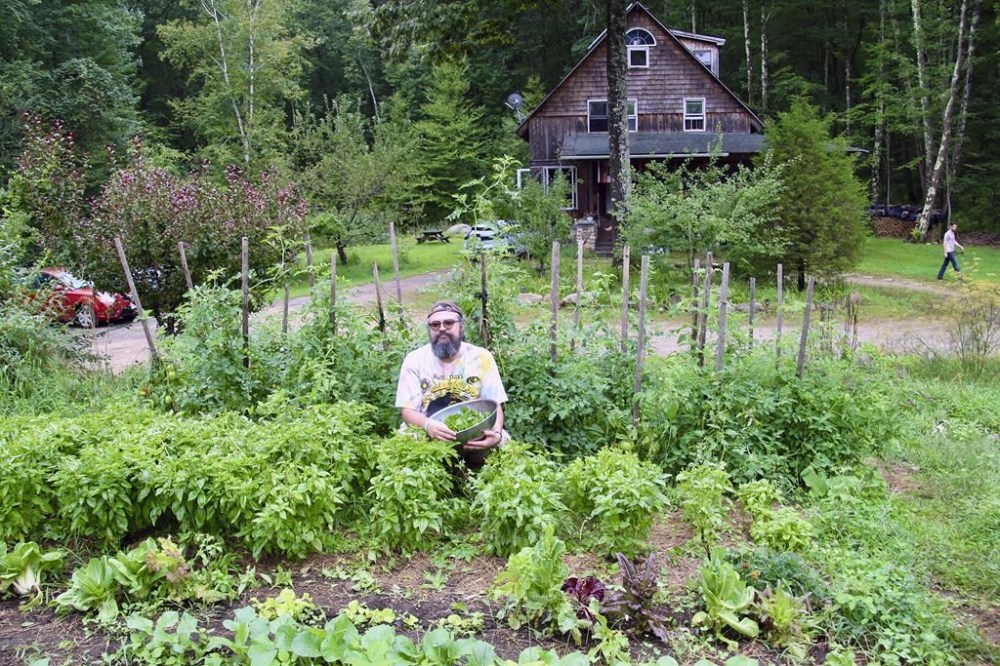
“I was a child of God, all for Jesus through Gandhi with a smile,” Brayton said. “That is how it started out.”
___
This content is written and produced by Religion News Service and distributed by The Associated Press. RNS and AP partner on some religion news content. RNS is solely responsible for this story.
___
In the commune’s heyday, hundreds of volunteers and community members attended its annual events and work days, which entailed planting crops, chopping wood and helping prepare the land for the coming season. Centered on two sustainable houses, one large garden and a small hermitage, it has functioned as a combination lay monastery, retreat center and commune. Most of the food served at Agape, exclusively vegan, is grown on the land.
The largest community house, Francis House, has six bedrooms, a chapel, a kitchen, an office and a wood-burning fireplace. The other house, Brigid House, is insulated with straw bales and serves as the Shanleys’ residence.
“This is our small contribution to things like climate change, we hope. A little oasis here in the woods of Hardwick,” Suzanne said.
But since 2020, participation has dropped dramatically, leaving the elderly couple to manage the land on their own, and the Shanleys have begun to worry about Agape’s future. “We’re limping,” Brayton said. “We lost three colleges who don’t have a program with us anymore. Volunteering is down overall.”
Stonehill College and the College of the Holy Cross, Catholic colleges a short drive away, used to send student volunteers to Agape through their campus ministry programs but no longer do so.
Volunteer retreats to the commune have typically involved up to 20 participants, including campus ministries, WWOOF (World Wide Opportunities on Organic Farms) volunteers who work on organic farms in exchange for food and lodging, or rural immersion groups that stay for days or weeks at a time.
Many longtime visitors still attend its annual interfaith Francis Day celebration. In the past, the event has attracted prominent speakers such as peace activist Arun Gandhi, grandson of Mahatma Gandhi, and Victor Lewis, a speech writer for the Rev. Martin Luther King Jr.
Their homestead relies on a combination of donations and revenue from retreat programs. Volunteers help with essential tasks to keep the commune running, such as planting and harvesting food, preserving produce and chopping firewood for heat through the winter.
In past summers, up to six volunteers have resided at Agape to perform this labor. This year, only one volunteer stayed to help.
In the 1960s and 1970s, thousands of intentional communities cropped up across the U.S. embracing sustainability, collective living and personal transformation. In most cases, participation was free or in exchange for work, reflecting the communities’ ideals of rebellion against materialism.
Timothy Miller, a scholar of religious studies at the University of Kansas, said while these communities flourished in the mid-20th century, urban and rural, many have seen significant membership declines. “Communes have to attract new members to stay alive, and it’s pretty clear that most communally minded young adults prefer to start new communities rather than join established ones,” he said. “Agape’s not alone in seeing changes.”
Suzanne said that she had hoped that by this stage in her life, Agape would be populated with other homesteaders and peace-minded individuals.
“It wasn’t a stated goal, but we were always saying to people, come and join,” Suzanne said. “A real lingering question in my mind is, will this kind of community be relevant to the younger generation?”
The Shanleys are looking at members of the community for guidance. Jim Robinson, 34, a lecturer at Iona University who writes about the intersection of theology and ecology, said he felt an immediate calling to Agape when he first met Brayton and Suzanne at an academic conference at Harvard Divinity School in 2016.
“I was struck by a sense that they were authentically living what I was thinking about,” Robinson said. “They were living a form of Catholicism that is oriented toward care for creation and radical resistance to systems of violence.”
For eight years, Robinson has remained a consistent visitor, often volunteering on the community’s mission council, which helps guide Agape’s operations.
Robinson does not, however, feel called to stay at the commune long term. “I like being involved in multiple communities,” Robinson said. “I think there will be a lot of people who have a stance similar to mine.”
Some long-time visitors to Agape say the challenge lies in stepping into the considerable legacy of Brayton and Suzanne.
“One of the dangers of strong leadership is replacement,” Skip Schiel, an activist and photographer who helped Brayton survey the land for Agape nearly 50 years ago, said. “Brayton and Suzanne are unique people.”
Before retreating to the quiet woods of rural Massachusetts, the Shanleys lived in a once-condemned two-bedroom house they bought in working-class Brockton, Massachusetts, not far from Agape. They took in vulnerable people while working as part-time lecturers of peace and nonviolence at Catholic high schools around the state.
Over the years, they have gone head-to-head with the IRS, refusing to pay taxes to protest war. (The Shanleys purposely live below the federal taxable income threshold of $20,000 per year, as a commitment to resisting the use of tax dollars for military funding.) Through a connection with Mother Teresa, they helped move a man off death row.
At Agape, they have sheltered victims of war and the criminal justice system, held retreats for Muslim communities after 9/11, built a vegetable oil-powered vehicle and constructed composting toilets. In 2016, they traveled to Standing Rock, South Dakota, to join the protest against the proposed oil pipeline there. They continue to host vigils in a town near Agape for the people who have died in Palestine since Oct. 7, 2023.
Agape has maintained relationships with nearby intentional communities for many years, such as the Sirius Community, an eco-village and retreat center in Shutesbury, and Noonday Farm, a Catholic Worker-affiliated organic farm in Winchendon. At Sirius, founded in 1978, members can rent homes or stay in the main house for internship programs or as full-time residents.
“I think I grew into understanding the importance of being a peacemaker, and Suzanne and Brayton have been important mentors for me,” Jeanelle Wheeler, a 28-year-old educator and lifelong Agape member, said.
Wheeler, who said she has been visiting Agape since she was a baby, serves on the group’s mission council. She doesn’t plan to move to Agape because she teaches at Montclair State University, a four-hour drive away in New Jersey, but she has hope for the community, suspecting Agape and spaces like it will become vital as young people face a world marked by climate change, war and social instability.

“There’s a yearning for spaces like Agape that I feel from my friends, and I think there’s a spiritual yearning among them, too,” Wheeler said.
For Brayton and Suzanne, the search continues for volunteers and what they refer to as “transition people”—individuals who can step in and enable the couple to take on a less hands-on role.
“I feel that I’ve been true to a vision that really captivated me and still does,” Suzanne said. “I just hope for enough physical strength and endurance to live to see something new emerge.”
___
This article was produced as part of the RNS/Interfaith America Religion Journalism Fellowship.
The Free Press acknowledges the financial support it receives from members of the city’s faith community, which makes our coverage of religion possible.