An underground detector in China will sniff out mysterious ghost particles called neutrinos
Advertisement
Read this article for free:
or
Already have an account? Log in here »
To continue reading, please subscribe:

Digital Subscription
One year of digital access for only $205*
- Enjoy unlimited reading on winnipegfreepress.com
- Read the E-Edition, our digital replica newspaper
- Access News Break, our award-winning app
- Play interactive puzzles
*First annual payment billed as $205.00 + GST for one year. This annual subscription will automatically renew at $233.00 + GST every 52 weeks (10% off the regular annual price of $259.35). Offer available to new and qualified returning subscribers only. Cancel any time.
To continue reading, please subscribe:
Add Free Press access to your Brandon Sun subscription for only an additional
$1 for the first 4 weeks*
- Enjoy unlimited reading on winnipegfreepress.com
- Read the E-Edition, our digital replica newspaper
- Access News Break, our award-winning app
- Play interactive puzzles
*Your next Brandon Sun subscription payment will increase by $1.00 and you will be charged $17.95 plus GST for four weeks. After four weeks, your payment will increase to $24.95 plus GST every four weeks.
Read unlimited articles for free today:
or
Already have an account? Log in here »
Hey there, time traveller!
This article was published 17/12/2024 (634 days ago), so information in it may no longer be current.
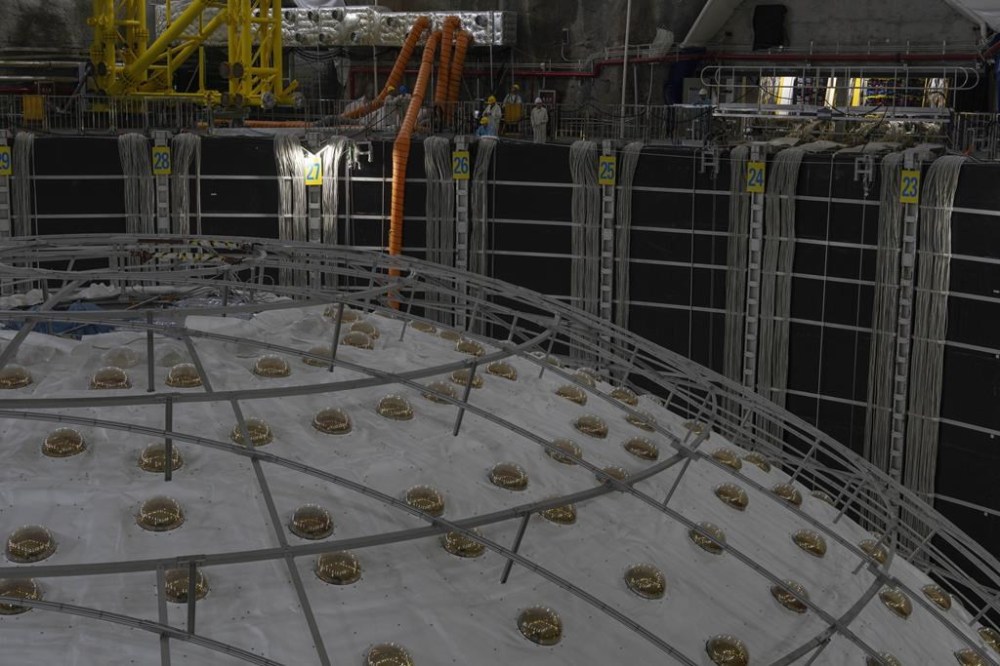
KAIPING, China (AP) — Underneath a granite hill in southern China, a massive detector is nearly complete that will sniff out the mysterious ghost particles lurking around us.
The Jiangmen Underground Neutrino Observatory will soon begin the difficult task of spotting neutrinos: tiny cosmic particles with a mind-bogglingly small mass.
The detector is one of three being built across the globe to study these elusive ghost particles in the finest detail yet. The other two, based in the United States and Japan, are still under construction.
Spying neutrinos is no small feat in the quest to understand how the universe came to be. The Chinese effort, set to go online next year, will push the technology to new limits, said Andre de Gouvea, a theoretical physicist at Northwestern University who is not involved with the project.
“If they can pull that off,” he said, “it would be amazing.”
What are neutrinos?
Neutrinos date back to the Big Bang, and trillions zoom through our bodies every second. They spew from stars like the sun and stream out when atomic bits collide in a particle accelerator.
Scientists have known about the existence of neutrinos for almost a century, but they’re still in the early stages of figuring out what the particles really are.
“It’s the least understood particle in our world,” said Cao Jun, who helps manage the detector known as JUNO. “That’s why we need to study it.”
There’s no way to spot the tiny neutrinos whizzing around on their own. Instead, scientists measure what happens when they collide with other bits of matter, producing flashes of light or charged particles.
Neutrinos bump into other particles only very rarely, so to up their chances of catching a collision, physicists have to think big.
“The solution for how we measure these neutrinos is to build very, very big detectors,” de Gouvea said.
A big detector to measure tiny particles
The $300 million detector in Kaiping, China, took over nine years to build. Its location 2,297 feet (700 meters) underground protects from pesky cosmic rays and radiation that could throw off its neutrino-sniffing abilities.
On Wednesday, workers began the final step in construction. Eventually, they’ll fill the orb-shaped detector with a liquid designed to emit light when neutrinos pass through and submerge the whole thing in purified water.
It’ll study antineutrinos — an opposite to neutrinos which allow scientists to understand their behavior — produced from collisions inside two nuclear power plants located over 31 miles (50 kilometers) away. When the antineutrinos come into contact with particles inside the detector, they’ll produce a flash of light.
The detector is specially designed to answer a key question about a longstanding mystery. Neutrinos switch between three flavors as they zip through space, and scientists want to rank them from lightest to heaviest.
Sensing these subtle shifts in the already evasive particles will be a challenge, said Kate Scholberg, a physicist at Duke University who is not involved with the project.
“It’s actually a very daring thing to even go after it,” she said.
China’s detector is set to operate during the second half of next year. After that, it’ll take some time to collect and analyze the data — so scientists will have to keep waiting to fully unearth the secret lives of neutrinos.
Two similar neutrino detectors – Japan’s Hyper-Kamiokande and the Deep Underground Neutrino Experiment based in the United States – are under construction. They’re set to go online around 2027 and 2031 and will cross-check the China detector’s results using different approaches.
“In the end, we have a better understanding of the nature of physics,” said Wang Yifang, chief scientist and project manager of the Chinese effort.
Understanding how the universe formed
Though neutrinos barely interact with other particles, they’ve been around since the dawn of time. Studying these Big Bang relics can clue scientists into how the universe evolved and expanded billions of years ago.
“They’re part of the big picture,” Scholberg said.
One question researchers hope neutrinos can help answer is why the universe is overwhelmingly made up of matter with its opposing counterpart — called antimatter — largely snuffed out.
Scientists don’t know how things got to be so out of balance, but they think neutrinos could have helped write the earliest rules of matter.

The proof, scientists say, may lie in the particles. They’ll have to catch them to find out.
___
AP video producer Olivia Zhang contributed to this report. Ramakrishnan reported from New York.
___
The Associated Press Health and Science Department receives support from the Howard Hughes Medical Institute’s Science and Educational Media Group. The AP is solely responsible for all content.