Climate-friendly electricity sees big battery projects soar again for 2024
Advertisement
Read this article for free:
or
Already have an account? Log in here »
To continue reading, please subscribe:

Digital Subscription
One year of digital access for only $205*
- Enjoy unlimited reading on winnipegfreepress.com
- Read the E-Edition, our digital replica newspaper
- Access News Break, our award-winning app
- Play interactive puzzles
*First annual payment billed as $205.00 + GST for one year. This annual subscription will automatically renew at $233.00 + GST every 52 weeks (10% off the regular annual price of $259.35). Offer available to new and qualified returning subscribers only. Cancel any time.
To continue reading, please subscribe:
Add Free Press access to your Brandon Sun subscription for only an additional
$1 for the first 4 weeks*
- Enjoy unlimited reading on winnipegfreepress.com
- Read the E-Edition, our digital replica newspaper
- Access News Break, our award-winning app
- Play interactive puzzles
*Your next Brandon Sun subscription payment will increase by $1.00 and you will be charged $17.95 plus GST for four weeks. After four weeks, your payment will increase to $24.95 plus GST every four weeks.
Read unlimited articles for free today:
or
Already have an account? Log in here »
Hey there, time traveller!
This article was published 27/12/2024 (621 days ago), so information in it may no longer be current.
2024 was another banner year for a source of electricity that is better for people’s lungs, better for climate change and may be reaching your home when you turn on the lights or turn up the thermostat — large banks of batteries.
This ability to store large amounts of electricity in batteries was essentially nonexistent a decade ago, but the country had about 24 gigawatt-hours operating as of the end of November, up a whopping 71% over the same date in 2023.
This is welcome news to clean energy advocates including Dariella Rodriguez. She has seen what happens on days when demand for air conditioning or heating spikes and extra power plants fueled by natural gas, located in Port Morris and Mott Haven, fire up not far from where she works in Hunts Point in the South Bronx, New York.
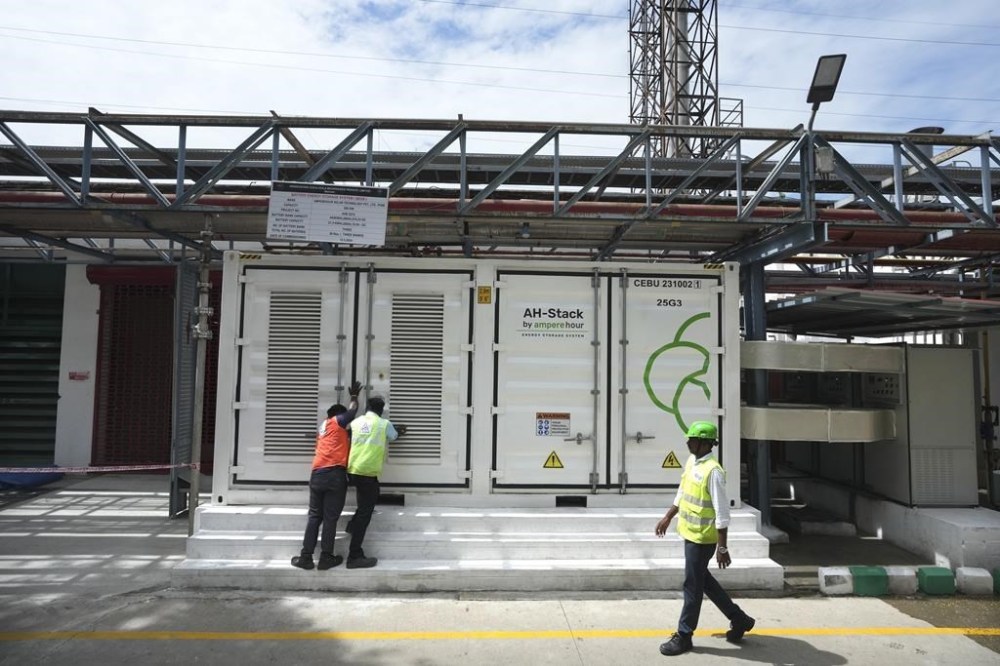
Batteries can jolt into service, sending electricity onto overhead wires, instead of these dirty “peaker” plants. Rodriguez hasn’t seen that transition yet, but she hopes to.
“The people that are exposed to these plants are the most vulnerable people in environmental justice communities already,” said Rodriguez, a director at THE POINT Community Development Corporation there, noting that lower-income people and communities of color often live near peakers.
The nation’s 1,000 peaker plants can be very dirty, inefficient and expensive, according to an analysis by the U.S. Government Accountability Office, a watchdog group that works for the U.S. Congress. Some 63 million people are estimated to live within a three-mile radius of one.
Although peakers run only a small part of the time, they release more harmful nitrogen oxides and sulfur dioxide per unit of energy, the agency said. Those two pollutants cause asthma and other breathing problems.
Peakers also release more greenhouse gases than other power plants do per unit of electricity.
Batteries are “a really obvious solution” to reducing need for peakers, says Daniel Chu, senior energy planner for the New York City Environmental Justice Alliance.
Storing extra power in batteries also extends the hours of the day that you can use clean energy.
“It’s not always sunny, the wind’s not always blowing, but energy storage can help move that generation to when it’s most needed,” said Tim Fox, managing director at research firm ClearView Energy Partners.
That’s why at least half of battery storage facilities in the U.S. are co-located with, or in some other way support solar, an AP analysis of Energy Information Administration data shows. The amount of solar energy in the U.S. is growing and surpassed the 100-gigawatt mark this year.
Another way that the addition of these batteries is helpful to the American electrical grid and grids around the world is that forecasting is getting more difficult.
“With weather patterns changing, the old ways of essentially figuring out how much capacity you need on the grid for extreme events just doesn’t work,” said Oliver Garnett, director of energy services product at the technology company Fermata Energy.
Last, global electricity demand is slated to increase — by about one-third to three-quarters by 2050, according to the Energy Information Administration. Data centers for artificial intelligence, switching vehicles to electricity and population growth are all contributing.
“‘Do we have enough power plants?’ is the classic question every utility asks every year,” said Mike Jacobs, senior energy analyst at the science nonprofit Union of Concerned Scientists. “The beauty of the batteries is that if there’s energy in them, they can be used for unexpected needs.”
Otherwise, if utilities have to find more power generation, they may keep investing in plants that burn gas or coal and account for one-quarter of the nation’s greenhouse gas emissions, instead of retiring them.
Leading the charge for adding new batteries to the grid this year was California with more than 11 gigawatt-hours operating. One way to think about this is roughly the amount of electricity that a nuclear power plant would put out over 11 hours. Then the batteries would need to be recharged to do the same thing again. It’s a limited, but meaningful amount of power. In Texas, 6 gigawatt-hours were online. Arizona saw nearly 2 gigawatt-hours humming and Nevada — the fourth-largest deployer of storage in the U.S. — had 1.1 gigawatt-hours operational.
Some regions are lagging
Yet many states aren’t using storage yet. As of November, 86% of large-scale battery storage in the U.S. was operating in just those four states.
Some states haven’t set targets telling utilities to go out and build or buy energy storage on their own. Only 18 states have 50 megawatt-hours or more operating.
Others don’t have as much clean electricity to pair with the batteries, or claim storage isn’t reliable in times of crisis. It can also be challenging to connect storage to the grid. Still, experts expect more momentum.
Especially in California and Texas, “That investment and that experiment is paying off very well,” said John Hensley, senior vice president of markets and policy analysis at American Clean Power.
“The word is getting out,” he said. “We’re increasingly seeing the technology move to other parts of the country.”
___
Alexa St. John is an Associated Press climate solutions reporter. Follow her on X: @alexa_stjohn. Reach her at ast.john@ap.org.
___
Read more of AP’s climate coverage at http://www.apnews.com/climate-and-environment
___
The Associated Press’ climate and environmental coverage receives financial support from multiple private foundations. AP is solely responsible for all content. Find AP’s standards for working with philanthropies, a list of supporters and funded coverage areas at AP.org.