
‘Tinder of construction’ aims to keep B.C. building waste out of landfills

Advertisement

Advertise with us

COBBLE HILL, B.C. - Gil Yaron barely contains his excitement when asked to describe his non-profit venture to convince construction companies, developers and renovation contractors to recycle tonnes of building material waste on Vancouver Island.

Read this article for free:


or

Already have an account? Log in here »

To continue reading, please subscribe:

Subscribe and receive a limited-edition Free Press branded hat or tote.

Digital Subscription

One year of digital access for only $205*

  • Enjoy unlimited reading on winnipegfreepress.com
  • Read the E-Edition, our digital replica newspaper
  • Access News Break, our award-winning app
  • Play interactive puzzles

*First annual payment billed as $205.00 + GST for one year. This annual subscription will automatically renew at $233.00 + GST every 52 weeks (10% off the regular annual price of $259.35). Offer available to new and qualified returning subscribers only. Cancel any time.

To continue reading, please subscribe:

Add Free Press access to your Brandon Sun subscription for only an additional

$1 for the first 4 weeks*

  • Enjoy unlimited reading on winnipegfreepress.com
  • Read the E-Edition, our digital replica newspaper
  • Access News Break, our award-winning app
  • Play interactive puzzles
Start now

*Your next Brandon Sun subscription payment will increase by $1.00 and you will be charged $17.95 plus GST for four weeks. After four weeks, your payment will increase to $24.95 plus GST every four weeks.

Hey there, time traveller!
This article was published 30/12/2024 (652 days ago), so information in it may no longer be current.

COBBLE HILL, B.C. – Gil Yaron barely contains his excitement when asked to describe his non-profit venture to convince construction companies, developers and renovation contractors to recycle tonnes of building material waste on Vancouver Island.

“We’re the Tinder of the construction sector,” he said, chuckling at the reference to the online dating application. “We’re the matchmaker.”

Yaron said it’s not a sexy topic, enticing construction companies to keep waste materials on their projects from being sent to landfills, but he’s looking to build relationships that benefit developers and the environment.
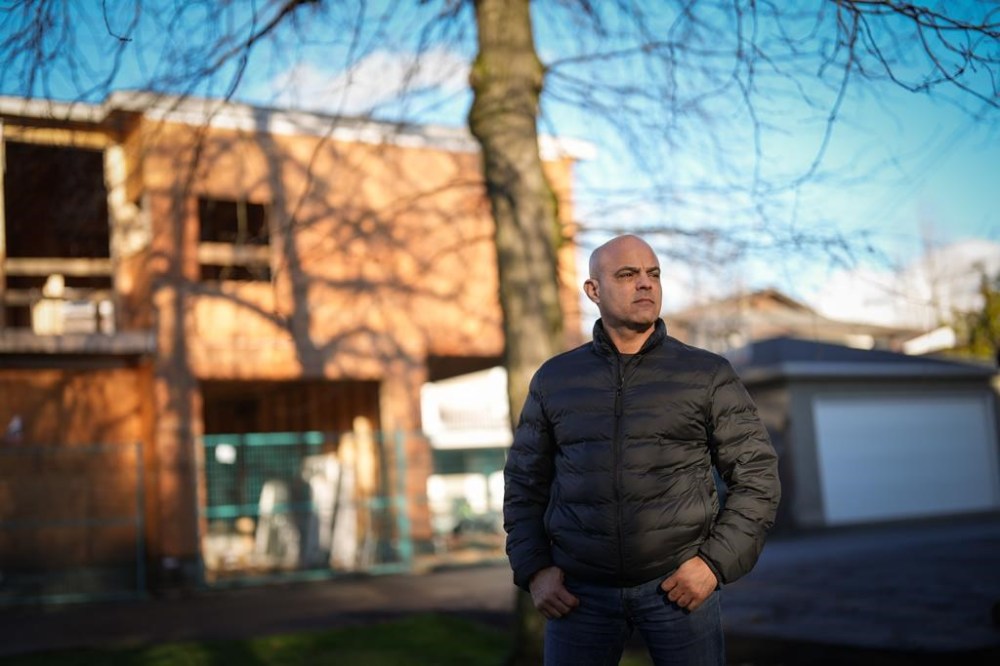
Gil Yaron, managing director of circular innovation at Light House, poses for a photograph in Vancouver, on Wednesday, December 18, 2024. The Vancouver-based non-profit launched the Building Material Exchange (BMEx) in November, aimed at getting the word out to the construction and development community that their excess or salvaged construction materials have value. THE CANADIAN PRESS/Darryl Dyck

“It’s trying to connect companies directly. It’s trying to create those relationships,” he said.

Recently, more than 150 development industry leaders, including those in contracting, manufacturing, demolition, deconstruction and waste management, gathered in Nanaimo and Victoria to nail down partnerships to keep waste materials in circulation and out of the dump.

The launch in November of the Building Material Exchange, abbreviated to BMEx, aims at getting the word out to the construction and development community that their project leftovers have value, said Yaron, the managing director of circulation innovation at Light House, the Vancouver-based non-profit behind the exchange.

The unique in-Canada program, funded by regional districts in Nanaimo, Cowichan Valley, Victoria and the City of Nanaimo, is free to join, he said.

In early 2025, the project will launch an online BMEx Marketplace, which will become a business-to-business platform for the construction industry to list and exchange excess or salvaged construction materials, said Yaron.

“We want to create a formal program that makes it easy for companies to exchange these materials,” he said. “Right now, materials are increasing in costs and the less efficient you are, the more you are spending on materials, and tipping fees at landfills are also going up, so the higher your waste management costs are going to be on projects.”

The BMEx pitch is twofold, said Yaron.

Recycling construction materials rather than sending them to landfills saves money, while participating in the program can elevate and showcase the business as a supporter of environmental and sustainable practices, he said.

“They can get value from doing a good thing,” Yaron said.

Vancouver Island homebuilder Noah Topp said the data show benefits are both economic and environmental.

Reducing construction waste and emissions are priorities for Nexus Modular Solutions, a Cobble Hill company, located about 50 kilometres north of Victoria, that builds complete homes at an indoor warehouse facility, said Topp, who’s the business development manager at Nexus.

An average 2,000-square-foot home will create 17,460 kilograms of construction waste, but by building indoors, reducing timelines and using local suppliers to limit transportation emissions, waste is cut to 2,080 kilograms on a Nexus project, Topp said.

Total greenhouse gas emissions from a 2,000-square-foot Nexus home amounts to about 0.59 tonne, while for a traditional home build of the same size produces 7.80 tonnes of GHGs, he said.

“I think this is something that can get really big,” said Topp in an interview inside the living room of one of his modular show homes. “The construction industry — and I’m hesitant to use the word egregious — but it’s a pretty big contributor to landfill waste.”

He said local artisans are using leftover wood and metal from Nexus housing builds to produce art and unique functional products, including putting together outdoor neighbourhood libraries from unused end cuts of wood.

“There’s so much potential for that symbiotic relationship between companies,” Topp said. “One company can be both a supplier and a receiver of materials.”

Yaron said up to one-third of landfill waste is connected to the construction industry.

The BMEx project has the backing of Habitat for Humanity, said Jeff Krafta, the global non-profit housing organization’s mid-Island executive director in Nanaimo, about 110 kilometres north of Victoria.

Habitat for Humanity, which operates a largely volunteer-operated store that sells and accepts donations of home products, plans to transform an empty lot on its property to a location where developers and builders can leave their waste products or pick up needed items, he said.

“What we’re proposing right now is, through the Building Material Exchange program using some of our space here as a hub for builders, developers, people in the construction industry,” said Krafta. “There’s been lots of excitement, lots of buy in.”

Habitat for Humanity is still working on details that will allow the non-profit to issue tax receipts to companies for the construction waste, he said.

“What is going to make it unique is it’s the first official partnership and program officially designed for builders to have a direct line of sight to a place to deliver their overages and waste,” Krafta said.

“We’ll take lumber, plywood. We’ll take siding, cladding, sheathing, sheeting, that kind of stuff. Insulation, we’ll take. We’ll take windows, doors. When we have more space, masonry, cement blocks.”

Construction companies are always looking for ways to cut costs, but many owners are also concerned about their environmental footprint, and finding ways to reduce costs and limit pollution will be the selling points of the exchange program, he said.

“Getting rid of wires, fixtures and insulation, even pulling out fibreglass insulation and putting it off to the side, as long as it doesn’t get wet, we can package it up and it will be gone in a day here,” said Krafta.

This report by The Canadian Press was first published Dec. 30, 2024.

Report Error Submit a Tip

More Stories

Piece of magic history disappears

Kelly-Anne Riess 5 minute read Preview

Piece of magic history disappears

Kelly-Anne Riess 5 minute read Updated: Yesterday at 4:15 PM CDT

A piece of Winnipeg’s magic history has vanished, and internationally renowned escape artist Dean Gunnarson is offering a $500 reward to anyone who can make it reappear.

The plaque marked the birthplace of what has become the world’s largest organization of professional and amateur magicians, the International Brotherhood of Magicians, which was founded in Winnipeg more than a century ago.

Gunnarson said fellow magician and local magic historian Bruce Thompson discovered the disappearance Tuesday while on his way to work.

Thompson returned to inspect the site and found what appeared to be evidence it had been forcibly removed.

Read
Updated: Yesterday at 4:15 PM CDT

Free Press columnist transforms into killer clown for escape-room adventure

Jen Zoratti 6 minute read Preview

Free Press columnist transforms into killer clown for escape-room adventure

Jen Zoratti 6 minute read Yesterday at 9:43 PM CDT

‘Would you ever try being a killer clown?”

This question came to me from my friend Lisa McMillan who, with her husband Chris, owns Killer Noob Escapes on Century Street. The escape rooms at KNE are immersive and narrative-driven and, oh yeah, horror-themed.

This seems like a good time to mention I don’t do horror. I hate clowns — who doesn’t? — and I don’t like being startled. I don’t visit haunted houses, mostly for the safety of others. My fight-or-flight reflex sometimes skews more fight, and I worry I’m a Fear Puncher.

But being on the other side of things? That, maybe, I could do. So I accepted Lisa’s challenge.

Read
Yesterday at 9:43 PM CDT

Collaros turns back the clock in crucial win over Stamps

Taylor Allen 7 minute read Preview

Collaros turns back the clock in crucial win over Stamps

Taylor Allen 7 minute read Sunday, Oct. 11, 2026

It was around this time seven years ago that the Winnipeg Blue Bombers officially became Zach Collaros’s team.

Making his first start in blue and gold after being acquired via trade, Collaros ran backwards to escape a collapsing pocket before rolling to his right and firing a perfect pass to Darvin Adams in the back corner of the south end zone during a home game against the Calgary Stampeders.

The play marked the beginning of the Collaros era in Winnipeg.

And a similar play Saturday night, once again against the Stampeders, served as a reminder that the 38-year-old pivot isn’t done just yet.

Read
Sunday, Oct. 11, 2026

Hurricane Simon pounds resorts and vulnerable towns along Mexico’s Pacific coast

Fernando Llano And Martin Silva, The Associated Press 5 minute read Preview

Hurricane Simon pounds resorts and vulnerable towns along Mexico’s Pacific coast

Fernando Llano And Martin Silva, The Associated Press 5 minute read Updated: Yesterday at 2:38 AM CDT

PUERTO VALLARTA, Mexico (AP) — Hurricane Simon pounded Mexico’s Pacific coast as a Category 3 storm on Sunday, its eye remaining just offshore as its most powerful winds and rain slammed people living between the Sierra Madre and the ocean.

The hurricane's center swirled parallel to the coast, closing in on the Puerto Vallarta area, where its most damaging winds and rain were expected to hit around midnight and continue through Monday morning. Its maximum sustained winds weakened late Sunday to 115 mph (185 kph), according to the U.S. National Hurricane Center in Miami, but it was still expected to remain a dangerous hurricane.

That’s not good news for people in and around Puerto Vallarta, a popular tourist destination in the state of Jalisco. Just inland and uphill from the resort areas, many Mexicans live in communities where housing might not stand up to the storm.

By late Sunday, Simon's eye was moving northwest about 45 miles (75 kilometers) south of Cabo Corrientes at about 5 mph (7 kph). A senior hurricane center specialist, Philippe Papin, said this westernmost tip of mainland Mexico is the area most likely to get a direct hit from the system. Cabo Corrientes is at the southern tip of Bahia de Banderas, the wide bay where Puerto Vallarta looks out to the Pacific.

Read
Updated: Yesterday at 2:38 AM CDT

Comparing the Iran and Vietnam Wars

Peter McKenna 5 minute read Preview

Comparing the Iran and Vietnam Wars

Peter McKenna 5 minute read 2:00 AM CDT

The other day I asked my students in U.S. foreign policy to think about the relevance of the Vietnam War in relation to the ongoing war in Iran. More specifically, I wanted them to identify the similarities and differences between the two wars.

What is immediately striking is how domestic politics played such a seminal role in both conflicts. While American public opinion was generally in favour of U.S. military involvement in Vietnam in the early years, things started to turn very sour after U.S. soldiers started arriving stateside in flag-draped coffins and body bags. As for Iran, just about every single poll and TV newscast since the first few weeks of the war have illustrated an overwhelming public repudiation of President Trump’s military adventurism.

The electoral implications were also quite apparent for the two wars. The U.S.-Iran War is clearly having a positive effect on the Democratic Party’s electability, as it looks set to capture both the House of Representatives and the Senate in the Nov. 3 midterm elections. Democratic President Lyndon Johnson, reading the political tea leaves from the Vietnam fallout, opted not to contest the 1968 U.S. presidential election.

Equally interesting, the U.S. press had a crucial, and mostly negative, impact on both the Vietnam and Iran conflicts. Who could forget Gen. William Westmoreland — the commander of U.S. forces in Vietnam (1964-1968) — maintaining that it was the media’s fault the U.S. lost the war in Vietnam. While I take issue with his thesis, I do believe the news coverage and visuals of the first televised war served to raise serious concerns about why the U.S. was at war in Southeast Asia.

Read
2:00 AM CDT

Israel and Palestine: 30 wasted years

Gwynne Dyer 5 minute read 2:00 AM CDT

Here is how the high command of the Israel Defence Forces (IDF) laid down the rules for “remotely” killing suspected Palestinian activists in the densely populated Gaza Strip after the surprise Hamas attack on Israel on Oct. 7, 2023.

Israeli forces were told that up to 20 Palestinian civilians could be killed in a strike against a single suspected member of Hamas, even one of the lowest rank and importance. For a more “senior” Hamas member, the permissible number of non-combatants who could be ‘accidentally’ killed in the process went up to 100.

The order went out only hours after the attack, when there were not yet any IDF troops on the ground in Gaza and all strikes had to be remote, but most strikes have remained remote right down to the present because using drones and artillery keeps Israeli casualties very low.

The drone operators or artillery gunners who delivered the high explosives did not choose the targets themselves. An AI system called Lavender did that, using a network of surveillance devices that generated tens of thousands of likely targets, some known by name, some just “acting suspiciously.” Human operators spent about 20 seconds confirming each one.

