Famous orca mother carrying body of another dead calf in act of grief: researchers

Advertisement

Advertise with us

A mother killer whale who famously pushed the body of her dead newborn for 17 days in 2018 has lost another calf, and researchers say she is again carrying the body in an apparent act of grief.

Read this article for free:


or

Already have an account? Log in here »

To continue reading, please subscribe:

Subscribe and receive a limited-edition Free Press branded hat or tote.

Digital Subscription

One year of digital access for only $205*

  • Enjoy unlimited reading on winnipegfreepress.com
  • Read the E-Edition, our digital replica newspaper
  • Access News Break, our award-winning app
  • Play interactive puzzles

*First annual payment billed as $205.00 + GST for one year. This annual subscription will automatically renew at $233.00 + GST every 52 weeks (10% off the regular annual price of $259.35). Offer available to new and qualified returning subscribers only. Cancel any time.

To continue reading, please subscribe:

Add Free Press access to your Brandon Sun subscription for only an additional

$1 for the first 4 weeks*

  • Enjoy unlimited reading on winnipegfreepress.com
  • Read the E-Edition, our digital replica newspaper
  • Access News Break, our award-winning app
  • Play interactive puzzles
Start now

*Your next Brandon Sun subscription payment will increase by $1.00 and you will be charged $17.95 plus GST for four weeks. After four weeks, your payment will increase to $24.95 plus GST every four weeks.

Hey there, time traveller!
This article was published 02/01/2025 (619 days ago), so information in it may no longer be current.

A mother killer whale who famously pushed the body of her dead newborn for 17 days in 2018 has lost another calf, and researchers say she is again carrying the body in an apparent act of grief.

The Center for Whale Research said in a New Year’s Day post on social media that the mother known as Tahlequah, or J35, has now lost two of her four documented calves.

The centre had announced on Dec. 21 that the new female calf was travelling with J pod in the Puget Sound area, on the northwest coast of Washington state. The pod also frequents British Columbia waters.
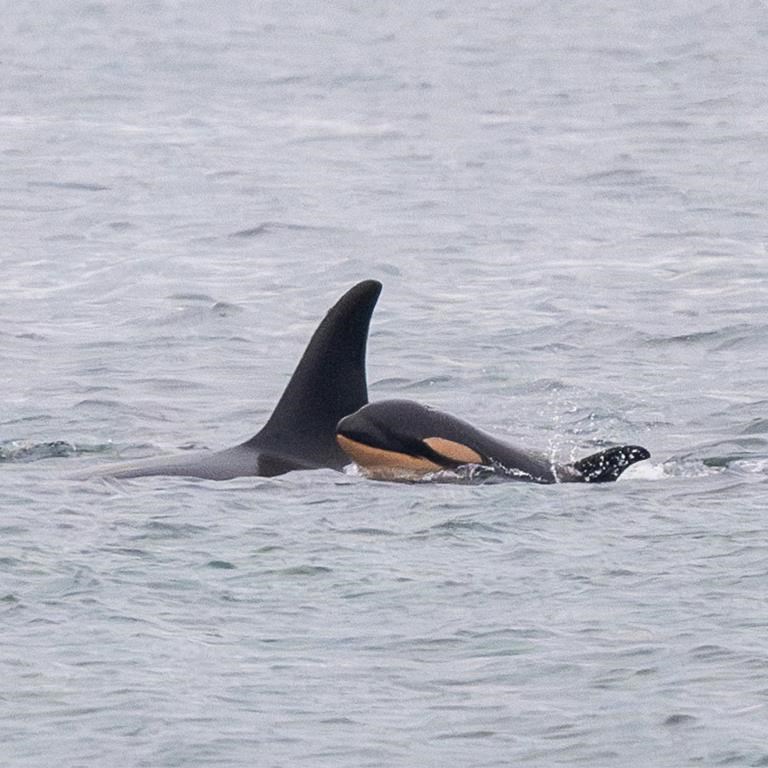
A killer whale calf is shown travelling with her mother, J35, also known as Tahlequah, in the Puget Sound area in this December 2024 handout photo. The Center for Whale Research announced on Jan. 1, 2025, that the calf had died, and its body was being carried by her mother. THE CANADIAN PRESS/HO-Center For Whale Research-Maya Sears **MANDATORY CREDIT**

But the organization expressed concern about the calf’s health, and on Wednesday said it had confirmed the calf had died, although a second newborn was also observed with the pod.

Brad Hanson, a research scientist with the National Oceanic and Atmospheric Administration’s Northwest Fisheries Science Center, told a news conference Thursday that researchers are not yet sure why the calf died, but a necropsy likely won’t be possible.

“Given that J35 is very attached to it, the likelihood of us being able to recover the calf is fairly low,” he said.

Hanson said researchers are concerned about Tahlequah’s welfare as she continues to carry the calf’s body, draped over the top of her head.

“That essentially results in a lot more drag, and so her energy expenditure is going to be fairly significant,” he said, noting it may also make foraging difficult during a time of year when fish availability is more limited.

“It is a concern that she was spending a lot of energy to try to take care of this calf that she has lost.”

But, he said, she is not lagging behind her pod.

“She’s still integrated as part of the group.”

The Center for Whale Research, based in Washington state, says the death of any calf among the endangered southern resident killer whale population is “a tremendous loss,” but the latest is “particularly devastating” because she was a female and because of J35’s history.

Michael Weiss, research director for the centre, told the news conference that other southern resident orcas have been observed carrying dead calves before, but not for weeks as J35 did in 2018.

“It’s usually been kind of one-off observations within a particular encounter, as opposed to multiple weeks,” he said.

Joe Gaydos, the science director for marine conservation program SeaDoc Society, said “it is fair to say that she is grieving, or mourning.”

“Over the last few years, we realized that we have the same neurotransmitters that they have,” he said of the whales. “I think it’s fair to say from a scientific perspective that they have the same hard wiring, (so) they’re going to have the same emotions.”

The research centre said the sex and mother of the other recent newborn calf have not yet been identified, but it appears “physically and behaviourally normal.”

Orcas along the West Coast are categorized into three families known as the J, K and L pods, each of which has its own dialect and calls that differ from the others.

Fisheries and Oceans Canada and Parks Canada, in consultation with Transport Canada and Environment and Climate Change Canada, completed an assessment of the southern resident population last year, finding the population had dwindled to 73, with only 23 breeding females.

The Center for Whale Research also said the population had dipped to 73 in its July 1, 2024, census following the death of two adult male orcas as well as the only whale born within the census period, a male calf. It said that as of July 1, 2024, J pod stood at 25 individuals, K pod at 15 and L pod at 33.

Misty MacDuffee, a conservation biologist with the Raincoast Conservation Foundation, said in an interview that she is always hopeful when she hears of a new calf being born, but noted southern residents have high pregnancy failure rates and their calves have high mortality rates.

She said those rates highlight the need to better protect the waning population. She cited recent research published in the journal Communications Earth & Environment in April that said “there is no possibility of recovery” for southern residents under existing conditions in their habitat.

MacDuffee said the whales face a variety of threats in the “increasingly industrialized” Salish Sea, including reduced numbers and quality of fish, pollutants that are flowing into their waterways and noise.

“We have so much information. We know exactly what’s threatening them, and yet they continue to decline because of lack (of) political will to address the hard issues that this population faces,” she said.

“We’re losing this potential for recovery. We’re losing the number of breeding females and their capacity to recover this population.”

This report by The Canadian Press was first published Jan. 2, 2025.
Report Error Submit a Tip

More Stories

Sunday-night auto aficionados work to steer away from unwelcome elements they say aren’t a part of their tradition

Zoe Pierce 12 minute read Preview

Sunday-night auto aficionados work to steer away from unwelcome elements they say aren’t a part of their tradition

Zoe Pierce 12 minute read Friday, Sep. 11, 2026

The red 1969 Dodge Coronet Super Bee out for a cruise on Portage Avenue draws admiring eyes from onlookers on a recent Sunday night, many of them seeing a specimen of the now-rare muscle car for the first time on a Winnipeg street. Or any other street, for that matter.

Longtime car enthusiast Bob Sudoma was behind the wheel, participating in the decades-old show-offy summer tradition.

The Sunday night cruise is built around a simple idea: proud car owners take their beloved vehicles for a spin to meet up with others of the same autophile ilk.

Less-fortunate appreciators, or just curious folks, also gather along the route to watch the highly-polished parade. Portage Avenue is one of cruise night’s best-known stretches.

Read
Friday, Sep. 11, 2026

The port of Churchill — but done right

Editorial 4 minute read Preview

The port of Churchill — but done right

Editorial 4 minute read Yesterday at 2:00 AM CDT

The seagoing grain carrier wasn’t christened with a champagne bottle. There was no confetti or streamers. Nevertheless, the Aug. 31 event marking the first shipment of grain to be loaded at the Port of Churchill since 2020 was celebrated like the launch of a brand new vessel.

The presence of the federal minister of northern and arctic affairs, provincial cabinet ministers and leaders and elders from several northern First Nations signalled that the fast-tracked process of refurbishing and buffing up Manitoba’s deep-water seaport gem is gaining momentum.

For OneNorth, the partnership of 29 First Nations and 12 northern communities which owns the Port of Churchill and the Hudson Bay Railway (both operated by the Arctic Gateway Group) the event heralded a new beginning. It’s been eight years since OneNorth purchased the port and railroad, and six years since grain was moved by rail through Manitoba and then by ship to European markets. Two more grain shipments, plus shipments of potash and critical minerals, will continue through the fall.

When Prime Minister Mark Carney solicited the premiers to suggest “nation-building” projects following his election in 2025, Premier Wab Kinew pitched a Manitoba trade corridor that would move wheat, critical minerals, potash and energy (oil or liquid natural gas) through the Port of Churchill.

Read
Yesterday at 2:00 AM CDT

Pokemon thieves clear out collectibles shop

Scott Billeck 5 minute read Preview

Pokemon thieves clear out collectibles shop

Scott Billeck 5 minute read Friday, Sep. 11, 2026

Terri Settle loved watching children walk into her collectibles shop to hunt for their favourite Pokemon cards.

After the latest break in stripped her shelves of much of the inventory, she’s not sure she’ll get to see it again.

Thieves broke into Terri’s Trinkets and Toys on Tuesday evening, punching through a grate and then the store’s bathroom wall to reach the storefront.

They made off with about $6,000 worth of merchandise, including all of the store’s Pokemon cards — about 7,000 of them — along with toys, Lego, jewelry, video games, a debit machine and personal laptop. They even took her vacuum cleaner.

Read
Friday, Sep. 11, 2026

Sex assault charges against basketball referee stayed

Dean Pritchard 3 minute read Preview

Sex assault charges against basketball referee stayed

Dean Pritchard 3 minute read Friday, Sep. 11, 2026

A Winnipeg basketball referee accused of sexual offences involving three men has had criminal charges against him stayed.

Michael Shane Maryk, 45, had been set to stand trial July 20 on five counts of sexual assault and two counts of committing an indecent act, but instead agreed to a one-year peace bond prohibiting him from having any contact with the three men.

Maryk was employed by the Manitoba Association of Basketball Officials at the time the offences were alleged to have occurred.

The peace bond requires that Maryk not come within 200 metres of the men’s homes, schools or places of worship and have no contact with their families.

Read
Friday, Sep. 11, 2026

Nifty neighbours also jonesing for geniality

Maureen Scurfield 4 minute read Yesterday at 2:01 AM CDT

DEAR MISS LONELYHEARTS: Recently, a new couple with no children moved onto our cul de sac, and everybody is taking notice! This attractive pair with no kids both drive amazing cars, work from home and leave their garage doors up a lot. Everybody on the street walks by to sneak a peek into the big garage at just about any time of day.

Lately, the man’s been out on his front lawn in a muscle shirt in the late afternoon, planting shrubs and putting up stylish fall-themed ornaments. At night they often leave the living-room curtains open. That makes for convenient viewing for curious neighbours like us!

A few days ago, my wife invited the new couple over for a barbecue and swim in our pool. They are really nice people, but mentioned that other people nearby have been pretty stand-offish. They wonder why. Should I tell them it’s probably just jealousy over their beautiful vehicles and enviable lifestyle, or should I just shut up?

—Wanting to Help, Sage Creek

Citizen reports help highlight connectivity issues across southwest Manitoba

Nicole Buffie 5 minute read Preview

Citizen reports help highlight connectivity issues across southwest Manitoba

Nicole Buffie 5 minute read Updated: Yesterday at 10:43 AM CDT

A southwestern Manitoba man has created a map to document cell service blackout spots in an effort to push for better access in rural areas.

Mark Custance compiled more than 300 citizen reports over the last few months to document where service in southwest Manitoba is strong, spotty or doesn’t exist at all.

“I’ve heard people complain and say, ‘cell service sucks’ or ‘this is not working.’ But what does the data actually say?” Custance said from his office in Melita, where he has installed a cell-service booster to maintain connectivity with the rest of the world.

Analyzing where service is good and poor, he cross-references it with the location of cellphone towers across the region.

Read
Updated: Yesterday at 10:43 AM CDT