The seven key pieces of Justin Trudeau’s political legacy
Advertisement
Read this article for free:
or
Already have an account? Log in here »
To continue reading, please subscribe:

Digital Subscription
One year of digital access for only $205*
- Enjoy unlimited reading on winnipegfreepress.com
- Read the E-Edition, our digital replica newspaper
- Access News Break, our award-winning app
- Play interactive puzzles
*First annual payment billed as $205.00 + GST for one year. This annual subscription will automatically renew at $233.00 + GST every 52 weeks (10% off the regular annual price of $259.35). Offer available to new and qualified returning subscribers only. Cancel any time.
To continue reading, please subscribe:
Add Free Press access to your Brandon Sun subscription for only an additional
$1 for the first 4 weeks*
- Enjoy unlimited reading on winnipegfreepress.com
- Read the E-Edition, our digital replica newspaper
- Access News Break, our award-winning app
- Play interactive puzzles
*Your next Brandon Sun subscription payment will increase by $1.00 and you will be charged $17.95 plus GST for four weeks. After four weeks, your payment will increase to $24.95 plus GST every four weeks.
Read unlimited articles for free today:
or
Already have an account? Log in here »
Hey there, time traveller!
This article was published 07/01/2025 (646 days ago), so information in it may no longer be current.
OTTAWA – Prime Minister Justin Trudeau announced Monday he will resign as prime minister and Liberal leader once the party chooses a successor. Trudeau, who was first elected Oct. 19, 2015, steps down after nearly a decade in power. Here are the key pieces of his political legacy.
Legalizing pot
On Oct. 17, 2018, cannabis became legal in Canada. Legalization sparked a new industry, with a domestic recreational market now valued in the billions. Cannabis legalization was one of the campaign promises Trudeau made in the 2015 election that saw him win a landslide majority government.
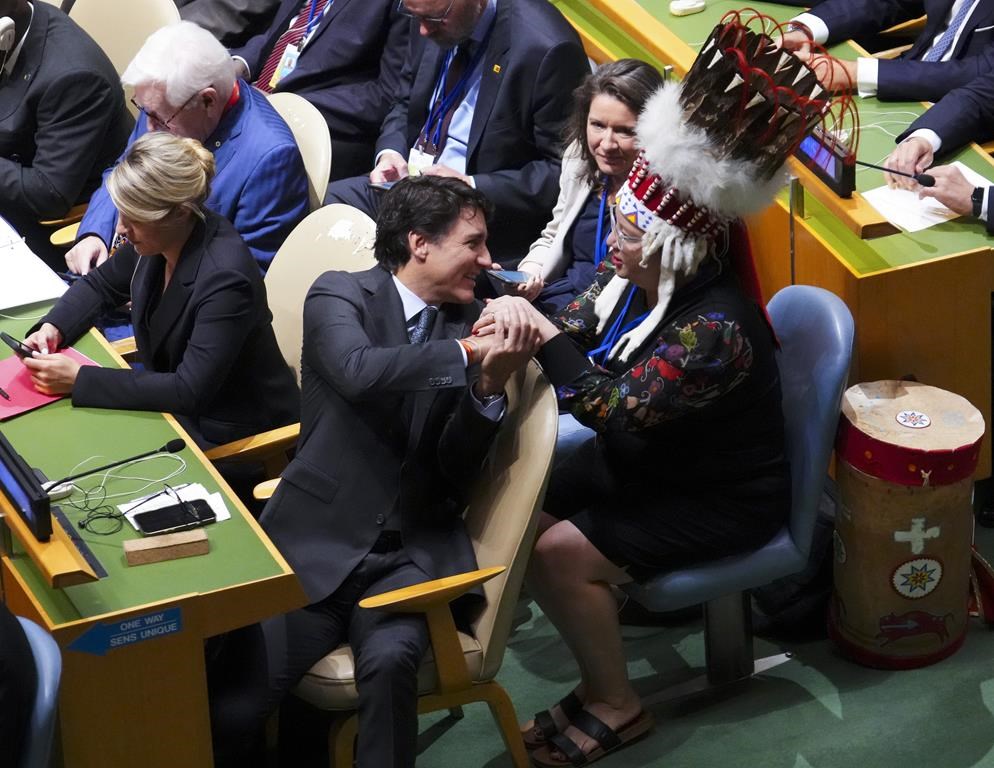
Prime Minister Justin Trudeau shakes hands with Assembly of First Nations National Chief Cindy Woodhouse Nepinak as they attend the opening of the 79th Session of the UN General Assembly at United Nations headquarters, Tuesday, Sept. 24, 2024. THE CANADIAN PRESS/Sean Kilpatrick
Andrew McDougall, an assistant professor in the department of political science at the University of Toronto, said cannabis legalization was “a political debate in Canada literally for decades.”
“While I think people are still fighting about the public health implications of that,” legalization is “here to stay,” he said.
“I think most people would point to that as being a success of the Trudeau government, something he promised to do, and it was a promise that he kept.”
Reneging on electoral reform
One key early pledge Trudeau did not keep was bringing about electoral reform. Speaking to reporters after his resignation, Trudeau said if he had one regret about his time in office, it would be reneging on that promise.
In 2015, Trudeau said that if he was elected, the federal election held that year would be the last to use the first-past-the-post method.
“I do wish that we had been able to change the way we elect our governments in this country, so that people could simply choose a second choice or a third choice on the same ballot,” he said Monday. He said that would have resulted in people “looking for things they have in common instead of trying to polarize and divide Canadians against each other.”
But Trudeau said it was something he “could not change unilaterally without support of other parties.”
Jennifer Wallner, an associate professor in the school of political studies at the University of Ottawa, said Trudeau had a majority government in his first mandate, and could have made it happen.
“There would have been ways of doing it, and he certainly didn’t need all parties to be supporting it.”
Reconciliation
When it comes to Trudeau’s record on reconciliation, Wallner said “there’s no denying that this government has been oriented, at least symbolically, to transforming the relationship” with Indigenous Peoples.
McDougall said Trudeau did his “best to associate the Liberal party with reconciliation in a way that maybe it hadn’t been before.”
Assembly of First Nations National Chief Cindy Woodhouse Nepinak pointed to a historic $23-billion settlement for First Nations children harmed by the child welfare system, Trudeau’s work to end long-term boil water advisories in First Nations communities and the advancement of Indigenous rights on the world stage.
She said during his time in power, Trudeau has “done more to help improve the quality of life for First Nations than any other prime minister.”
“While many generational and rights challenges remain unsolved, the prime minister has been an ally for meaningful reconciliation and set a new standard for future prime ministers to exceed.”
Woodhouse Nepinak said that by the time Trudeau came in, First Nations hadn’t been “talked to for over a decade” under the government of Conservative prime minister Stephen Harper.
Canada Child Benefit
In 2016, the Liberals launched the Canada Child Benefit to replace Harper’s Universal Child Care Benefit. The new benefit was not taxable and is dependent on family income.
Marking the seven-year anniversary of its launch in 2023, Trudeau said the program reduced poverty across the country. In 2021, 7.4 per cent of Canadians lived in poverty, down from 12.9 per cent in 2016 when the benefit came into place.
Jennifer Robson, an associate professor of political management at Carleton University, told The Canadian Press at the time that it’s hard to prove that the benefit is fully responsible for the reduction of poverty in the country.
But she said a look at the data shows child poverty rates declined more sharply after it came into place, while the “intensity” of poverty was also reduced.
Carbon price
In 2018, Trudeau’s government introduced the Greenhouse Gas Pollution Pricing Act, which imposed a revenue-neutral price on carbon for provinces that don’t already have one. A carbon price makes it more expensive to burn fossil fuels, which produce the greenhouse gases that cause global warming.
The government put in place rebates, designed to encourage people to save money by curbing their fossil fuel use without penalizing those who don’t.
But the carbon price has become the centrepiece of Conservative Leader Pierre Poilievre’s attacks on Trudeau’s government, under Poilievre’s “axe the tax” rallying cry.
“Fighting climate change…and the environment generally was central to the Trudeau brand, and that made sense coming in against the backdrop of Stephen Harper,” said McDougall.
Carbon pricing was central to Trudeau’s agenda, McDougall said, noting “the extent to which this has actually been turned on him in the last two years or so.”
What was supposed to be a central legacy for Trudeau is “now being used very powerfully against him.”
That means it will take more time to determine the ultimate effects of the carbon price on Trudeau’s legacy, he said.
COVID — and the backlash
After the World Health Organization declared COVID-19 a global pandemic in March 2020, Trudeau responded with a $1-billion package, including support for surge capacity at provincial hospitals. There was also billions in domestic aid to help workers who were laid off and businesses that tried to stay afloat through closures.
The government also introduced vaccine mandates, requiring COVID-19 vaccines for public servants and train and air travellers, as well as requirements for Canadian truck drivers to be vaccinated.
In response, the self-styled “Freedom Convoy” protesters rolled into Ottawa in January 2022, in a massive, three-week demonstration against COVID-19 mandates and Trudeau’s government. The crowds, big-rig trucks and police barriers gridlocked the streets around Parliament Hill, and many of the protesters carried flags and signs with expletives directed at the prime minister.
Wallner said COVID enabled a “real buildup of resentment and outright anger toward the government.”
McDougall said Trudeau was credited for handling the pandemic well at the beginning, which is one of the reasons Trudeau opted to trigger an election in 2021. He was re-elected with a minority government.
“He felt he would get rewarded for that,” McDougall said. “But obviously not all Canadians were on the same page with some of the restrictions.”
NAFTA
A big challenge of Trudeau’s time in government was how to handle U.S. President Donald Trump’s first term. Trudeau’s government renegotiated the North American Free Trade Agreement, an effort in which Chrystia Freeland played a significant role.
It was Freeland’s surprise resignation as finance minister on Dec. 16 that intensified calls for Trudeau to resign, leading to Monday’s announcement.
McDougall said there were initial fears that Trump would “sink that agreement altogether and that would have obviously had a very negative impact on the Canadian economy.”

He said “most people perceived the way that (Trudeau) managed the first Trump administration as being basically a success for Canada, given that it was in a tough situation.”
Trump’s second term in office is set to begin Jan. 20.
-With files from Alessia Passafiume
This report by The Canadian Press was first published Jan. 7, 2024.
Note to readers: This is a corrected story. An earlier version incorrectly identified Jennifer Wallner as an assistant professor in the school of political studies at the University of Ottawa
Related Articles
Liberals split on how quickly to proceed with choosing new leader
Advertisement Advertise With Us
Advertisement Advertise With Us