

As elite Davos event ends, some hail ‘constructive optimism’ despite divisions, suffering in world
Advertisement
Read this article for free:
or
Already have an account? Log in here »
To continue reading, please subscribe:
Monthly Digital Subscription
$1 per week for 24 weeks*
- Enjoy unlimited reading on winnipegfreepress.com
- Read the E-Edition, our digital replica newspaper
- Access News Break, our award-winning app
- Play interactive puzzles
*Billed as $4.00 plus GST every four weeks. After 24 weeks, price increases to the regular rate of $19.95 plus GST every four weeks. Offer available to new and qualified returning subscribers only. Cancel any time.
Monthly Digital Subscription
$4.99/week*
- Enjoy unlimited reading on winnipegfreepress.com
- Read the E-Edition, our digital replica newspaper
- Access News Break, our award-winning app
- Play interactive puzzles
*Billed as $19.95 plus GST every four weeks. Cancel any time.
To continue reading, please subscribe:
Add Free Press access to your Brandon Sun subscription for only an additional
$1 for the first 4 weeks*
*Your next subscription payment will increase by $1.00 and you will be charged $16.99 plus GST for four weeks. After four weeks, your payment will increase to $23.99 plus GST every four weeks.
Read unlimited articles for free today:
or
Already have an account? Log in here »
Hey there, time traveller!
This article was published 24/01/2025 (429 days ago), so information in it may no longer be current.
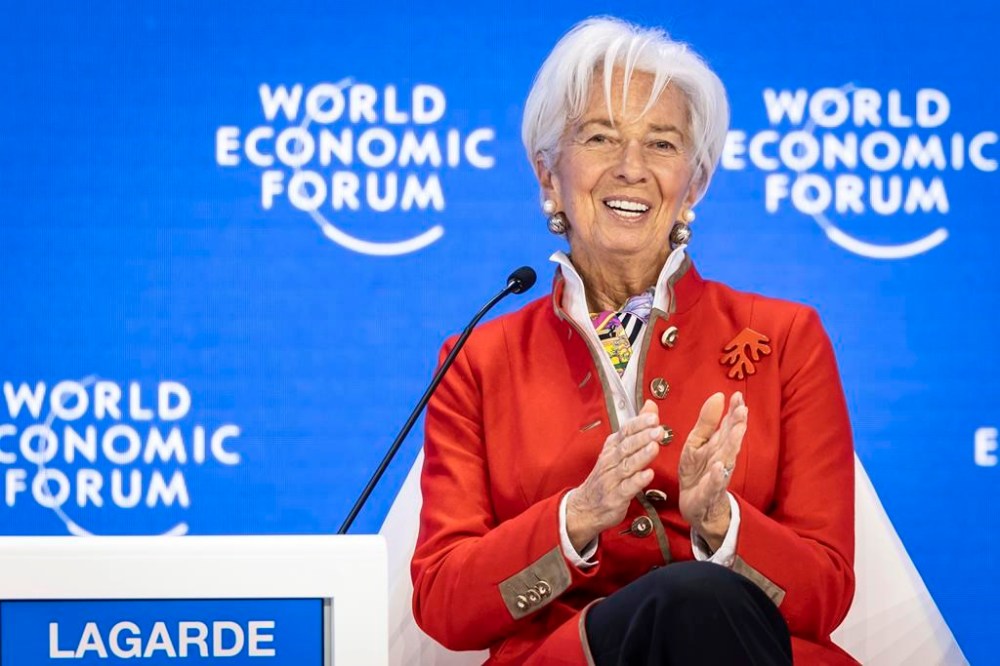
DAVOS, Switzerland (AP) — The European Central Bank’s president responded Friday to U.S. President Donald Trump’s accusation of unfair trade treatment by the European Union by calling for negotiations and mutual respect rather than a focus purely on trans-Atlantic trade figures.
The comments by Christine Lagarde alluding to a U.S.-EU rift offered a fitting final note at the World Economic Forum’s weeklong meeting: Trump’s return to the White House on Monday was on everyone’s lips, overshadowing traditional Davos talk about issues like climate change, free trade and economic development.
Many business leaders, world-class academics, top government officials and other elites on hand sought to cast an upbeat tone about economic prospects, efforts to end wars in places like Ukraine and the Middle East, and technological progress.
Some human rights advocates insisted that the poor, war victims and struggling migrants shouldn’t be forgotten.
Trump talks tariffs
Trump, in an video address and question-and-answer session on Thursday, said that the United States had “hundreds of billions of dollars of deficits with the EU and nobody’s happy with it. And we’re going to do something about it.”
Lagarde noted his focus on the U.S. trade deficit, but said decision-makers should look deeper at the details.
“You have to look at the good exchanges, you have to look at the services exchanges, you have to look at the capital account, “she said. ”It cannot just be black and white. What is true is that there has to be negotiation.”
“Some countries are in a stronger position than others, but we all need each other,” Lagarde added.
Tariffs weren’t popular in Davos: Economic policymakers and trade officials warned that they could backfire and fan inflation.
Kristalina Georgieva, the managing director of the International Monetary Fund, echoed Lagarde by saying that trade patterns show the benefits of open relationships, and countries that fare best are ones “that are friends with everybody.”
An intensified trans-Atlantic competition, despite calls for cooperation, belied an overall upbeat mood among many business leaders in Davos who are looking for economic growth, fewer regulations, lower taxes and greater efficiencies through technologies like artificial intelligence — another key theme to the week.
Optimism for some, obliviousness for others
Rich Lesser, global chairman of Boston Consulting Group, a leading management advisory firm, noted a strong U.S. economy and investment flowing in, but acknowledged “the high uncertainty is tariffs” and cited risks of both inflation and further budget deficits that could drive up interest rates.
As for Europe, he said he came away “more optimistic from this week.”
“The first stage to fixing something is awareness,” Lesser said. He sensed “more understanding” among European government leaders about “the need for competitiveness in Europe, the need to undertake reform, (and) the need to make some hard changes that still, politically, will be hard.”
Critics insisted that talk of “constructive optimism” — a buzzword among many this week — was overblown.
Amnesty chief says ‘we can’t hide our faces in the sand’
Agnès Callamard, the secretary-general of Amnesty International, said that the reception to Trump among many elites in Davos was “very striking,” adding: “There is almost not a negative word that is being uttered about what he is planning to do.”

In Davos, where luxury suites, Champagne-doused parties and custom-tailored suits abound — far from the suffering around the world — “there is a real determination not to see Trump 2.0 as a threat to peace and to prosperity,” she said.
“Whether it will be peace and security for the climate refugees; for the migrants fleeing Venezuela; for the Sudanese in the midst of crimes against humanity; for the Palestinians in Gaza living in rubbles: That is questionable,” Callamard said.
“We cannot hide our faces in the sand,” she added.
___
David McHugh reported from Frankfurt, Germany. David Keyton contributed to this report from Davos.