Takeaways from AP’s reporting on the thousands disappeared in Colombia, Peru and Paraguay
Advertisement
Read this article for free:
or
Already have an account? Log in here »
To continue reading, please subscribe:

Digital Subscription
One year of digital access for only $205*
- Enjoy unlimited reading on winnipegfreepress.com
- Read the E-Edition, our digital replica newspaper
- Access News Break, our award-winning app
- Play interactive puzzles
*First annual payment billed as $205.00 + GST for one year. This annual subscription will automatically renew at $233.00 + GST every 52 weeks (10% off the regular annual price of $259.35). Offer available to new and qualified returning subscribers only. Cancel any time.
To continue reading, please subscribe:
Add Free Press access to your Brandon Sun subscription for only an additional
$1 for the first 4 weeks*
- Enjoy unlimited reading on winnipegfreepress.com
- Read the E-Edition, our digital replica newspaper
- Access News Break, our award-winning app
- Play interactive puzzles
*Your next Brandon Sun subscription payment will increase by $1.00 and you will be charged $17.95 plus GST for four weeks. After four weeks, your payment will increase to $24.95 plus GST every four weeks.
Read unlimited articles for free today:
or
Already have an account? Log in here »
Hey there, time traveller!
This article was published 26/01/2025 (628 days ago), so information in it may no longer be current.
Thousands of people have disappeared in Latin America during decadeslong conflicts. Many have never been found, presumed to be the victims of dictatorships, insurgencies or organized crime.
The most well-known of these mass disappearances occurred in Argentina and Chile during their military dictatorships. There are similarly wrenching but less well-known traumas elsewhere in the region.
In Peru, Colombia and Paraguay, for example, many people are still searching for answers. Loved ones have found comfort in their faith but have faced years of uncertainty and a lack of official justice.
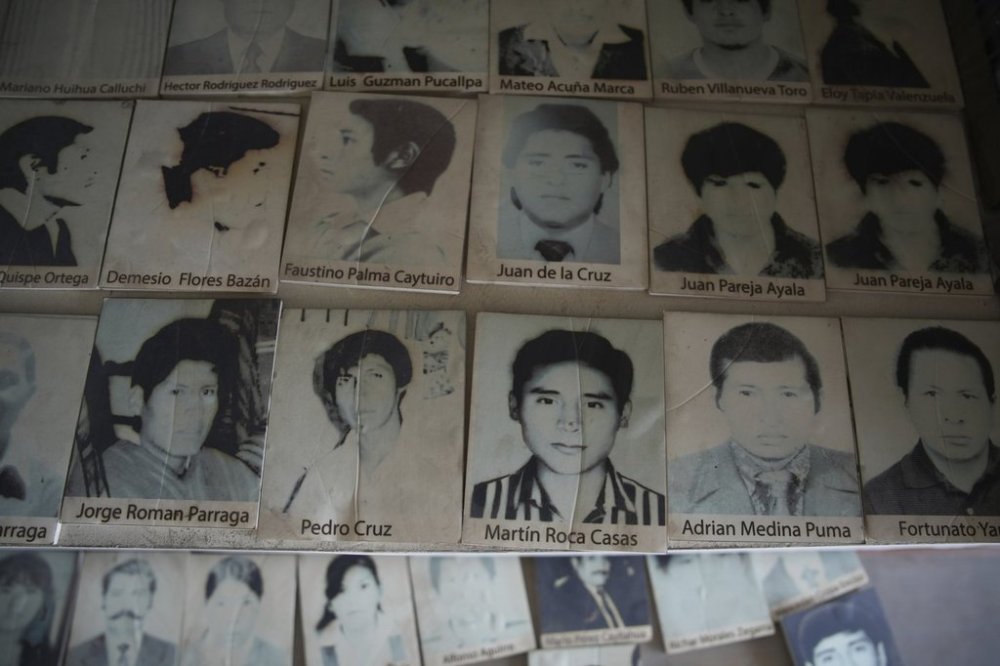
In Peru, out of 20,000 disappeared people, only 3,200 remains have been found. In Colombia, five decades of war left a staggering death toll and more than 124,000 people missing. Paraguay’s dictatorship left a smaller number of disappeared (500 people), but only 15 bodies have been recovered.
Some key aspects of AP’s reporting from these three countries:
A divisive peace in Colombia
Fighting among leftist guerrillas, right-wing paramilitaries, drug lords and government forces left more than 450,000 people killed and 124,000 disappeared. These figures are on par with other conflicts in Latin America, where thousands have vanished under similar circumstances.
In Colombia, though, a peculiar thing happened. Aiming to heal long-time wounds and build new paths toward reconciliation, dozens of former rebels, officials, forensic anthropologists and religious leaders now work side-by-side in finding their country’s disappeared.
A 2016 peace pact with the main rebel group — the Revolutionary Armed Forces of Colombia (FARC) — earned then-President Juan Manuel Santos a Nobel Peace Prize. But neither he nor his successors have fully addressed endemic violence, displacement and inequality — issues that helped spark Colombia’s conflict in the 1960s.
In 2022, Gustavo Petro, a former rebel, was sworn in as the country’s first leftist leader. His goal is to demobilize all rebels and drug trafficking gangs, but even as a ceasefire was carried out, negotiations with Colombia’s remaining guerrilla group, the National Liberation Army (ELN), failed and violence reemerged. Simultaneously, FARC hold-out groups and trafficking mafias continue to affect the country.
The peace pact established three crucial institutions for searching efforts: the Truth Commission; the Special Jurisdiction for Peace, which encourages offenders to confess their crimes and make restitution actions in exchange for not serving any jail time; and the Search Unit for Disappeared Persons, which traces disappearances, conducts exhumations and returns loved ones’ remains to hurting relatives like Doris Tejada, whose son Óscar Morales disappeared in 2007.
“It’s been 17 years and still hurts,” said Tejada, who found Morales’ remains in 2024. “I asked God for help because it was difficult to see his bones. We still mourn.”
Government forces and illegal groups were as responsible for massacres, forced recruitment and disappearances. According to the Truth Commission, paramilitary groups committed 45% of the homicides, while guerrillas — most of them FARC — carried out 27% and the government forces 12%.
In Paraguay, a dictator’s sway is felt long after his ouster
Despite being ousted in 1989 after a 35-year reign of terror, during which 20,000 people were tortured, executed or disappeared, some Paraguayans feel as if Gen. Alfredo Stroessner never truly left.
“This is probably the only country in which the political party that supported a dictator, once he is gone, remains in power,” said Alfredo Boccia, an expert on Paraguay’s history. “That’s why scrutiny took so long, most disappeared were never found and there were barely trials.”
Stroessner served as Paraguay’s president, leader of the conservative Colorado Party, commander of the armed forces and chief of police. He was not overthrown by enemies, but by his in-law, and the military members involved were affiliated with his party, which has ruled almost uninterrupted since.
The Colorado Party’s dominance makes accountability elusive. Few of those responsible for crimes have faced trial, and public schools avoid mentioning the dictatorship during history lessons.
“Paraguayans now vote for the party freely,” Boccia said. “For those of us who fight for memory, that battle was lost.”
Rogelio Goiburu, who has searched for his father for 47 years, was named director of historic memory at the Ministry of Justice, but has no budget. By his own means or raising funds, he has filled in the blanks about the fate of his father and other disappeared people, earning the trust of retired police and military officers who confessed to him how bodies were disposed.
Only one major excavation has been done in Paraguay seeking to solve disappearances. It was led by Goiburu between 2009 and 2013. Of the 15 bodies found, only four were identified.
While 30,000 Argentinians disappeared in a less than a decadelong dictatorship, around 500 people vanished in Paraguay amid the 35-year regime. Regardless, relatives argue that searches must continue.
“Every disappearance attacks the right to mourn,” said Carlos Portillo, who interviewed thousands of victims for the Truth Commission. “There’s no culture which doesn’t have a ritual for mourning. A disappearance is the denying of this ritual, and that’s why it’s impossible to let go.”
Grim legacy of Peru’s 20-year insurgency
In Peru, an estimated 20,000 people disappeared between 1980 and 2000 during a brutal conflict between the government and the Sendero Luminoso (or Shining Path), a Communist organization that claimed to seek social transformation through an armed revolution.
Founded in the 1970s by Abimael Guzman, the group turned violent a decade later. Older Peruvians still tell tales about donkeys strapped with explosives detonating in crowds, bombs that blew up streetlamps to plunge cities into darkness, and massacres that wiped out entire families.
The terror, though, was not merely unleashed by the insurgents. The armed forces were equally responsible for deaths and human rights violations.
Hundreds of men — many of them innocent — were captured by the military, often to face torture and execution. Others were slain and buried in mass graves by insurgents seeking to control communities by spreading fear.
Although hundreds of people have disappeared for other motives since then, the Truth Commission said this was the most violent period in Peru’s history. More than 69,000 people are counted as “fatal victims” — about 20,000 classified as “disappeared” and the rest killed by insurgents or the military.

“In many ways, Peru is still dealing with the repercussions of the political violence from the late 20th century,” said Miguel La Serna, a history professor at the University of North Carolina.
“Whole generations of adult men disappeared and that impacted the demographics in these communities. People moved out to escape the violence and some never returned,” he added. “And that’s to say nothing of the social, collective trauma that people experienced.”
Despite the work of forensic doctors, prosecutors and organizations like the International Committee of the Red Cross, only about 3,200 remains have been found. Some now fear that President Dina Boluarte might cut the government’s support to keep searching.
___
Associated Press religion coverage receives support through the AP’s collaboration with The Conversation US, with funding from Lilly Endowment Inc. The AP is solely responsible for this content.
The Free Press acknowledges the financial support it receives from members of the city’s faith community, which makes our coverage of religion possible.