A sporting no-trans land? While issue flares in U.S., Canada’s athletic governing bodies opt for inclusion as science on competitive advantage for transgender females over biological women far from conclusive
Read this article for free:
or
Already have an account? Log in here »
To continue reading, please subscribe:

Digital Subscription
One year of digital access for only $205*
- Enjoy unlimited reading on winnipegfreepress.com
- Read the E-Edition, our digital replica newspaper
- Access News Break, our award-winning app
- Play interactive puzzles
*First annual payment billed as $205.00 + GST for one year. This annual subscription will automatically renew at $233.00 + GST every 52 weeks (10% off the regular annual price of $259.35). Offer available to new and qualified returning subscribers only. Cancel any time.
To continue reading, please subscribe:
Add Free Press access to your Brandon Sun subscription for only an additional
$1 for the first 4 weeks*
- Enjoy unlimited reading on winnipegfreepress.com
- Read the E-Edition, our digital replica newspaper
- Access News Break, our award-winning app
- Play interactive puzzles
*Your next Brandon Sun subscription payment will increase by $1.00 and you will be charged $17.95 plus GST for four weeks. After four weeks, your payment will increase to $24.95 plus GST every four weeks.
Read unlimited articles for free today:
or
Already have an account? Log in here »
Hey there, time traveller!
This article was published 07/02/2025 (599 days ago), so information in it may no longer be current.
They were just the latest headlines in a long list of them targeting transgender athletes in the United States.
On Wednesday, U.S. President Donald Trump signed an executive order that would prevent people designated male at birth from participating in women’s or girls’ sporting events.
On Thursday, the NCAA announced only athletes who were assigned female at birth will be eligible to play women’s university and college sports.
The controversial subject has long been a simmering political firestorm in the U.S. It boiled over last fall when NCAA women’s volleyball schools repeatedly forfeited games against San Jose State because it was believed a member of the team identified as transgender.
This week’s moves follow in the steps of state legislators. Since 2020, 23 U.S. states have passed laws restricting transgender athletes’ ability to participate in school sports in accordance with their gender identity, according to ESPN.
Related Articles
Trump delivered on his promise to order a ban on transgender female athletes. What's next?








It could be the most contentious issue in sports.
While most of the headlines have occurred south of the border, the first major flashpoint in Canada occurred last fall when the Alberta government, under the proposed Bill 29, introduced plans to restrict transgender female athletes from competing against biological women.
If passed into law, the bill would require school boards, provincial sports organizations and academic institutions to “protect the integrity of female athletic competitions by ensuring women and girls have the opportunity to compete in biological female-only divisions.”
Dubbed the Fairness and Safety in Sport Act, critics suggest it is anything but.
“This topic is very polarizing,” says Guylaine Demers, a Laval University academic and a national leader on gender equality and inclusion in sport. “It’s like there’s no grey zone. People are either black or white — it’s include them or exclude them. And the basis behind those decisions are more emotional than based on facts — on actual data. And one of the reasons is we don’t have much data.”
Spencer Colby / the Canadian Press Laval University Prof. Guylaine Demers is a driving force for gender equality and inclusion in sport across Canada and around the world.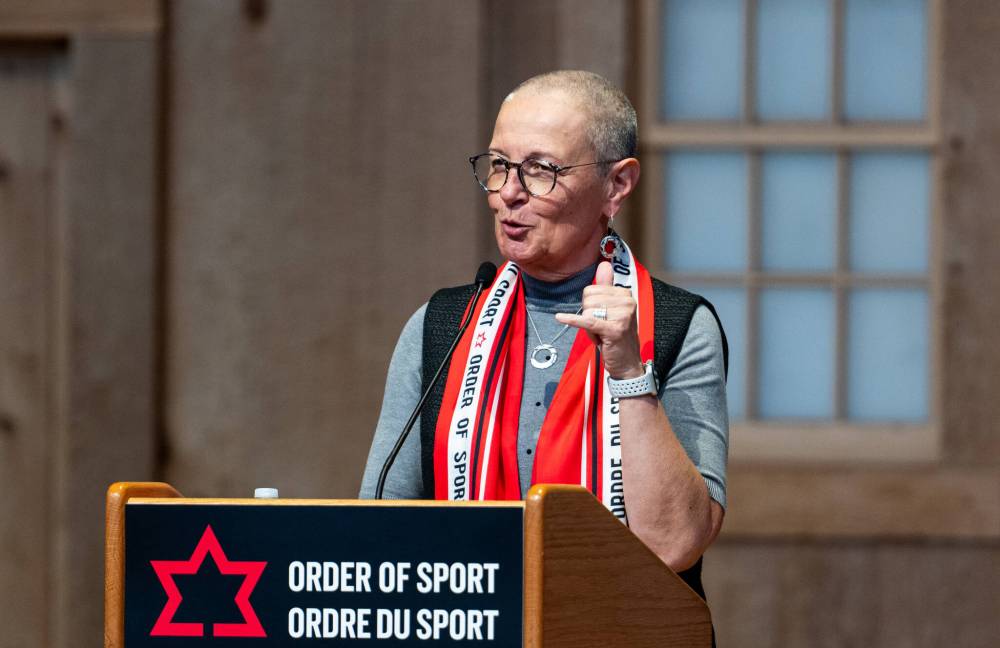
The crux of the dispute is the implication there is a retained physiological advantage after transitioning from male to female.
Dr. Sarah Teetzel, a University of Manitoba researcher specializing in sports ethics, says the science is inconclusive.
“If you look at the research that’s been done, the canon of it is very small,” says Teetzel.
“It’s maybe 12 or 13 papers that are cited by the same organizations that are arguing against transgender inclusion… And what they found is that all but one of the studies didn’t involve a population that had been athletes before transitioning and after and the one that did include trans athletes in their study cautioned in their discussion that their results can’t be used to support a ban on trans inclusion.
“So there’s the perception that the science says the physiological advantages are retained, but it’s really not a clear area yet, and it’s such a difficult area to study because you have such a small population of people who are both high-performance trained athletes who have had their markers and measurements taken before transitioning, then transition, and want to be part of this study afterwards.”
RUTH BONNEVILLE / FREE PRESS files Janet McMahon, Sports Manitoba president and CEO, estimates 10-15 provincial sport organizations have established guidelines with respect to trans athletes.
In Manitoba, there has been no pressure to restrict participation by transgender athletes.
“The data that I’ve heard is it’s probably less than one per cent of the population in Manitoba that would identify as transgender, so if you extrapolate that into the numbers of registered sport participants, it’s such a small number,” says Sports Manitoba president and CEO Janet McMahon, whose organization oversees 60 sports-specific organizations and five of the multi-sport variety.
“It’s very difficult for us to even be able to determine how we would restructure the system to allow it. There’s also a part of me that says, at a community, local or provincial level, what impact does that really have? Particularly in team sport, you have a superstar on most teams, so unless it’s impacting national or moving onto international, world and Olympic level, shouldn’t we be able to find a place for everyone to play?”
McMahon estimates between 10 and 15 provincial sport organizations have established guidelines with respect to trans athletes.
“It would be great to have a vision and a pathway for us to get (to an overall policy) but I think the first thing is talking about it — educating,” says McMahon.
“We need some of that science to know what the right decision is. But again, at the community, local, provincial level, if you have a transgender person on your team and they’re a superstar, then my answer would be, get better.”
Open-door policy
The Manitoba High Schools Athletic Association has officially maintained an open-door policy since 2015, revising the language in 2017 to permit athletes to “participate fully and safely in sex-separated sports activities in accordance with his or her gender identity.”
Athletes only need to indicate their choice at the start of the school year.
“I think the world’s becoming more accepting, obviously, as we move forward, but I think there’s always going to be someone out there willing to or looking to make a distraction out of it,” says MHSAA executive director Chad Falk, who estimates a handful of students decide to switch each school year.
‘I think a lot of it also will depend on the government of the day and the legislation or policies they decide to enact. I know our counterparts in Alberta are very concerned with pending legislation in Alberta, and they’re trying to figure out how it’s going to affect them, because they have very similar policy to ours right now.”
Similarly, Hockey Manitoba does not restrict individual choice.
“There’s a Hockey Canada regulation that embraces (choice) and we would like to provide as safe and welcoming an environment as we can and that’s fully based on inclusion,” says Hockey Manitoba executive director Peter Woods.
“Maybe other sports or other jurisdictions might not support that, but that’s currently what we do. The more kids or people that play the sport, the better. That’s how we look at it.”
U Sports, which governs the highest level of university sports in the country, does not restrict athletes.
“We’re talking about a very small number of people. That’s one of the reasons we don’t have much data, is because that population is so small, so we don’t know a lot.”–Guylaine Demers, a Laval University academic and a national leader on gender equality
“We’re aware, anecdotally, of some (transgender athlete) participation at the league level,” says U Sports executive director Pierre Arsenault. “(But) we’re not aware at the national championship level that this happens to any great degree.”
“What we’ve said… related to Alberta’s scenario, is that we would find it difficult to bring U Sports events to a jurisdiction where we can’t fully apply our own rules of any kind,” says Arsenault.
“That ultimately is kind of how we’re approaching it. Now, the information we have from Alberta to this point in time suggests that whatever legislation is passed would only apply to groups that have jurisdiction in Alberta, which is to say, if we brought a U Sports national championship (to Alberta), there would be no restrictions on teams from outside of Alberta who are coming to play in that event.”
Demers says the assertion transgender women will destroy women’s sports is not supported by facts.
“We have an estimation of the trans population in Canada and non-binary population but when you go into sport, then the numbers shrink,” says Demers. “We’re talking about a very small number of people. That’s one of the reasons we don’t have much data, is because that population is so small, so we don’t know a lot.
“The other thing is that sport is so binary. Everything is based on sex — it’s you (either) go on the woman’s side or the men’s side and everything is split that way. And now that we hear more and more the voices of trans and non-binary athletes, suddenly it’s like we’re shaking the sport temple. What we have known for being the truth forever, now we are, (saying), ‘Oh my god, what’s happening now?’”
mike.sawatzky@winnipegfreepress.com