

Canada resorting to its tried and true playbook
Building Canada Strong Act just another way of sidestepping Indigenous rights

Advertisement
Read this article for free:
or
Already have an account? Log in here »
To continue reading, please subscribe:

Digital Subscription
One year of digital access for only $205*
- Enjoy unlimited reading on winnipegfreepress.com
- Read the E-Edition, our digital replica newspaper
- Access News Break, our award-winning app
- Play interactive puzzles
*First annual payment billed as $205.00 + GST for one year. This annual subscription will automatically renew at $233.00 + GST every 52 weeks (10% off the regular annual price of $259.35). Offer available to new and qualified returning subscribers only. Cancel any time.
To continue reading, please subscribe:
Add Free Press access to your Brandon Sun subscription for only an additional
$1 for the first 4 weeks*
- Enjoy unlimited reading on winnipegfreepress.com
- Read the E-Edition, our digital replica newspaper
- Access News Break, our award-winning app
- Play interactive puzzles
*Your next Brandon Sun subscription payment will increase by $1.00 and you will be charged $17.95 plus GST for four weeks. After four weeks, your payment will increase to $24.95 plus GST every four weeks.
Read unlimited articles for free today:
or
Already have an account? Log in here »
In 1846, Britain faced an emergency influenced by the Irish famine, so leaders repealed the country’s “Corn Laws” and restrictions on imported food and grain, transitioning to a system of free trade.
This created a crisis in the then Province of Canada, which had relied on British “preferential” status to prop up its agricultural and resource industries.
As a result, Canada looked south for new markets and eventually negotiated a free trade agreement with the United States.
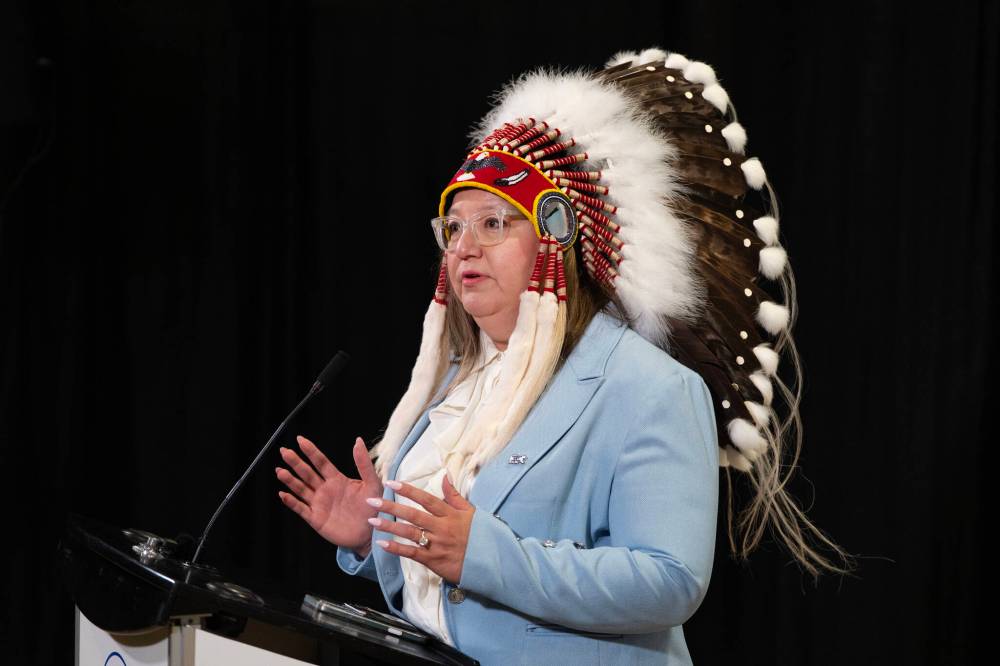
DARREN CALABRESE / THE CANADIAN PRESS FILES
‘We warn the government against abusing its majority status and dishonouring the Crown through procedural tools, time allocation or closure to frustrate Parliament’s ability to hear from rights holders and consider amendments,’ National Chief Cindy Woodhouse Nepinak says.
This required land to be acquired and converted for industrial use quickly, so Canada quickly dispatched Commissioner William Robinson to negotiate with Indigenous communities along Lake Huron and Lake Superior for land.
Robinson was told to obtain the land using whatever means necessary, whether through money or force.
In a few weeks, 130,000 square kilometres of what is now northern Ontario were obtained through what is called the “Robinson Treaties.”
Canada has always used “emergencies” to obtain Indigenous lands.
After confederation in 1867, Canadian legislators used the paranoia surrounding American expansionism to justify the forcible removal of Indigenous peoples from lands needed for the transcontinental railway.
Read about the wars against the Cree and Métis in 1885 to see what I mean.
During the First and Second World Wars, Indigenous lands were seized under the Expropriation Act and War Measures Act in order to train soldiers or test weapons. After the wars were over and thousands of returning soldiers suddenly needed compensation, Indigenous lands were re-allocated through venues like the Soldier Settlement Board.
During the Cold War, Canada relocated Inuit in northern Québec and Baffin Island in order to assert Canada’s permanent presence in the High Arctic.
This is basically the story of Iqaluit (formerly known as Frobisher Bay).
My point: emergencies are always the justification for taking Indigenous lands.
So, I wasn’t surprised to see the federal government’s new Bill C-39, the Building Canada Strong Act, suddenly proposed in Parliament on Sept. 21.
Expanding and replacing provisions in the One Canadian Economy Act (Bill C-5) passed last fall, this legislation seeks to accelerate infrastructure development and reshape environmental regulations, labour laws and legal duties to Indigenous peoples.
The omnibus bill is nearly 250 pages long (five times the average) — making any full analysis, whether here or in Parliament, impossible.
So, I’ll summarize as best I can.
The message in the Building Canada Strong Act is: United States President Donald Trump and his economic policies have forced Canada to expand the economy as fast as possible and definitely not let labour laws, environmental regulations or Indigenous rights get in the way.
I could get into the bill’s one-year timeline on decisions for projects, changes to the federal labour code, streamlining of environmental assessments or the immense discretionary powers given to cabinet ministers to green-light projects but it’s best to just hear the justification being used for such sweeping legislative changes.
“[Canadians] understand what we’re facing is unprecedented in Canada’s history,” Finance Minister François-Philippe Champagne told reporters when asked about the bill. “We need to make sure that we have the proper tools in the toolbox to favour economic security in our country.”
In other words: it’s an emergency, don’t question what we need to do about it.
Familiar with this reasoning, First Nations leaders were immediately suspicious.
“We warn the government against abusing its majority status and dishonouring the Crown through procedural tools, time allocation or closure to frustrate Parliament’s ability to hear from rights holders and consider amendments,” Assembly of First Nations National Chief Cindy Woodhouse Nepinak said.
“Any predetermined timeline principally designed to attract investment subordinates the honour of the Crown to commercial imperatives.”
She’s right.
The average time for consultation with Indigenous peoples on any resource development project in Canada is around seven years.
That is: if suitable community meetings, decent legal analysis of the initiative’s impacts on Indigenous rights and inclusive discussions surrounding the intricate ways Indigenous cultures and communities are impacted by pipelines, highways and nuclear facilities take place.
Did I mention that virtually every single consultation with Indigenous communities ends up in long, drawn-out court battles which take years to work out?
Don’t worry though, the writers of Bill C-39 thought about that possibility too.
“Preparatory or early construction work” on projects approved by the federal government and “deemed in the public interest” can “begin before a final project review or approval is fully completed.”
One wonders what might be the point of consultation after the fact.

It’s probably easier to just say to Indigenous communities: “Do you want us to give you money or use force? Your choice.”
Of course, this isn’t how the federal government puts it.
The Building Canada Strong Act will ensure that projects are “advancing reconciliation through meaningful engagement with Indigenous Peoples,” said Environment, Climate Change and Nature Minister Julie Dabrusin.
Well, we’ve all heard that before.
niigaan.sinclair@freepress.mb.ca
Niigaan Sinclair is Anishinaabe from Peguis First Nation and a professor in the Department of Indigenous Studies at the University of Manitoba. He’s been a columnist for the Free Press since 2018. Read more about Niigaan.
Every piece of writing Niigaan produces is reviewed by an editing team before it is posted online or published in print — part of the Free Press‘s tradition, since 1872, of producing reliable independent journalism. Read more about Free Press’s history and mandate, and learn how our newsroom operates.
Our newsroom depends on a growing audience of readers to power our journalism. If you are not a paid reader, please consider becoming a subscriber.
Our newsroom depends on its audience of readers to power our journalism. Thank you for your support.
Niigaan Sinclair is Anishinaabe from Peguis First Nation and a professor in the Department of Indigenous Studies at the University of Manitoba. He’s been a columnist for the Free Press since 2018. Read more about Niigaan.
Every piece of writing Niigaan produces is reviewed by an editing team before it is posted online or published in print — part of the Free Press‘s tradition, since 1872, of producing reliable independent journalism. Read more about Free Press’s history and mandate, and learn how our newsroom operates.
Our newsroom depends on a growing audience of readers to power our journalism. If you are not a paid reader, please consider becoming a subscriber.
Our newsroom depends on its audience of readers to power our journalism. Thank you for your support.
Related Articles
Labour bill will test limits of Ottawa's power to quash strikes: experts







Advertisement Advertise With Us
Advertisement Advertise With Us