Monkey trench Winnipeg Rifles soldiers enlisted a mischievous simian as their mascot while fighting in the First World War
Read this article for free:
or
Already have an account? Log in here »
To continue reading, please subscribe:

Digital Subscription
One year of digital access for only $205*
- Enjoy unlimited reading on winnipegfreepress.com
- Read the E-Edition, our digital replica newspaper
- Access News Break, our award-winning app
- Play interactive puzzles
*First annual payment billed as $205.00 + GST for one year. This annual subscription will automatically renew at $233.00 + GST every 52 weeks (10% off the regular annual price of $259.35). Offer available to new and qualified returning subscribers only. Cancel any time.
To continue reading, please subscribe:
Add Free Press access to your Brandon Sun subscription for only an additional
$1 for the first 4 weeks*
- Enjoy unlimited reading on winnipegfreepress.com
- Read the E-Edition, our digital replica newspaper
- Access News Break, our award-winning app
- Play interactive puzzles
*Your next Brandon Sun subscription payment will increase by $1.00 and you will be charged $17.95 plus GST for four weeks. After four weeks, your payment will increase to $24.95 plus GST every four weeks.
Read unlimited articles for free today:
or
Already have an account? Log in here »
Hey there, time traveller!
This article was published 07/02/2025 (553 days ago), so information in it may no longer be current.
Traditionally, British army regiments each had a mascot — be it a goose, goat, ram, donkey, deer, bird or dog.
So, it was not surprising, at the outbreak of the First World War, that new battalions with the Canadian Expeditionary Force (CEF) sought to follow in the senior service’s footsteps.
The most famous was Winnie, the real bear belonging to Winnipeg veterinarian Harry Colebourn, who became the unofficial mascot for Colebourn’s regiment, the Fort Garry Horse.
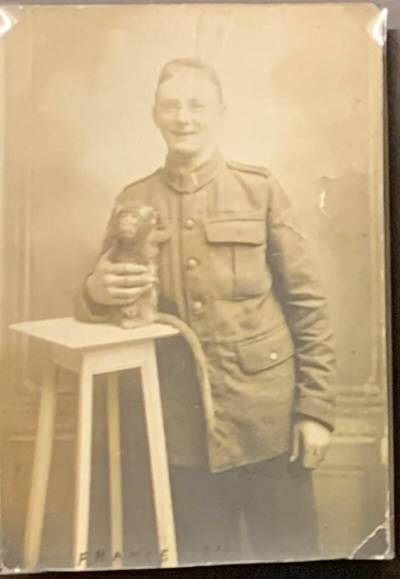
Royal Winnipeg Rifles Winnipeg Rifles soldier John Upritchard poses for a photo with the battalion’s mascot, Wickey the monkey, while in France.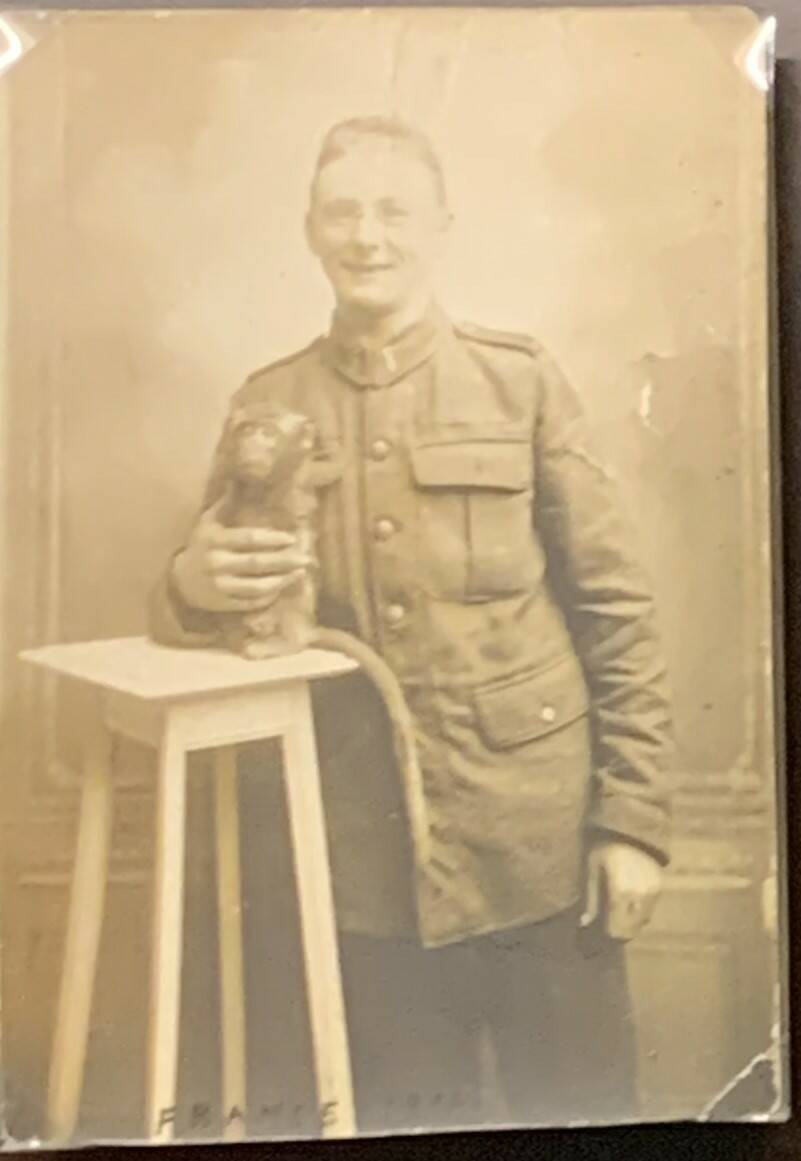
There’s another mascot, also with ties to Winnipeg, with an equally colourful backstory. While Winnie inspired a beloved fictional children’s book character; Wickey, a menacing monkey, did not.
At the onset of war, Winnipeg newspapers reported how Manitoba’s soldiers competed to have the most unique mascot to represent their battalions. Much to the bureaucratic chagrin of British officials, the first contingent of Canadian soldiers brought along a menagerie of “lucky charms” when they arrived in late 1914.
All animals required a Canadian veterinarian’s certificate of health before they could enter Britain. And while the officials might “turn a blind eye” to some, the Fort Garry Horse battalion’s bear proved to be the last straw, according to reporting back home in Winnipeg.
The British colonial office telegrammed Canada’s Secretary of State and emphatically said, “No more!” Bowing to British stuffiness, Canadian military officials ordered that “canine mascots and other pets are not allowed to accompany units overseas.”
Winnie, meanwhile, was donated to the London Zoo when Colebourn’s regiment was deployed to France. It was there where it was later encountered by A.A. Milne, an English author and First World War vet, who eventually introduced readers to the character Winnie-the-Pooh. (Milne’s birthday, Jan. 18, is celebrated as the official Winnie-the-Pooh Day.)
So, how did Canadian troops acquire battalion mascots? The dogs and cats began their lives in the battlefield trenches, being the offspring of lost or abandoned farm animals. There are many heart-warming tales of poor creatures who were saved and loved by Canadian trench warriors.
Wickey the monkey came to the Rifles in late 1915 while they were manning trenches in Ypres Salient during the First World War.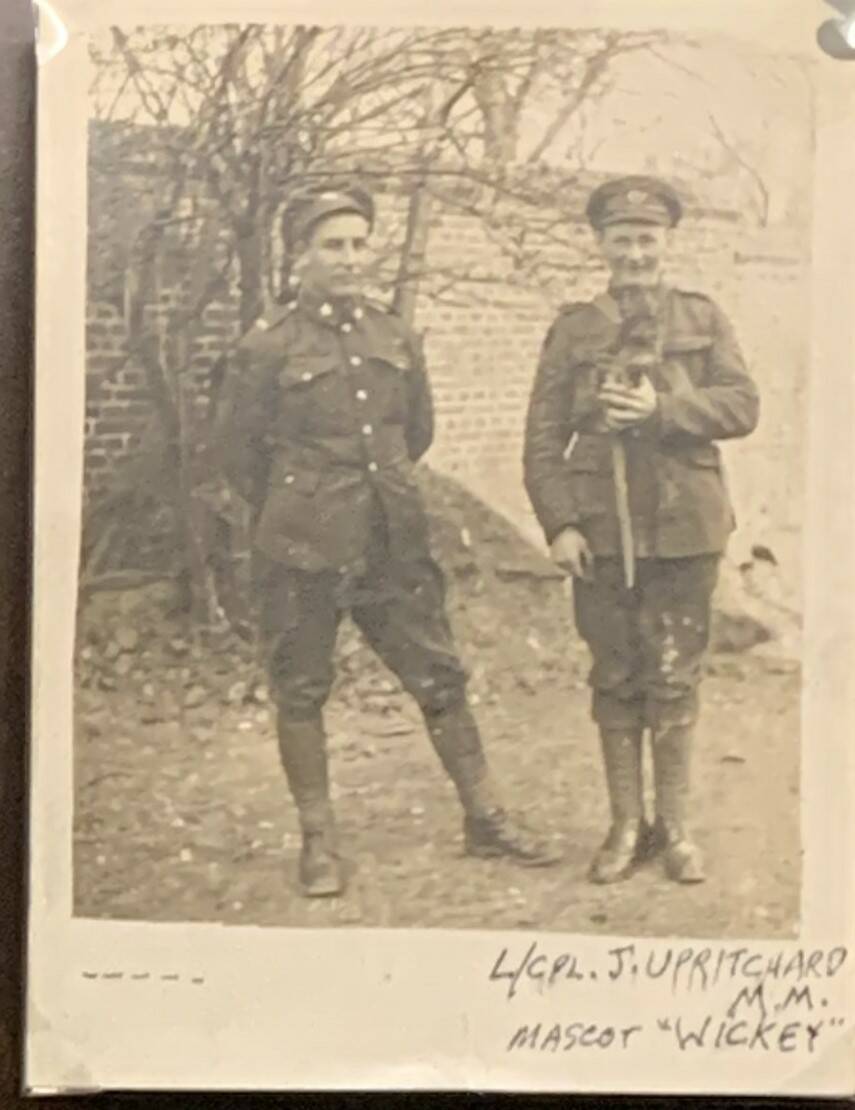
One was the 8th Canadian’s (90th Winnipeg Rifles) primate Wickey, a unique character in the history of the CEF. There are no known records of any other monkey mascot in the Library and Archives Canada.
Wickey came to the Rifles in late 1915 while they were manning trenches in the mud and blood of the Ypres Salient. Her story is told by Winnipeg soldier John Upritchard, who was wounded in 1918 during the Battle of Amiens and was later awarded a military medal for bravery.
Little is known about the men who looked after Wickey. However, service records show the group was a microcosm of the CEF at large: at least seven were born in England, most were unmarried industrial workers and labourers, three were wounded, one died of his wounds and another of Spanish Flu, and one won a medal for gallantry.
Wickey was originally owned by a French officer who was an interpreter for the Canadians. He could no longer keep her and was going to give the monkey to an officer in the 10th Battalion (Calgary Highlanders). However, 8th Battalion soldier Kenny Crossing believed he should have “first dibs” on the monkey since he was the one who had been looking after her.
The curious, trouble-making, boozy little monkey never got a special day named for her like Winnie. However, Upritchard’s comical memoir provides insight into the sneaky simian who made life a little more tolerable during the worst war the world had ever seen.
Upritchard writes:
Former members of the 8th Battalion have told many accounts of the activities of Wickey, some true, many fictitious and with the passing of the years and repeated accounts of Wickey’s escapades, many have been greatly embellished.
Cpl. Stan Taylor, Sam Sears, George Legge, Dan Maus and myself were on a fatigue (work) party, loading up a G.S. (General Service) wagon when Kenny Crossing came out of the officer’s billet and told his story about the monkey.
When asked, “Where is it?” he stated, “Hanging up in its bloody harness.” Kenny brought it out and I stuck it in the sand bag. In half an hour we moved off and a new life for the monkey began.
Several attempts were made by the 10th Battalion to get the monkey (back), but someone, somehow always managed to save the day, but you know the saying, “Possession is 90 per cent of the law.” Finally, it was taken for granted that the monkey belonged to the 8th.
She chased a rat and cornered it, the rat turned on her and she ran back to Dan and scrambled into his blanket. With the monkey chattering and Dan howling that a rat was eating the monkey, they woke the billet up, but it would be hard to say who was scared the most – Dan, Wickey or the rat
Instead of special food, she ate what she could get. The same evening, she had wine and grenadine with the boys and seemed to enjoy it. She had no harness to sleep in at night, but she attached herself to Dan Maus and for a long time she would crawl into Dan’s blanket. She would go to Bill Brooks for food.
Over time she developed quite an appetite for liquor, especially wine and grenadine. It was through trips to the estaminet (a French term for a small café) that the boys of the 8th really became acquainted with Wickey. The name Wickey was given to the monkey because of the chattering sound that she made when fighting back at anyone. She was the size of an average cat.
When in the Dickebusch (Belgium) area, the monkey developed a cold and was taken to the veterinary surgeon, Capt. Edwards, who stated that the monkey had pneumonia and was not likely to survive. This would be about the end of June 1916. With good care and with Dan Maus devoting a lot of attention to Wickey, she gradually got back to normal health. By then the battalion had moved to the Somme and was billeted in Albert (France).

The monkey was left at the Brickfield, about one mile out of Albert. During one of the intermittent periods of shelling, Wickey was injured and another anxious time was experienced. Again, Dan Maus, assisted by Jack Ray, succeeded in bringing Wickey back to normal health. Her injury left her with a limp in her right hind leg, nevertheless she was soon back to her mischievous and amusing antics that so (endeared) her to the troops.
So it continued until she was again injured on the Lens-Arras road in the Vimy Ridge area. Just what happened was never found out. Injury or no injury, Wickey always seemed to be the centre of interest and able to create a great deal of amusement.
Such as when she chased a rat and cornered it, the rat turned on her and she ran back to Dan and scrambled into his blanket. With the monkey chattering and Dan howling that a rat was eating the monkey, they woke the billet up, but it would be hard to say who was scared the most — Dan, Wickey or the rat. Dan got out of his blanket and succeeded in chasing the rat with Wickey clinging to Dan and chattering as if she were trying to explain what it was all about.
Over time Wickey the monkey developed quite an appetite for liquor, especially wine and grenadine. The name Wickey was given to the monkey because of the chattering sound that she made when fighting back at anyone.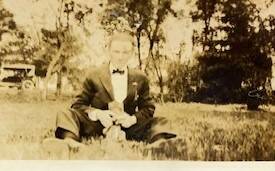
Another incident worth mentioning was when Wickey went into a roadside shrine that was close to the billet (home). An elderly woman was kneeling at the shrine when the monkey apparently jumped on her shoulders. The screams attracted several of us, who rushed to the shrine and saw the old girl swinging at the monkey with a stick. One blow would have been lights-out for the monkey. When it saw us, the monkey went after the old girl again. We had a few anxious moments to get hold of the monkey and pacify the old lady with the monkey chattering, as if to explain and justify her actions.
The monkey also found out that she could get the best of a dog by grabbing the dog’s hind leg and pulling it inwards, which put the dog on its stern end, and it was surprising how quickly Wickey could do it and amusing to see how rapidly the dog would take off.
At night, on Wickey’s return from the estaminet, after having indulged in a few drinks, she would endeavour to sneak into the billet without anyone seeing her. It was usually Dan, who would say, “You flat-faced SOB!” followed by the usual chattering to tell us all about it. One would actually have to see Wickey with her eyes looking as if they were going to pop out, a look that could only be interpreted as repentant, as she told her story about drinking. The monkey did not drink out of a glass but put its hand into the glass and then licked her hand. It was surprising how quickly a drink would be mopped up in that manner.
My connection with the monkey ended on Aug. 10, 1918, when I was wounded and never returned to the battalion. Dan Maus became the principal custodian of the monkey and, in December of 1918, he succumbed to an attack of what was referred to as the Spanish Flu. Harry Morris took charge of the monkey and brought it back to Winnipeg, when the battalion returned home. On that same evening, Harry had dinner with me and turned the monkey over to me.
I then requested the regiment to take the monkey off my hands, for what was amusing in the army was a source of trouble in civilian life.
I kept (her) from May until September but had to get rid of (her) due to the problems that she caused — such as sitting on the branch of a tree and reaching down and pulling the hats off women passing by; going around the neighbours’ clotheslines, taking clothes pegs off and dropping the clothes onto the ground; she would also bring back wool socks, usually only one, then I would have to find the owners. The last straw came when she started climbing up my neighbour’s veranda and going into his bed. It will be of interest to tell you that my neighbour was Bill Johnson, who was the Honorary Colonel of the Rifles.
I then requested the regiment to take the monkey off my hands, for what was amusing in the army was a source of trouble in civilian life. Wickey ultimately found a home at the headquarters on Main Street where a Mr. Boston was the caretaker and, in the winter of 1921, I was notified that the monkey had passed away.
The carcass was taken to a Mr. Henderson, a taxidermist on Fort Street, and during the process of curing the hide, Mr. Henderson took sick and the carcass was turned over to Mr. Darby, a taxidermist on Main Street. Unfortunately, the carcass had deteriorated to such an extent that it could not be stuffed.
So Wickey, who had created so much amusement and mischief, became a memory. Many stories can be told, the similarity would be too repetitious, therefore I hope this account will suffice to keep alive the memory of our mascot Wickey.
Perhaps, after you visit the Winnie-the-Pooh statue at the Assiniboine Park Zoo, go see the monkeys, enjoy their antics and think of Wickey in the trenches with the men who looked after her so long ago.
Ian Stewart is author of Holding Their Bit: Remembering the 8th Canadian Battalion (90th Winnipeg Rifles) 1914-1918.