

A city home with a mountain view?
You won’t find a real one, but AI-generated visual suggests otherwise

Advertisement
Read this article for free:
or
Already have an account? Log in here »
To continue reading, please subscribe:

Digital Subscription
One year of digital access for only $205*
- Enjoy unlimited reading on winnipegfreepress.com
- Read the E-Edition, our digital replica newspaper
- Access News Break, our award-winning app
- Play interactive puzzles
*First annual payment billed as $205.00 + GST for one year. This annual subscription will automatically renew at $233.00 + GST every 52 weeks (10% off the regular annual price of $259.35). Offer available to new and qualified returning subscribers only. Cancel any time.
To continue reading, please subscribe:
Add Free Press access to your Brandon Sun subscription for only an additional
$1 for the first 4 weeks*
- Enjoy unlimited reading on winnipegfreepress.com
- Read the E-Edition, our digital replica newspaper
- Access News Break, our award-winning app
- Play interactive puzzles
*Your next Brandon Sun subscription payment will increase by $1.00 and you will be charged $17.95 plus GST for four weeks. After four weeks, your payment will increase to $24.95 plus GST every four weeks.
Read unlimited articles for free today:
or
Already have an account? Log in here »
Manitoba’s mountain range peeked out behind a Scotia Street home.
At least, it did in a photo attached to a real estate listing for 232 Scotia St. in Winnipeg’s (flat) Seven Oaks neighbourhood.
Another picture — now removed — showed a cartoon cityscape viewable from the bungalow’s front porch.
Both photos had tags in their bottom left corners: “AI-generated content.”
An AI-generated image used in a Winnipeg real-estate listing showed mountains in the distance. (Screenshot from realtor.ca)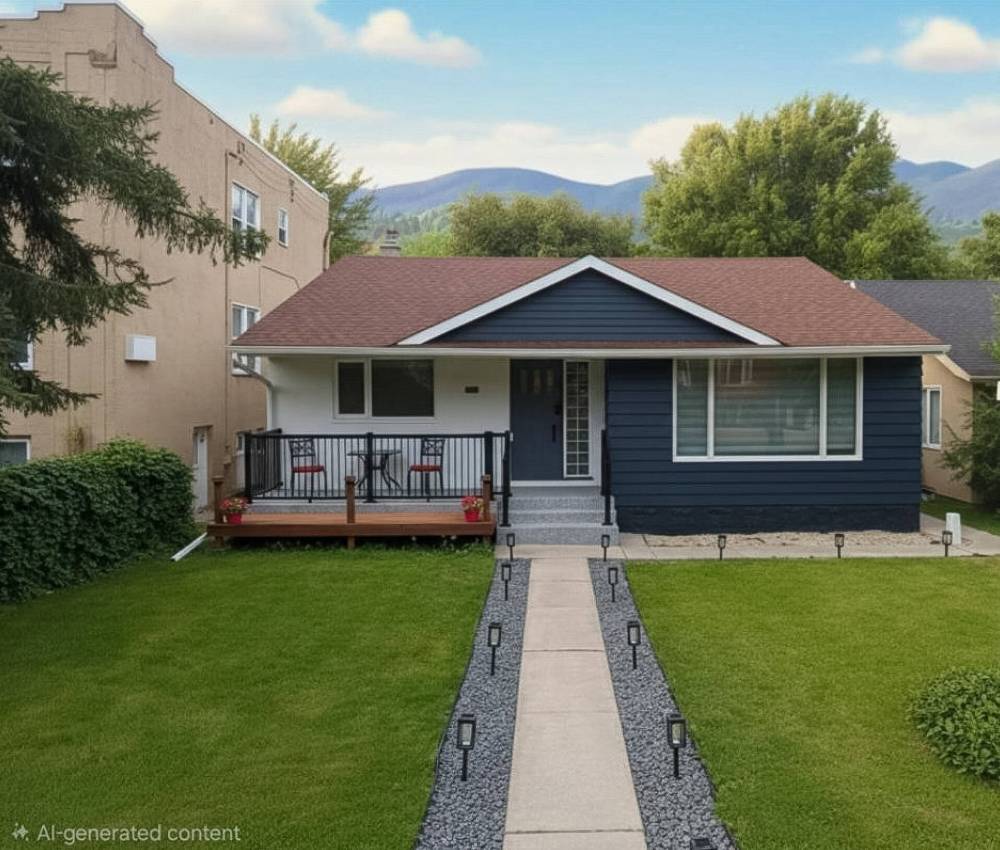
The pictures have been deleted from the online listing. But the churn of marketing content Manitoba companies make using artificial intelligence continues at a rapid pace.
“It’d be naïve to think that digital editing of photos is not used in almost every photo,” said Michael Froese, a managing broker with Royal LePage.
“It’d be naïve to think that digital editing of photos is not used in almost every photo.”
Real estate agents, and professional photographers they’ve hired, have been editing photos for years using programs such as Adobe Photoshop. Adjusting lighting and small touch-ups are common, Froese said.
“What has changed… (is) the knowledge to know how to edit photos is no longer required,” he said.
It’s hard to track how many listings use AI-augmented photos, Froese added. Real estate agents aren’t allowed to mislead the public. Removing home defects from pictures, for example, should be reported, Froese said.
A cartoon cityscape was among the AI images used in a real estate listing. The images have since been removed from the listing. (Screenshot from realtor.ca)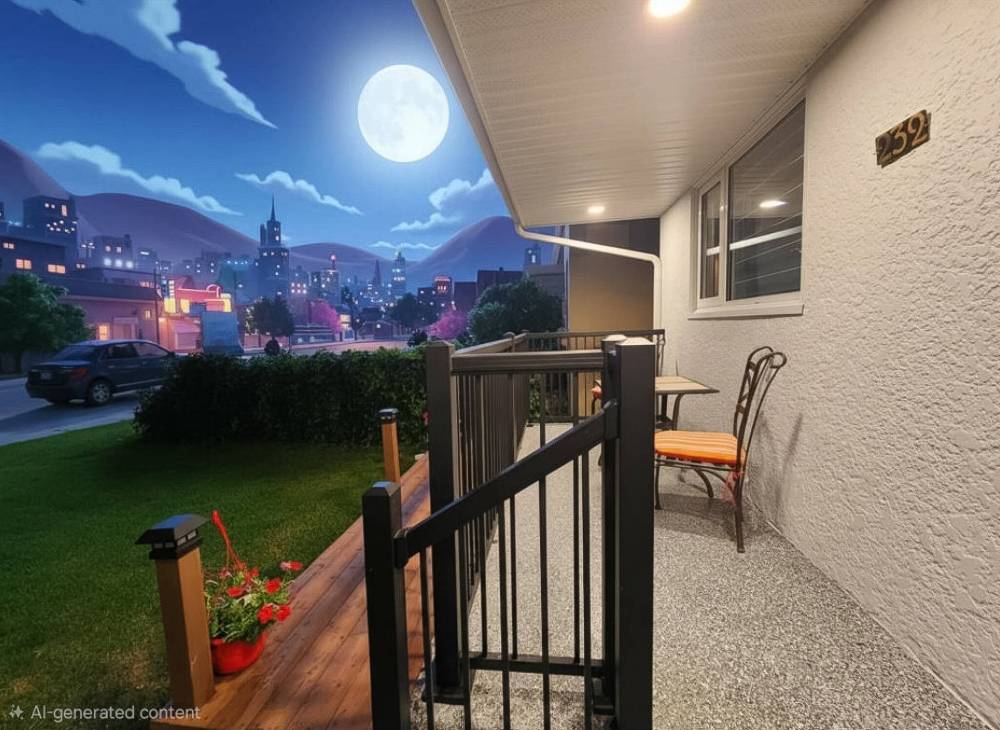
Real estate agents report concerns to the Winnipeg Regional Real Estate Board. The public can file complaints with the Manitoba Real Estate Association.
Repercussions vary on a case-by-case basis, but misleading photos are removed, said Dan O’Brien, the WRREB’s president.
The real estate board has updated its internal policies to include AI in the last year.
JP Neufeld saw the mountain-filled Winnipeg home listing. He called the pictures “ridiculous.”
“My trust of the brand does fall when I see obvious AI-generated images like that,” said Neufeld, an Osborne Village resident. “The real danger is in the non-obvious AI generated images.”
Neufeld said he’s avoided restaurants after noticing AI-generated photos on their menus: “How hard can it be to take a picture of the food you make?”
The pictures have been deleted from the online listing. (Screenshot from realtor.ca)
Eateries are using artificial intelligence “everywhere you turn,” noted Tony Siwicki, owner of Silver Heights Restaurant and Lounge.
His company has been posting AI-generated content on social media. One picture shows Siwicki on top of the Empire State Building with a plate of ribs.
He’s drawn a line: photos of Silver Heights food and people can’t be altered, but the background is fair game. Light-hearted clips have attracted people, Siwicki said.
Restaurants generally don’t have the time, resources or money to market themselves, he added.
“It was… very rare that we’d get a post out when we needed to,” Siwicki said. “(AI) just made it so easy, so fast — you can create an ad within seconds.”
He’s needed to hire since increasing the company’s social media content; it’s led to more sales, Siwicki said.
“It’s very important that you use your organic pictures,” he added. “If you’re false promoting something, that’s going to leave you lots of trouble.”

The European Union requires AI content to be clearly labelled as such. This isn’t the case for Canada, though a social media bill the feds introduced would mandate AI content labelling.
Manitoba has protections against false claims under the Business Practices Act.
Innovation Minister Mike Moroz said the provincial government aims to “lead by example” through Bill 51, which will dictate AI use in the public sector.
“The sensitivity around AI and its capacity to alter images certainly is something that the Manitobans have told us… that they’re deeply concerned about, and that they want us to work on,” Moroz said.
He’s talked to federal artificial intelligence and Canadian identity ministers about the topic, he added.
“AI has tremendous potential to improve the way we do things,” Moroz said. “It’s important that as it becomes more a part of everyday life, that Manitobans can trust what it does.
“That’s not currently the case, and we’ve got a lot of work in front of us.”
Instances such as the mountain-filled Winnipeg home listing are reminders that human oversight is needed in content creation, said Loren Remillard, president of the Winnipeg Chamber of Commerce.
He’s noticed companies from various sectors using AI in market research, content creation and social media management.
He hasn’t seen widespread marketing department layoffs, he said, but it’s possible fewer marketing jobs are posted.
“The more prolific AI becomes, AI runs the risk of… learning from AI-generated content,” Remillard said. “If there’s errors in that initial content created… it runs the risk of perpetuating these inaccuracies.”
“The sensitivity around AI and its capacity to alter images certainly is something that the Manitobans have told us… that they’re deeply concerned about, and that they want us to work on.”
It’s further reason for human intervention, he said: “(And) ultimately, your intended audience is human.”
AI allows for hyper-personalization of marketing, noted Kiran Pedada, a University of Manitoba marketing professor who studies artificial intelligence use.
Data privacy can be a concern, Pedada said. He listed speed, scale and cost savings as benefits to using AI in marketing.
“It has gone up like crazy,” he said of use. “If you are not using it, I think you’re behind.”
The bar to stand out has gotten higher because of the advertising flood, said Lam An, a University of Winnipeg marketing professor: “Your content has to be even more unique, even more human-driven, story-driven.”
Global revenue for AI marketing reached roughly US$47 billion last year, Statista reported. It predicts global AI marketing revenue will hit US$107 billion by 2028.
gabrielle.piche@winnipegfreepress.com
Gabrielle Piché reports on business for the Free Press. She interned at the Free Press and worked for its sister outlet, Canstar Community News, before entering the business beat in 2021. Read more about Gabrielle.
Every piece of reporting Gabrielle produces is reviewed by an editing team before it is posted online or published in print — part of the Free Press‘s tradition, since 1872, of producing reliable independent journalism. Read more about Free Press’s history and mandate, and learn how our newsroom operates.
Our newsroom depends on a growing audience of readers to power our journalism. If you are not a paid reader, please consider becoming a subscriber.
Our newsroom depends on its audience of readers to power our journalism. Thank you for your support.
Gabrielle Piché reports on business for the Free Press. She interned at the Free Press and worked for its sister outlet, Canstar Community News, before entering the business beat in 2021. Read more about Gabrielle.
Every piece of reporting Gabrielle produces is reviewed by an editing team before it is posted online or published in print — part of the Free Press‘s tradition, since 1872, of producing reliable independent journalism. Read more about Free Press’s history and mandate, and learn how our newsroom operates.
Our newsroom depends on a growing audience of readers to power our journalism. If you are not a paid reader, please consider becoming a subscriber.
Our newsroom depends on its audience of readers to power our journalism. Thank you for your support.
Related Articles
Government wants public input on use of AI
Advertisement Advertise With Us
Advertisement Advertise With Us