

Northern First Nation reveals ‘persons of interest’ names in provocative move to curb criminal behaviour

Advertisement
Read this article for free:
or
Already have an account? Log in here »
To continue reading, please subscribe:

Digital Subscription
One year of digital access for only $205*
- Enjoy unlimited reading on winnipegfreepress.com
- Read the E-Edition, our digital replica newspaper
- Access News Break, our award-winning app
- Play interactive puzzles
*First annual payment billed as $205.00 + GST for one year. This annual subscription will automatically renew at $233.00 + GST every 52 weeks (10% off the regular annual price of $259.35). Offer available to new and qualified returning subscribers only. Cancel any time.
To continue reading, please subscribe:
Add Free Press access to your Brandon Sun subscription for only an additional
$1 for the first 4 weeks*
- Enjoy unlimited reading on winnipegfreepress.com
- Read the E-Edition, our digital replica newspaper
- Access News Break, our award-winning app
- Play interactive puzzles
*Your next Brandon Sun subscription payment will increase by $1.00 and you will be charged $17.95 plus GST for four weeks. After four weeks, your payment will increase to $24.95 plus GST every four weeks.
Read unlimited articles for free today:
or
Already have an account? Log in here »
Hey there, time traveller!
This article was published 14/02/2025 (609 days ago), so information in it may no longer be current.
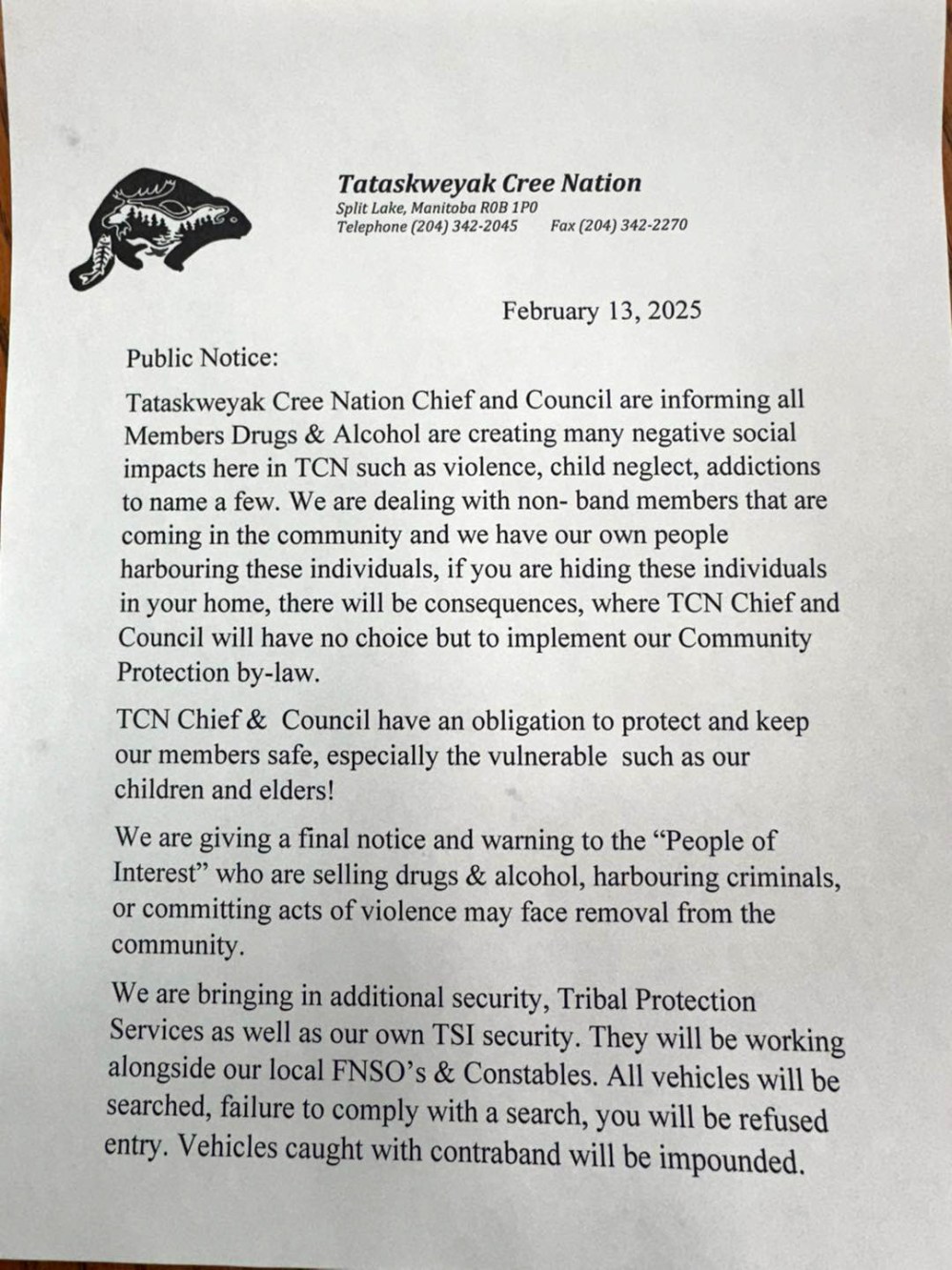
A northern Manitoba First Nation has published the names of more than 60 people — accusing them of being persons “of interest” — in a rare step amid efforts to crack down on drugs and alcohol.
Tataskweyak Cree Nation singled out residents and non-band members Thursday in social media posts that warned people could be kicked out of the community.
“We are giving a final notice and warning to the ‘people of interest’ who are selling drugs and alcohol, harbouring criminals, or committing acts of violence may face removal from the community,” a letter reads.
The letter, which contained a list of names, and an online post displaying photos of six men who appeared to be in custody, raised questions about potential legal ramifications if allegations are not proven or are untrue.
The post with the men’s photos, published on the TCN chief and councillors’ Facebook page, claimed they were “hiding” in homes, and that one was wanted for murder in Alberta.
RCMP spokesman Sgt. Paul Manaigre said no one arrested was wanted for murder in Alberta.
TCN Chief Doreen Spence was not available for comment, a band office employee said.
The federal government declined to comment on the community-led initiative.
Prof. Jennifer Schulz, an associate dean in the University of Manitoba’s faculty of law, said a person “could very well succeed” in a defamation lawsuit if allegations are not true or if someone was erroneously listed.
“The false allegation could have devastating personal and professional implications for the person listed in error, and damages (money) can be obtained in civil court for such harm,” Schulz wrote in an email.
Manaigre said the RCMP continually works with northern communities to target and combat illicit drugs.
“With respect to posting names and photos, this is not something we would do, unless there is a valid reason (warrant of arrest, public safety concern, etc.) which would be carried out by our media relations unit here in Winnipeg,” he wrote in an email.
In May, TCN declared a state of emergency due to violence and illegal activity. Council warned that removal orders would be given to “persons of interest” under the band’s community protection bylaw.
Multiple First Nations have declared states of emergency or taken steps, such as banning people or withdrawing services, via bylaws in recent years to curb drug trafficking and use.
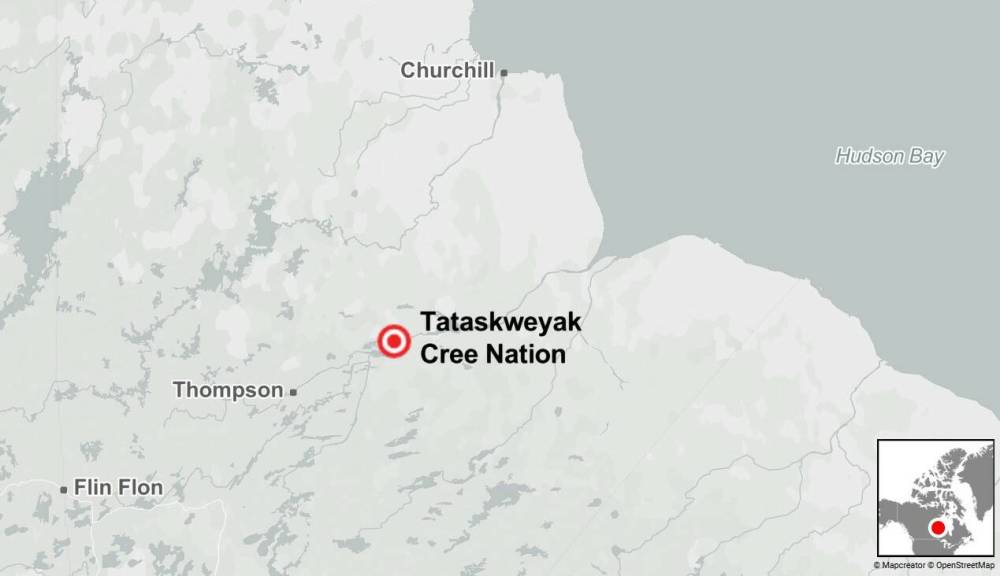
In Thursday’s letter, TCN’s council said drugs and alcohol have led to violence, child neglect and addictions in the community, which is about 770 kilometres north of Winnipeg. More than 2,400 people live in TCN, the federal government’s website states.
Checkstops and vehicle searches were among additional security measures in TCN starting this week. Rewards were offered for tips that lead to arrests or drug seizures.
“TCN chief and council have an obligation to protect and keep our members safe, especially the vulnerable, such as our children and elders!” the letter reads.
People who were named were invited to speak to Spence and councillors Thursday and Friday. The letter said “support services” were offered to people who were given “final warning” during conversations Wednesday.
‘Everybody knows’
Dakota Tipi First Nation, located just outside Portage la Prairie, about 70 kilometres west of Winnipeg, hands out evictions to residents who are accused of selling drugs, while working with police.
Chief Dennis Pashe said the community suffered nine substance-related deaths in a two-year period. Council declared a state of emergency in February 2024 due to “catastrophic effects of predatory drug trafficking.”
“We had to take steps to curb all that, and we did. We took an aggressive approach,” he said. “We enacted bylaws — trespassing bylaws and anti-drug bylaws — and tightened up our housing policy. You can’t sell or use in homes.”
Dakota Tipi’s bylaws are enforced by its own security team.
“We don’t have the deaths that we had in the past. It’s a lot… safer for kids, for families,” Pashe said.
People found to be using drugs are offered help to access treatment programs, he said. Checkstops are carried out from time to time in the community of about 300 people.
Dakota Tipi doesn’t publish lists of names such as the one posted online by TCN. That’s because it’s a small community, Pashe said.
“Everybody knows,” he said.
Joseph Fourre, who speaks to youth in First Nations and other communities about the dangers of drugs, said tough measures reflect the priorities of the people.
“It’s not just chief and council. It’s the community that is initiating the change,” he said. “They’ve had enough.”
Fourre, a resident of The Pas who started an awareness campaign called “No Thanks, I’m Good,” after his son Harlan, 31, died of a recreational drug poisoning in April 2023, said banishments can be a last resort for councils.
“They don’t want to do that. They want to have that hope the individual will turn around and be a contributing member of the community,” he said.
chris.kitching@freepress.mb.ca
Chris Kitching is a general assignment reporter at the Free Press. He began his newspaper career in 2001, with stops in Winnipeg, Toronto and London, England, along the way. After returning to Winnipeg, he joined the Free Press in 2021, and now covers a little bit of everything for the newspaper. Read more about Chris.
Every piece of reporting Chris produces is reviewed by an editing team before it is posted online or published in print — part of the Free Press‘s tradition, since 1872, of producing reliable independent journalism. Read more about Free Press’s history and mandate, and learn how our newsroom operates.
Our newsroom depends on a growing audience of readers to power our journalism. If you are not a paid reader, please consider becoming a subscriber.
Our newsroom depends on its audience of readers to power our journalism. Thank you for your support.
Chris Kitching is a general assignment reporter at the Free Press. He began his newspaper career in 2001, with stops in Winnipeg, Toronto and London, England, along the way. After returning to Winnipeg, he joined the Free Press in 2021, and now covers a little bit of everything for the newspaper. Read more about Chris.
Every piece of reporting Chris produces is reviewed by an editing team before it is posted online or published in print — part of the Free Press‘s tradition, since 1872, of producing reliable independent journalism. Read more about Free Press’s history and mandate, and learn how our newsroom operates.
Our newsroom depends on a growing audience of readers to power our journalism. If you are not a paid reader, please consider becoming a subscriber.
Our newsroom depends on its audience of readers to power our journalism. Thank you for your support.
Advertisement Advertise With Us
Advertisement Advertise With Us