

Take precautions for your heart while snow shoveling, cardiovascular experts say
Advertisement
Read this article for free:
or
Already have an account? Log in here »
To continue reading, please subscribe:
Monthly Digital Subscription
$1 per week for 24 weeks*
- Enjoy unlimited reading on winnipegfreepress.com
- Read the E-Edition, our digital replica newspaper
- Access News Break, our award-winning app
- Play interactive puzzles
*Billed as $4.00 plus GST every four weeks. After 24 weeks, price increases to the regular rate of $19.95 plus GST every four weeks. Offer available to new and qualified returning subscribers only. Cancel any time.
Monthly Digital Subscription
$4.99/week*
- Enjoy unlimited reading on winnipegfreepress.com
- Read the E-Edition, our digital replica newspaper
- Access News Break, our award-winning app
- Play interactive puzzles
*Billed as $19.95 plus GST every four weeks. Cancel any time.
To continue reading, please subscribe:
Add Free Press access to your Brandon Sun subscription for only an additional
$1 for the first 4 weeks*
*Your next subscription payment will increase by $1.00 and you will be charged $16.99 plus GST for four weeks. After four weeks, your payment will increase to $23.99 plus GST every four weeks.
Read unlimited articles for free today:
or
Already have an account? Log in here »
Hey there, time traveller!
This article was published 17/02/2025 (404 days ago), so information in it may no longer be current.
TORONTO – Bev Gilbert was thinking about his heart as he and his wife dug their daughter’s car out of its snow prison on a Toronto side street.
“I take it really easy,” the 71-year-old said Monday as he gestured toward a vehicle almost entirely encased in snow.
“I got a small shovel. I’m not taking great big piles (of snow).”
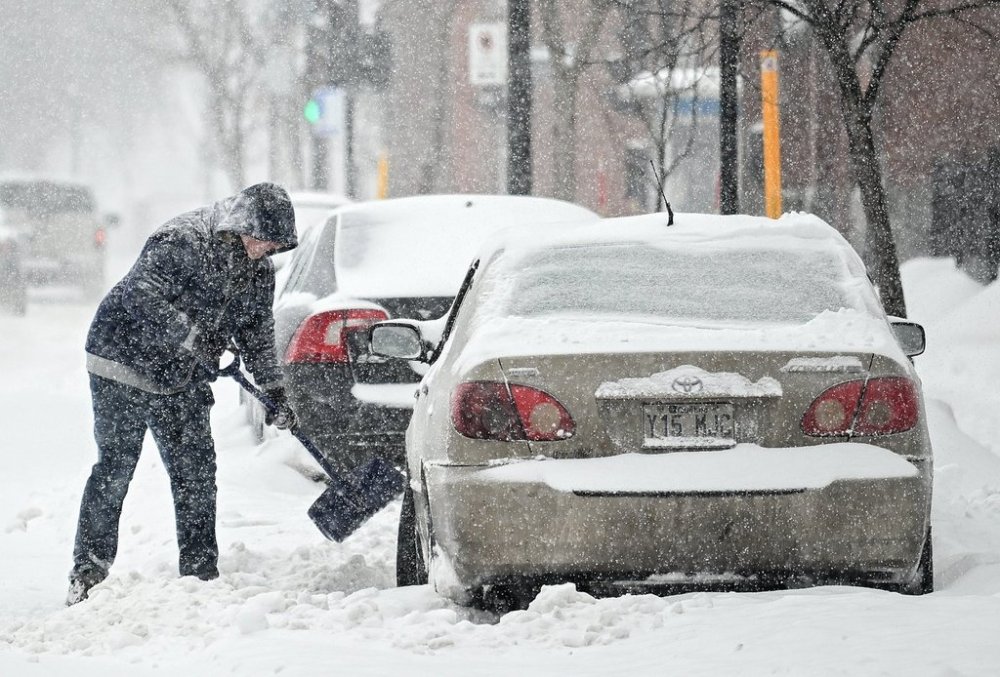
Gilbert was among many people across Eastern Canada digging themselves out from more snowfall than many have seen in years. Cardiovascular experts would approve of his precautions — along with the fact that he keeps in good shape overall by walking throughout the winter.
“If you’re not doing any physical activity, it’s not a good idea from one day to the other to go and (be) shoveling snow,” said Francine Forget Marin, director of health promotion and research for the Heart and Stroke Foundation in Quebec.
“You have to be physically active, you know, all year long.”
The death rate from heart attacks is about 10 per cent higher in the winter, according to the Heart and Stroke Foundation, noting the danger can be even higher for older people. In addition to the strain of shoveling snow, cold weather raises blood pressure, which in itself is a risk factor for heart disease and stroke, Forget Marin said.
Dr. Christopher Labos, a cardiologist and epidemiologist in Montreal, said most people “don’t fully appreciate how physically demanding” shoveling snow is.
Although the risk of heart disease and stroke does increase as people get older, Labos said there’s no particular age at which people should avoid shoveling since age is only one of several risk factors.
“If you are 60 but (have) no medical problems whatsoever, you’re probably going to be in good shape, especially if you exercise regularly,” Labos said.
“Whereas if you’re 55 but have, you know, diabetes and you smoke and you’re in poor shape because you don’t exercise, shoveling that driveway is going to be a much higher risk, much more difficult activity for you.”
Labos said the best way to minimize the risk of heart attack while shoveling is to take it slow and do it gradually.
“You wouldn’t wake up one day and decide to try to run a marathon. You would do a short walk and when you get tired, you would stop,” he said.
“You don’t have to shovel the entire driveway in one shot. You can do it in small sections. You can do a little bit and then take a break. You can try not to lift very much snow at any one time, so you can do it slowly.”
Pushing the snow as much as possible rather than lifting and carrying it can also make shoveling less strenuous, as well as prevent back and joint injuries, Labos said.
The Heart and Stroke Foundation also recommends stretching and warming up before shoveling, staying hydrated, and trying to tackle the snow while it’s fresh rather than waiting until it is frozen and harder.
The foundation also stresses the importance of recognizing the signs of a heart attack.
Those include: chest discomfort, shortness of breath, sweating, nausea, light-headedness or discomfort in the neck, jaw, shoulders arms or back.
Women may not have chest pressure when they have a heart attack, the Heart and Stroke Foundation says. Some other heart attack symptoms in women can include pressure or pain in the abdomen or upper back. Extreme fatigue can also be a symptom.
This report by The Canadian Press was first published Feb. 17, 2025.
Canadian Press health coverage receives support through a partnership with the Canadian Medical Association. CP is solely responsible for this content.