An encroaching desert threatens to swallow Mauritania’s homes and history
Advertisement
Read this article for free:
or
Already have an account? Log in here »
To continue reading, please subscribe:

Digital Subscription
One year of digital access for only $205*
- Enjoy unlimited reading on winnipegfreepress.com
- Read the E-Edition, our digital replica newspaper
- Access News Break, our award-winning app
- Play interactive puzzles
*First annual payment billed as $205.00 + GST for one year. This annual subscription will automatically renew at $233.00 + GST every 52 weeks (10% off the regular annual price of $259.35). Offer available to new and qualified returning subscribers only. Cancel any time.
To continue reading, please subscribe:
Add Free Press access to your Brandon Sun subscription for only an additional
$1 for the first 4 weeks*
- Enjoy unlimited reading on winnipegfreepress.com
- Read the E-Edition, our digital replica newspaper
- Access News Break, our award-winning app
- Play interactive puzzles
*Your next Brandon Sun subscription payment will increase by $1.00 and you will be charged $17.95 plus GST for four weeks. After four weeks, your payment will increase to $24.95 plus GST every four weeks.
Read unlimited articles for free today:
or
Already have an account? Log in here »
Hey there, time traveller!
This article was published 20/02/2025 (602 days ago), so information in it may no longer be current.
CHINGUETTI, Mauritania (AP) — For centuries, poets, scholars and theologians have flocked to Chinguetti, a trans-Saharan trading post home to more than a dozen libraries containing thousands of manuscripts.
But it now stands on the brink of oblivion. Shifting sands have long covered the ancient city’s 8th-century core and are encroaching on neighborhoods at its current edge. Residents say the desert is their destiny.
As the world’s climate gets hotter and drier, sandstorms are more frequently depositing inches and feet of dunes onto Chinguetti’s streets and in people’s homes, submerging some entirely. Tree-planting projects are trying to keep the invading sands at bay, but so far, they haven’t eased the deep-rooted worries about the future.
Chinguetti is one of four UNESCO World Heritage sites in Mauritania, a West African nation where only 0.5% of land is considered farmable. In Africa — the continent that contributes the least to fossil fuel emissions — only Somalia and Eswatini have experienced more climate change impacts, according to World Bank data.
Mauritanians believe Chinguetti is among Islam’s holiest cities. Its dry stone and mud mortar homes, mosques and libraries store some of West Africa’s oldest quranic texts and manuscripts, covering topics ranging from law to mathematics.
Community leader Melainine Med El Wely feels agonized over the stakes for residents and the history contained within Chinguetti’s walls. It’s like watching a natural disaster in slow motion, he said.
“It’s a city surrounded by an ocean of sand that’s advancing every minute,” El Wely, the president of the local Association for Participatory Oasis Management, said. “There are places that I walk now that I remember being the roofs of houses when I was a kid.”
He remembers that once when enough sand blew into his neighborhood to cover the palms used to make roofs, an unknowing camel walking through the neighborhood plunged into what was once someone’s living room.
Research suggests sand migration plays a significant role in desertification. Deserts, including the Sahara, are expanding at unprecedented rates and “sand seas” are being reactivated, with blowing dunes transforming landscapes where vegetation once stood.
“What we used to think of as the worst case scenario five to 10 years ago is now actually looking like a more likely scenario than we had in mind,” said Andreas Baas, an earth scientist from King’s College London who researches how winds and the way they blow sand are changing.
More than three-quarters of the earth’s land has become drier in recent decades, according to a 2024 United Nations report on desertification. The aridity has imperiled ability of plants, humans and animals to survive. It robs lands of the moisture needed to sustain life, kills crops and can cause sandstorms and wildfires.
“Human-caused climate change is the culprit; known for making the planet warmer, it is also making more and more land drier,” the U.N. report said. “Aridity-related water scarcity is causing illness and death and spurring large-scale forced migration around the world.”
Scientists and policymakers are mostly concerned about soils degrading in once-fertile regions that are gradually becoming wastelands, rather than areas deep in the Sahara Desert.
Still, in Chinguetti, a changing climate is ushering in many of the consequences that officials have warned about. Trees are withering, wells are running dry and livelihoods are vanishing.
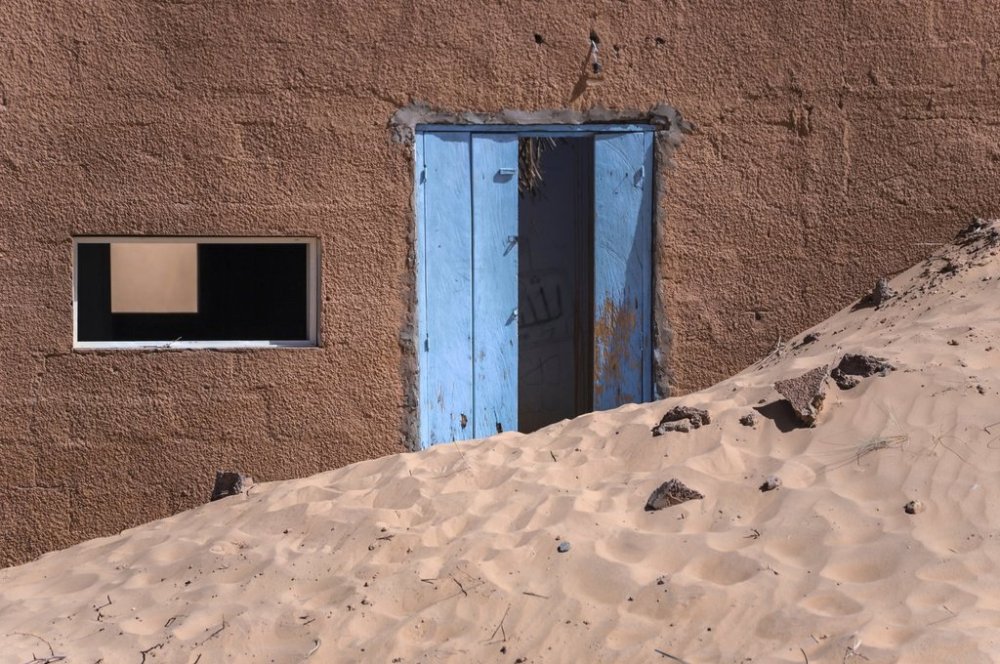
Date farmers like 50-year-old Salima Ould Salem have found it increasingly difficult to nourish their palm trees, and now have to pipe in water from tanks and prune more thoroughly to make sure it’s used efficiently. Salem’s neighborhood used to be full of families, but they’ve gradually moved away. Sand now blocks the doorway to his home. It’s buried those where some of his neighbors once lived. And a nearby guesthouse built by a Belgian investor decades ago is now half-submerged in a rippling copper-hued dune.
Though many have departed, Salem remains, aware that each time a member of the community leaves, their home can no long serve as a bulwark and the rest of the community therefore becomes more likely to be swallowed by the desert.
“We prefer to stay here. If I leave, my place will disappear,” the 50-year-old date farmer said.
Acacia, gum and palm trees once shielded the neighborhood from encroaching dunes, but they’ve gradually disappeared. The trees have either died of thirst or have been cut down by residents needing firewood or foliage for their herds to feed on.
Sandstorms are not new but have become increasingly intrusive, each leaving inches or feet in the neighborhoods on the edge of the city, retired teacher Mohamed Lemine Bahane said. Residents use mules and carts to remove the sand because the old city’s streets are too narrow to accommodate cars or bulldozers. When sand piles high enough, some build new walls atop existing structures.
“When you remove the vegetation, it gives the dunes a chance to become more active, because it’s ultimately the vegetation that can hold down the sand so it doesn’t blow too much,” Bahane said.
Bahane has for years taken measurements of the sand deposits and rains and says that Chinguetti has received an annual average of 2.5 centimeters (one inch) of rainfall over the past decade. As rainfall plummets, trees die, and more sand migrates into town. And with shorter acacia trees submerged in sand, some herders resort to cutting down date palm trees to feed their flocks, further disrupting the ecosystem and date farming economy. The sands also raise public health concerns for the community breathing in the dust, Bahane said.
The solution, he believes, has to be planting more trees both in neighborhoods and along the perimeter of town. Such “green belts” have been proposed on a continent-wide scale as Africa’s “Great Green Wall” as well as locally, in towns like Chinguetti. Mauritania’s Ministry of Environment and Ministry of Agriculture as well as European-funded NGOs have floated projects to plant trees to insulate the city’s libraries and manuscripts from the incoming desert.
Though some have been replanted, there’s little sign that it has contributed to stopping the desert in its tracks. It can take years for taproots to grow deep enough into the earth to access groundwater.
“We’re convinced that desertification is our destiny. But thankfully, there are still people convinced that it can be resisted,” El Wely, the community leader, said.
___
The Associated Press’ climate and environmental coverage receives financial support from multiple private foundations. It receives financial support for global health and development coverage in Africa from the Gates Foundation. AP is solely responsible for all content. Find AP’s standards for working with philanthropies, a list of supporters and funded coverage areas at AP.org.