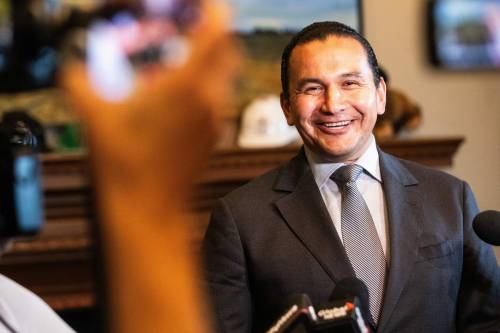
She never stops moving Manitoba’s Brita Hall has found glory and purpose over 44 medal-laden years as a fiercely competitive Special Olympics winter athlete
Read this article for free:
or
Already have an account? Log in here »
To continue reading, please subscribe:

Digital Subscription
One year of digital access for only $205*
- Enjoy unlimited reading on winnipegfreepress.com
- Read the E-Edition, our digital replica newspaper
- Access News Break, our award-winning app
- Play interactive puzzles
*First annual payment billed as $205.00 + GST for one year. This annual subscription will automatically renew at $233.00 + GST every 52 weeks (10% off the regular annual price of $259.35). Offer available to new and qualified returning subscribers only. Cancel any time.
To continue reading, please subscribe:
Add Free Press access to your Brandon Sun subscription for only an additional
$1 for the first 4 weeks*
- Enjoy unlimited reading on winnipegfreepress.com
- Read the E-Edition, our digital replica newspaper
- Access News Break, our award-winning app
- Play interactive puzzles
*Your next Brandon Sun subscription payment will increase by $1.00 and you will be charged $17.95 plus GST for four weeks. After four weeks, your payment will increase to $24.95 plus GST every four weeks.
Read unlimited articles for free today:
or
Already have an account? Log in here »
Hey there, time traveller!
This article was published 21/02/2025 (579 days ago), so information in it may no longer be current.
Almost as soon as she answers the front door, Brita Hall extends an invitation to see her bedroom, an airy pocket around the corner where nearly every square centimetre is covered with bronze, silver and gold. If a breeze were to blow through her window, the entire bungalow on Pasadena Avenue would sing with the chorus of a champion’s wind chime.
She used to know how many medals she’d won, and how many podiums she’d stood on, but a few decades ago, she and her mother Birgit say, they lost count. An estimate of 500 seems appropriate.
Hall isn’t bragging, though the 55-year-old has every right to show off her hardware, a collection that began accumulating in 1980 and continues to grow each time she clicks into her cross-country skis, which have guided her along a remarkable 44-year career in competitive winter sport that was set in motion at a stop light in Seattle.
RUTH BONNEVILLE / FREE PRESS
One of two bedroom walls covered in medals and awards won by Brita Hall.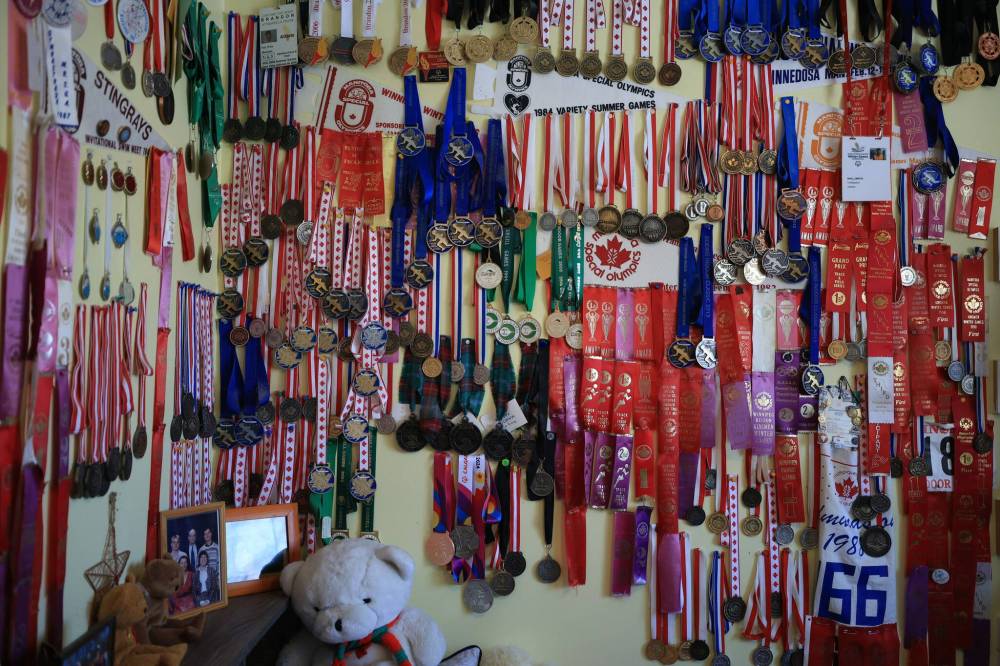
In the home of the Space Needle, during the year that man first set foot on the moon, Birgit Hall was behind the wheel of the family’s station wagon, idling at an intersection with newborn Brita in the pram to her rear on the driver’s side.
“I turned her head toward the back door because the sun was in her eyes and I saw that it irritated her,” she says. A few moments later came a crash: a driver didn’t notice the stalled traffic, blasting straight into the wagon’s bumper with such force that it wound up leading to a four-car pileup, the instigating car winding up on the Hall vehicle’s roof.
Everyone survived, but the injuries the infant Hall sustained were so significant that physicians expressed doubt as to whether she would ever speak a word or take a single step once her two-week stay in intensive care ended. There was a 90 per cent chance that because of the collision, Hall’s life would be quiet and stationary.
Birgit solemnly but resolutely prepared for that outcome.
Born in Hamburg and married to a British business scholar named Roger Hall who was working on his PhD in Seattle, the young, well-educated, multilingual mother abandoned a career that had seen her positioned as a secretary to diplomats at the German Embassy in London in order to give her daughter, who was certain to live with cognitive disabilities, proper support during an era that predated modern principles of inclusivity and acceptance.
For a while, the Halls grew accustomed to their daughter’s immovable reality: the 48-month windows of neurological and muscular development came and went without any major hint of forthcoming motion.
Their care was unconditional, but the parents still clung to the outside chance that Brita — rhymes with Rita — would someday move on her own accord, wriggle on the floor on her belly and race around the shopping mall, getting herself into all the mischief and glory associated with a toddler’s curiosity and ambulatory progress.
RUTH BONNEVILLE / FREE PRESS
Birgit Hall clung to the outside chance her daughter would someday move on her own accord.
They moved to Winnipeg, where Roger had been hired by the business faculty at the University of Manitoba.
Then in March 1974, Brita Hall was kidnapped.
She must have been, thought Birgit, because how else could she have disappeared from the bench at the centre of a Fort Richmond Royal Bank branch, where the mother had planted the daughter for a moment while conducting a transaction with a teller?
“It was like a miracle,” says Birgit, who collapsed and started crying when she turned around to see her daughter running around in circles. “She’d never before stood on her feet — had never before moved. I could sit her in the corner, and she would sit there all day until I moved her to a different spot. Then one day she decided, ‘That’s it’; she got up and ran and she never stopped.’”
By December of that year, Brita was skating on a pond in St. Vital.
Fast-forward more than a half-century. She’s preparing to compete next month in the Special Olympics World Winter Games in Turin, Italy, where she will look to bring home a few more souvenirs to cover what little blank space remains on her bedroom wall.
“I have to move my body,” she says.
RUTH BONNEVILLE / FREE PRESS
Brita Hall will head to the Special Olympics World Winter Games in Turin, Italy in March.
Brita waited three years after taking her first steps to utter her first words and, soon, her first two-word sentences: “Brita walk,” “Brita eat,” “Brita drink.” In 1977, Birgit had to plead with the school division for her daughter to have access to speech therapy.
“The answer was always that certain children were limited,” Hall recalls. Eventually, a speech therapist was assigned to work with Brita twice a week in 20-minute sessions. “After six weeks, it was day and night.”
Manitoba athletes Italy-bound
From March 8-16, Brita Hall will be joined in Turin by eight other Manitoba athletes at the Special Olympics World Winter Games. Team Canada will compete against more than 1,500 athletes from 102 countries across eight winter sports.
- Gimli’s Alec Baldwin (snowshoe)
- Thompson’s Cory Beardy (cross-country ski)
- Winnipeg’s Harry Burns (snowshoe)
- Selkirk’s Dylan Collins (alpine ski)
- Steinbach’s William Middleton (snowshoe)
- Winnipeg’s Rachel Nickel (snowshoe)
- Winnipeg’s Jenny Noonan (snowshoe)
- Winnipeg’s Brock Whiteway (alpine ski)
Her participation in the classroom skyrocketed; she became a voracious reader with penmanship skills to match.
By the time she was 11, the tide for special-needs education and special-needs specific programming was at last beginning, slowly, to turn with the incorporation of Special Olympics Manitoba in April 1980.
The fledgling organization, co-founded by ex-pro hockey player Ted Irvine, sought to create space for athletes living with cognitive impairments to not just participate and succeed, but to benefit from the long-term social relationships inherent to competitive sport.
Living with any sort of disability, or supporting a loved one living with one, can sometimes feel like taking on the entire world alone in a lopsided tug-of-war, or a game of one vs. 1,000 where the solo player rarely gets a chance to touch the ball and show what they can do.
Special Olympics represented a vision where widespread acceptance was the rule, not the exception: everyone can play.
The Halls were pitched the idea of Brita’s participation by her elementary school teacher Maureen Dowds, who spent six years as the CEO of Special Olympics Manitoba.
Brita was intrigued and decided to don a competitor’s bib at the 1980 provincial games, where she elected to train for the 800-metre event in cross-country skiing.
In her very first race, she won provincial gold.
Aside from when the Jets lose, Brita Hall is all smiles, but her coaches say you shouldn’t let the grin fool you: any athlete lining up against her should be prepared to keep up with a deceptively fierce competitor.
During her first training session with Red River Nordic, the club where she has trained for the past eight years, Hall was tethered to Chris Roe in a strength-and-endurance relay, with Hall tugging her coach along the path covered in fresh snow.
“I found out very quickly what Brita was all about,” says Roe, who tripped several times.
“She said, ‘Chris, if you stop falling, maybe we would win!’ I thought to myself, ‘I just met you!’ And then she had this great, infectious laugh, but already I noticed her competitive drive and her ability to bring light to any situation. She’s very of the moment.”
MIKE SUDOMA / FREE PRESS
“I found out very quickly what Brita was all about,” says her coach Chris Roe.
She’s also able to motivate herself on the playing field in ways that belie her loving demeanour, says Colleen Lowdon-Bula, the director of sport at Special Olympics Manitoba, who first met Brita in 2002 and has travelled with her to several national and provincial tournaments since.
“I’ll tell you a funny story,” says Lowdon-Bula, herself a former competitive figure skater.
“At the most recent national games in Calgary last February, the conditions were incredibly hilly and icy. Brita doesn’t like skiing on ice or on hills, and as a group we were watching her. Now, Brita always yells when she skis, but you can’t hear her at first. Then she gets closer, and we could hear her yelling, “I hate you, Colleen! You’re making me ski!
“Then I was the first person she hugged when she got across the finish line.”
Despite her displeasure with the conditions, Hall returned home with two silvers and a bronze, the third-place finish coming during the love-hate race, a 7.5-kilometre classic ski.
SUPPLIED
Brita Hall skiing at the 1998 Paralympics in Nagano, Japan.

But Hall’s success isn’t merely the result of emotional investment.
Her training schedule is rigorous, especially during February, which is typically the high season for cross-country ski competitions.
On Mondays, she recovers; at least twice a week, she exercises at the University of Manitoba’s Active Living Centre, where she’s worked for decades; on Wednesdays, she participates in time trials with Red River Nordic; on Thursdays, she does a recovery ski; Fridays are for rest, and the weekends are when she shines.
Her endurance is legendary, which is a double-edged ski pole. As a result of her injuries, Hall’s sensory receptors are muted, meaning that she — like many super-heroes — can withstand intense cold or heat without noticing its impact on her body.
“She doesn’t really feel pain,” says Roe.
“Once, I noticed she was walking funny and I wondered why, and it turned out that she skate-skied with a button under her foot for 10 kilometres,” her mother says. “If something’s wrong, it could do major damage without feeling.”
So, when Hall shouted out in discomfort last November during a training session, it came as a shock; her tolerance level for pain is so much higher than average that the members of Team Brita rushed to her aid.
A painful flare-up of plantar fasciitis took Hall off her feet for a few weeks, which momentarily threatened to curtail her path to the upcoming winter games in Turin, where she will be joined by eight other Manitoba competitors. But whatever agony she experienced that month was softened somewhat when she was honoured in a way no Special Olympian had ever been before.
On Nov. 7, Brita was inducted into the Manitoba Sports Hall of Fame.
MIKE SUDOMA / FREE PRESS
Brita's endurance is legendary.
Enshrined in a class that included hockey great Jennifer Botterill, the dynastic University of Manitoba men’s volleyball teams of the 1980s and Ted Irvine, Hall took to a different podium to deliver her acceptance speech, pausing whenever she flipped the page to roar with laughter at the spectacle.
The inductees were invited to a luncheon the following afternoon, where each new member took part in the tradition of signing their autograph in silver or gold pen on a black wall at the Sport Manitoba headquarters on Pacific Avenue.
Hall uncapped her marker and, as is her wont, gave a bit of an extra flair, signing in bold lettering, “Brita Hall of Fame.”
“It was a funny idea, right?” she says. “It just came to me.”
ben.waldman@winnipegfreepress.com
Special Olympics battles coach shortage, misconceptions
On April 16, Special Olympics Manitoba will mark the 45th anniversary of the organization’s incorporation.
For more than 1,900 local athletes and counting, the organization offers opportunities in athletics, basketball, bocce, 10-pin bowling, golf, rhythmic gymnastics, power-lifting, soccer, softball, swimming, alpine skiing, cross-country skiing, curling, five-pin bowling, snowshoeing, speedskating and floor hockey.
“The biggest challenge we have is finding volunteer coaches,” says director of sport Colleen Lowdon-Bula, who says there are athletes on wait lists for participation because of the shortage.
Ahead of the winter games in Italy, Manitoba’s Special Athletes will compete Saturday in the annual Winnipeg Winterfest, which includes five-pin bowling at Billy Mosienko Lanes, alpine skiing at Spring Hill Winter Park, cross-country skiing at the Windsor Park Nordic Centre, and floorball, speedskating and snowshoeing competitions at St. John’s-Ravenscourt.
“The biggest misconceptions people have is that we’re the same as Paralympics,” says Lowdon-Bula. “Paralympics are for athletes with physical disabilities, while athletes in Special O have intellectual disabilities. The other misconception is that we modify our sports, which we don’t. We follow all the same rules. Watching our athletes curl is like watching curling anywhere else.”
— Ben Waldman

Ben Waldman is a National Newspaper Award-nominated reporter on the Arts & Life desk at the Free Press. Born and raised in Winnipeg, Ben completed three internships with the Free Press while earning his degree at Ryerson University’s (now Toronto Metropolitan University’s) School of Journalism before joining the newsroom full-time in 2019. Read more about Ben.
Every piece of reporting Ben produces is reviewed by an editing team before it is posted online or published in print — part of the Free Press‘s tradition, since 1872, of producing reliable independent journalism. Read more about Free Press’s history and mandate, and learn how our newsroom operates.
Our newsroom depends on a growing audience of readers to power our journalism. If you are not a paid reader, please consider becoming a subscriber.
Our newsroom depends on its audience of readers to power our journalism. Thank you for your support.
History
Updated on Tuesday, March 4, 2025 3:29 PM CST: Correction made to copy.