Carlyle Group co-founder Bill Conway’s $1 billion plan to end the nursing shortage
Advertisement
Read this article for free:
or
Already have an account? Log in here »
To continue reading, please subscribe:

Digital Subscription
One year of digital access for only $205*
- Enjoy unlimited reading on winnipegfreepress.com
- Read the E-Edition, our digital replica newspaper
- Access News Break, our award-winning app
- Play interactive puzzles
*First annual payment billed as $205.00 + GST for one year. This annual subscription will automatically renew at $233.00 + GST every 52 weeks (10% off the regular annual price of $259.35). Offer available to new and qualified returning subscribers only. Cancel any time.
To continue reading, please subscribe:
Add Free Press access to your Brandon Sun subscription for only an additional
$1 for the first 4 weeks*
- Enjoy unlimited reading on winnipegfreepress.com
- Read the E-Edition, our digital replica newspaper
- Access News Break, our award-winning app
- Play interactive puzzles
*Your next Brandon Sun subscription payment will increase by $1.00 and you will be charged $17.95 plus GST for four weeks. After four weeks, your payment will increase to $24.95 plus GST every four weeks.
Read unlimited articles for free today:
or
Already have an account? Log in here »
Hey there, time traveller!
This article was published 25/02/2025 (594 days ago), so information in it may no longer be current.
Bill Conway didn’t start out wanting to make a big impact on the nursing profession.
In 2011, the financier announced he would give away $1 billion to create jobs for the poor and asked the public to send him ideas. In came around 2,500 suggestions. Most were sob stories, but some people had good ideas, he says, and several suggested backing bachelor’s degree nursing programs.
“It was along the lines of: If we support potential students to get a nursing degree, then they’ll always be able to get a job and take care of themselves, their families, and the rest of us,” remembers Conway. “My wife and I thought that sounded pretty good.”
Currently, private giving for the nursing profession accounts for only one cent of every dollar given for health care, according to a report from the foundation arm of the American Nurses Association. And giving to nursing isn’t a popular cause among most wealthy donors.
But there are exceptions. Leonard Lauder has given $177 million to nursing schools at the University of Pennsylvania and Hunter College, and Mark and Robyn Jones donated $100 million to expand Montana State University’s nursing program. Yet no other wealthy donor has dedicated as much money to such a wide range of nursing programs as Conway, the 75-year-old co-founder of the private equity giant the Carlyle Group, and his late wife, Joanne Barkett Conway, who died in January, 2024.
Those efforts are destined to grow, with Conway only about a third of the way toward his target of giving $1 billion to nursing. So far, he has donated $325.6 million to support student aid, new buildings, efforts to recruit and retain faculty, and more at 22 nursing schools in the Eastern and mid-Atlantic regions. He also is backing a pediatric nursing program at Children’s National Hospital, in Washington, D.C.
Over the past decade, that money has helped produce more than 7,000 nurses. Now, he says, he wants to take his support of nursing programs nationwide.
“I expect that of most of the money I leave to charity will go to continuing this mission,” says Conway, whose net worth Forbes estimates at $4 billion. “I see that we’re starting to make a difference in some places, and I’d like to make more of a difference over time.”
Faculty shortage
America’s nursing shortage is misunderstood, says Linda Aiken, a professor at the University of Pennsylvania’s nursing school. The public hears about a nursing shortage and thinks there are not enough nurses or people who want to become nurses, but the problem is more complicated than that, she says.
While nurses are the largest group of health care professionals and the backbone of health care, their contributions are frequently undervalued by health care systems, and many are underpaid and experience a higher rate of burnout than other medical professionals, according to Aiken and other nursing experts.
Many more people want to become nurses than there are spots available in nursing schools because there are not enough nursing professors. As a result, nursing schools can accept few of the students who apply.
In 2022, roughly 78,000 qualified applicants were not accepted to U.S. nursing schools because of insufficient faculty, classrooms and lab space, according to the American Association of Colleges of Nursing. There are also about 2,000 full-time nursing faculty vacancies at U.S. nursing schools, says Katie Fioravanti, director of the foundation arm of the American Association of Colleges of Nursing.
“Attracting people to teach nursing is challenging because they can make considerably higher salaries in actual practice,” Fioravanti says. “By the time they get a Ph.D. and go back to become a nursing faculty member or a dean, they’re already in their 50s, and that means they retire sooner.”
Philanthropy by learning
The Conways didn’t know much about nursing when they decided to donate to the field. With the help of a colleague whose wife was a nurse, the couple began learning about the profession and university nursing programs.
They first gave money to support tuition at nursing schools, largely at the behest of Joanne Conway, a onetime scholarship student, and because her husband wanted to ensure students graduated without the burden of college debt.
“I wanted them to be free to be the kind of nurse they wanted to be,” he says. “If they wanted to work in an inner-city clinic and not make too much money or if they wanted to work someplace where they were going to make a lot of money, I wanted them to do what they wanted.”
Gradually, Conway supported building projects that expanded classroom and lab space, the hiring of additional faculty, and scholarships for nurses seeking advanced degrees to teach.
His giving process has mostly stayed the same. When Conway is considering a first-time gift, he and the head of his Bedford Falls Foundation, Elizabeth Carrott Minnigh, visit nursing schools, meet with deans and ask for data related to graduation rates and nursing licenses.
“We’re looking to see if it’s going to be a partnership where we could fund a reasonably large number of students who would actually get to the finish line without debt that will cripple them in their career choices and opportunities,” Carrott Minnigh says.
Conway and Carrott Minnigh then visit the schools regularly to talk to deans, faculty and students about any challenges they might be facing. These conversations have often translated into more targeted grants.
“We don’t have a one-size-fits-all grant-making process,” Carrott Minnigh says. “It’s all customized to what we hear at the schools about what they want and need.”
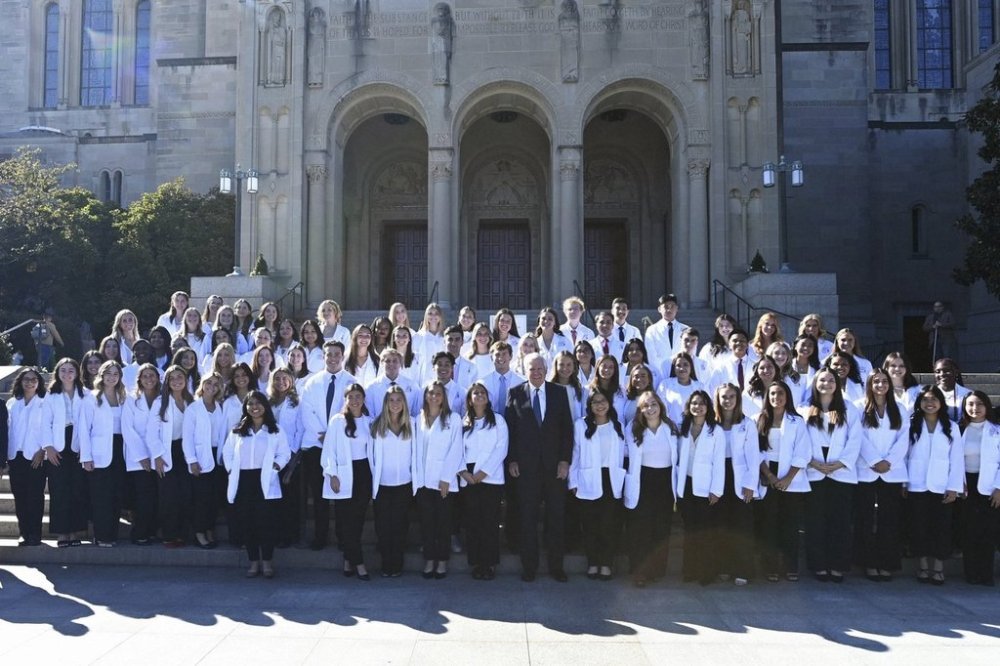
For example, in 2013, the Conways gave $4 million to Catholic University’s nursing school. Since then, their giving to the institution — now named the Conway School of Nursing — has grown to more than $64 million, expanding full scholarships, largely paying for a new nursing school building and backing graduate nursing programs. The Conways also have supported mentoring efforts and a review course to prepare students for the National Council Licensure Examination for Registered Nurses.
“Calling his donations transformational is not saying enough,” says Marie Nolan, dean of Catholic’s nursing school.
Over the past decade, Conway has also significantly funded the University of Virginia’s nursing school. In 2013, he gave $5 million for nursing scholarships and over time has donated nearly $50 million to expand scholarships for undergraduate and graduate nursing programs, support nurses who want to become professors, and help people pivot into nursing.
UVA’s nursing school’s dean, Marianne Baernholdt, says Conway’s extensive giving to nursing programs, and particularly his efforts to help nursing students early in their education, is rare among wealthy donors.
“There are a couple of nursing schools that got big sums to increase their advanced practice nursing programs,” Baernholdt says. “But very few invest in pre-licensure, which is what the Conways have done.”
_____
Maria Di Mento is a senior reporter at the Chronicle of Philanthropy, where you can read the full article. This article was provided to The Associated Press by the Chronicle of Philanthropy as part of a partnership to cover philanthropy and nonprofits supported by the Lilly Endowment. The Chronicle is solely responsible for the content. For all of AP’s philanthropy coverage, visit https://apnews.com/hub/philanthropy.