Culinary murder mystery ‘A Killing at La Cucina’ an acquired taste

Advertisement
Read this article for free:
or
Already have an account? Log in here »
To continue reading, please subscribe:

Digital Subscription
One year of digital access for only $205*
- Enjoy unlimited reading on winnipegfreepress.com
- Read the E-Edition, our digital replica newspaper
- Access News Break, our award-winning app
- Play interactive puzzles
*First annual payment billed as $205.00 + GST for one year. This annual subscription will automatically renew at $233.00 + GST every 52 weeks (10% off the regular annual price of $259.35). Offer available to new and qualified returning subscribers only. Cancel any time.
To continue reading, please subscribe:
Add Free Press access to your Brandon Sun subscription for only an additional
$1 for the first 4 weeks*
- Enjoy unlimited reading on winnipegfreepress.com
- Read the E-Edition, our digital replica newspaper
- Access News Break, our award-winning app
- Play interactive puzzles
*Your next Brandon Sun subscription payment will increase by $1.00 and you will be charged $17.95 plus GST for four weeks. After four weeks, your payment will increase to $24.95 plus GST every four weeks.
Read unlimited articles for free today:
or
Already have an account? Log in here »
Hey there, time traveller!
This article was published 27/02/2025 (542 days ago), so information in it may no longer be current.
Lucia Dante (a saucy Lauren Brotman) doesn’t tuck a pistol into her pocket, but as she struts her way into Fate, a restaurant that promises out-of-body experiences, the world-renowned detective has a more dangerous weapon strapped in a holster on her leather-covered thigh: a cellular phone.
In A Killing at La Cucina, playwright Thomas Morgan Jones’ intermittently insightful, more frequently slapdash skewering of modernist tastes that opened Wednesday at Prairie Theatre Exchange, the lingering threat of technocratic minimalism casts an unsavoury shadow on the fine art of dining, a pursuit that Fate’s haughty staffers define as an exercise in life or death.
Faced with clear warnings of caveat emptor, the consumer accepts all cookies as they leave behind a trail of digital crumbs.

Dylan Hewlett photo
Braden Griffiths in A Killing at La Cucina
Before tucking in for the first course of a four-hour, $15,000-per-plate culinary experience, prepared by the abrasive chef Sebastian (Braden Griffiths, who alternates among five roles with gusto), Fate’s patrons — like iOS users — are given the opportunity to peruse a 40-page waiver to comply with the terms and conditions; it doesn’t hide the potential for disaster in the fine print.
In fact, the chance to expire at the dinner table is the restaurant’s main draw: every customer accepts the risk that they may be poisoned, the one in a thousand — the 0.1 per cent — who bites the bullet in an indiscriminate game of kitchen roulette.
Alimentary, my dear Watson.
Jones, the former artistic director of PTE, is guilty of overseasoning his script with unwieldy and cumbersome (though admittedly ambitious) backstories grounded in perceived realities and artificial intelligence, while purposefully omitting key ingredients about the characters on and offstage that might have helped audiences connect more deeply with the dish they’ve been served.
Brotman’s Dante, who revels in Italian pronunciation (“I have a huncheh,” she says midway through the first act) is discussed by Griffith’s battery of characters — a brooding sous chef, a folksy hacker, a wealthy investor — in terms of celebrity.
However, there’s so much tip-toeing around the source of her fame that it feels as though the audience is simply meant to accept that a sleuth can even achieve world-renown in the digital age. Which cases did she crack that earned Dante such a reputation?
Perhaps this is an attempt by the writer to poke at the simulacrum of celebrity possessed by an ever-expanding roster of social media influencers, whose lives flourish and wither overnight like unpicked fruits of the vine, succumbing to the rapidly ticking clock of daily talking points.
Dylan Hewlett photo
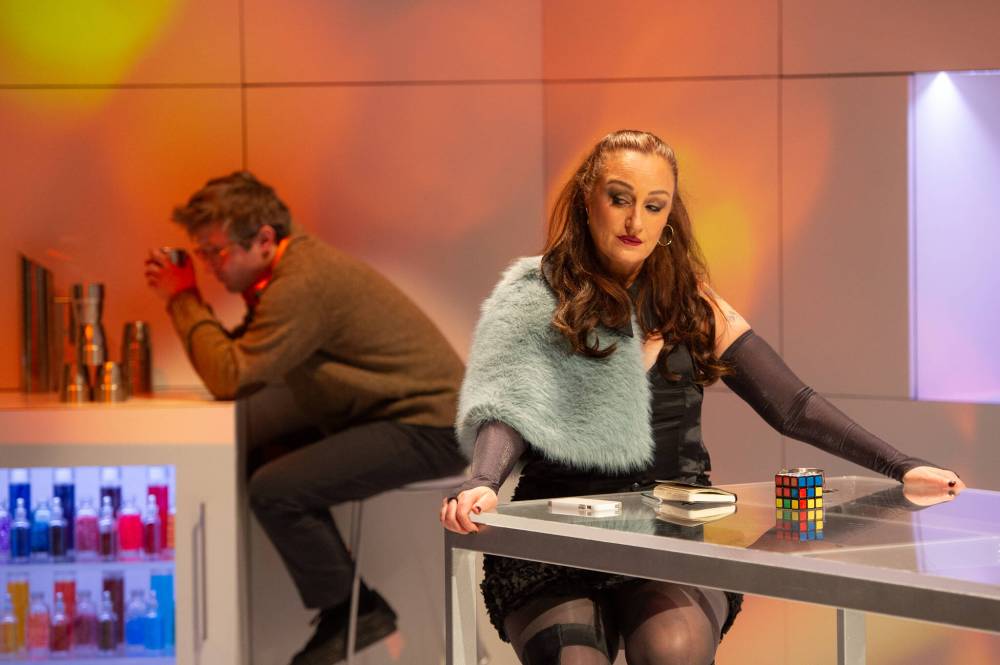
A Killing at La Cucina is bolstered by its likable performers, Lauren Brotman as Lucia Dante (right) and Braden Griffiths here in one of his five roles.
The themes of puzzling anonymity are plumbed further by the event that instigates Dante’s visit: the death, at the table, of Richard Carlyle, an influential reviewer who’s come to consider Fate as the be-all and end-all of restaurant experiences.
Here, Jones teases real depth of insight. Carlyle is considered a kingmaker, capable of moving millions of consumer dollars with a single rave or pan. But discerning viewers will note that Carlyle is an independent critical thinker, not representing any esteemed publication.
By presenting Carlyle — who makes an appearance in a video recording that probably needed a few more takes to meet the performance standard of Brotman and Griffiths — as an everyday eater, a mouth unchained, Jones eventually makes a compelling case for the power of the consumer, which can be wielded for better or worse to make or break an entrepreneurial spirit.
Especially as seen through a pandemicized lens, A Killing at La Cucina calls to mind the capacity to sic digital mobs against those with whom we disagree, when online reviews submitted by nameless, faceless entities can outweigh the authentic experiences of well-intentioned diners.
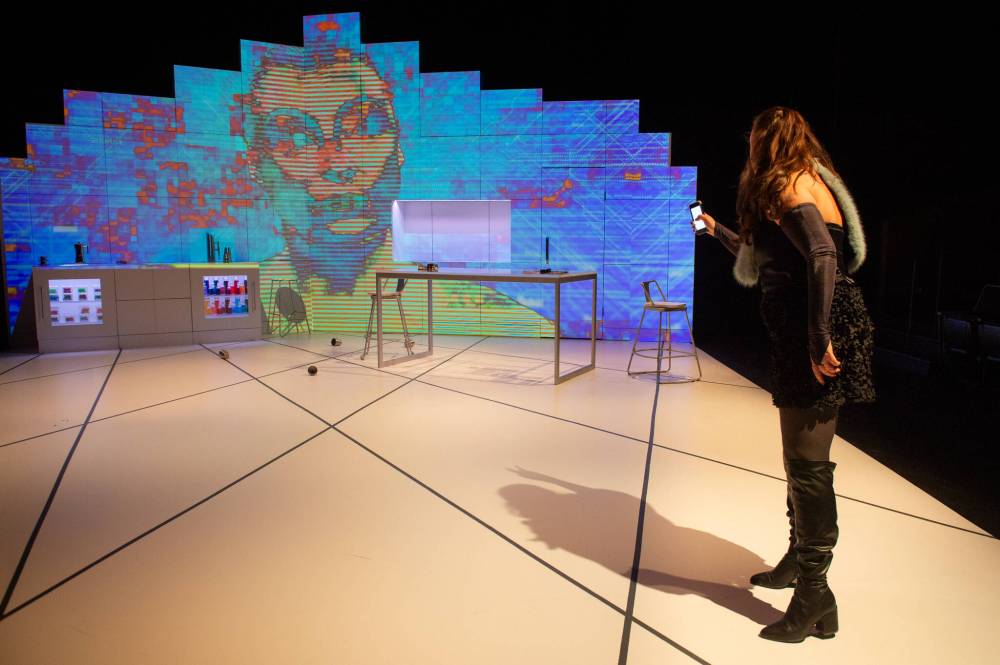
Ultimately, director and dramaturg Jack Grinhaus’ staging of A Killing at La Cucina (two hours, 10 minutes, with intermission) is bolstered by its likable performers, who twist and turn through designer Narda McCarroll’s perspective-shifting, sugar-cube set, lit up periodically by Andy Moro’s spookily conceived projections and jaymez’ pulsating light show. Sound design by MJ Dandeneau enriches the production whenever it’s given an opportunity to do so.
But for however much Jones and company offer us to chew and sip on, there remained on opening night in the Cherry Karpyshin Mainstage Theatre an obvious hunger for more depth of flavour.
Dylan Hewlett photo
Designer Narda McCarroll’s perspective-shifting, sugar-cube set is lit by Andy Moro’s spookily conceived projections and jaymez’ pulsating light show.
As always, it’s a matter of taste, and audiences who grab a seat at the table will take away bits and bites of insight into their own behaviours of consumption and cultural digestion.
An often-scathing critique of review culture that sometimes feels outweighed by design; with fewer characters, and a lower word count, it might have said more.
ben.waldman@winnipegfreepress.com
Ben Waldman is a National Newspaper Award-nominated reporter on the Arts & Life desk at the Free Press. Born and raised in Winnipeg, Ben completed three internships with the Free Press while earning his degree at Ryerson University’s (now Toronto Metropolitan University’s) School of Journalism before joining the newsroom full-time in 2019. Read more about Ben.
Every piece of reporting Ben produces is reviewed by an editing team before it is posted online or published in print — part of the Free Press‘s tradition, since 1872, of producing reliable independent journalism. Read more about Free Press’s history and mandate, and learn how our newsroom operates.
Our newsroom depends on a growing audience of readers to power our journalism. If you are not a paid reader, please consider becoming a subscriber.
Our newsroom depends on its audience of readers to power our journalism. Thank you for your support.
Theatre review
A Killing at La Cucina
● Prairie Theatre Exchange, 3rd floor, Portage Place
● Runs to March 9
★★½ out of five
Ben Waldman is a National Newspaper Award-nominated reporter on the Arts & Life desk at the Free Press. Born and raised in Winnipeg, Ben completed three internships with the Free Press while earning his degree at Ryerson University’s (now Toronto Metropolitan University’s) School of Journalism before joining the newsroom full-time in 2019. Read more about Ben.
Every piece of reporting Ben produces is reviewed by an editing team before it is posted online or published in print — part of the Free Press‘s tradition, since 1872, of producing reliable independent journalism. Read more about Free Press’s history and mandate, and learn how our newsroom operates.
Our newsroom depends on a growing audience of readers to power our journalism. If you are not a paid reader, please consider becoming a subscriber.
Our newsroom depends on its audience of readers to power our journalism. Thank you for your support.
Related Articles
New PTE murder mystery A Killing at La Cucina focused on food
Advertisement Advertise With Us
Advertisement Advertise With Us