

March madness
Big little city Winnipeg gears up for busy spring real estate market
Advertisement
Read this article for free:
or
Already have an account? Log in here »
To continue reading, please subscribe:
Digital Subscription
One year of digital access for only $1.44 a week*
- Enjoy unlimited reading on winnipegfreepress.com
- Read the E-Edition, our digital replica newspaper
- Access News Break, our award-winning app
- Play interactive puzzles
*Billed as $5.77 plus GST every four weeks. After 52 weeks, price increases to the regular rate of $19.95 plus GST every four weeks. Offer available to new and qualified returning subscribers only. Cancel any time.
To continue reading, please subscribe:
Add Free Press access to your Brandon Sun subscription for only an additional
$1 for the first 4 weeks*
- Enjoy unlimited reading on winnipegfreepress.com
- Read the E-Edition, our digital replica newspaper
- Access News Break, our award-winning app
- Play interactive puzzles
*Your next Brandon Sun subscription payment will increase by $1.00 and you will be charged $17.95 plus GST for four weeks. After four weeks, your payment will increase to $24.95 plus GST every four weeks.
Read unlimited articles for free today:
or
Already have an account? Log in here »
Hey there, time traveller!
This article was published 01/03/2025 (596 days ago), so information in it may no longer be current.
Winnipeg may not top the list for National Hockey League players, as one recent survey seems to show. Yet it should be for young adults looking for a toehold in Canada’s real estate market that in some big cities seems like a millionaires-only club.
A recent market forecast by Canada Mortgage and Housing Corp. suggests ‘Winterpeg’ will shine among resale markets this year, especially as the busy spring market gets underway.
“We also are going to see a little bit of price growth and more housing construction activity in 2025,” says CMHC housing economist Michael Mak. “This is a relative strength to other markets.”
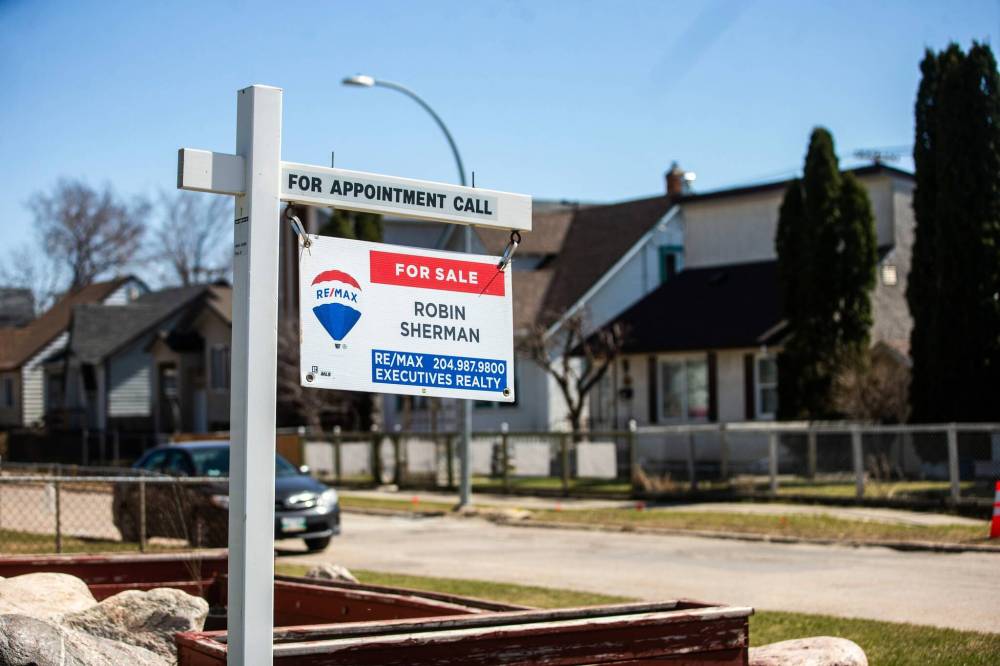
The “relative” in that statement is noteworthy. Mak is based in Vancouver, where the typical ownership of a house is largely out of reach for worker bees. The average aggregate price of a home in the West Coast seaport city — single-family, condo or townhome — is forecast to reach as a base case this year about $1.2 million.
That would be a down market, but CMHC forecasts the price could hit nearly $1.5 million by 2026’s end.
In contrast, fair Winnipeg’s market is a steal. Even a bad market will likely see growth from about $385,000 at 2024’s to $401,800 by 2025’s close, CMHC predicts.
Also notable is single-family detached homes — the Canadian dream — remain affordable. Well, relatively.
In January, the average price of a single-family home was up six per cent from the same month in 2024 to reach nearly $425,000, Winnipeg Real Estate Board statistics show. By comparison, the average price for the housing type in Greater Vancouver was more than $2 million.
Even though the average price is about a fifth of the cost as its West Coast peer, it doesn’t mean trying to buy a home today in Winnipeg isn’t stressful.
A recent IG Wealth Management survey suggests housing is an anxiety-inducing topic.
Affordability remains a concern in the seventh annual edition of the poll, says Alana Riley, head of mortgage, insurance and banking at IG Wealth Management in Calgary.
“It’s certainly a hot topic,” she says. “A discussion a lot of people are having is whether their kids will ever own a home.”
IG found Canadians are generally feeling more financially stable than past years — though this data was gathered late last year as opposed to the current tariff-threat-laden environment. A few months ago, Canadians had reason to be a bit upbeat, with interest rates decreasing and the potential for more cuts this year.
Only 56 per cent of respondents indicated housing affordability will get worse. That may not sound great, but it is an improvement from 2023, when 62 per cent stated affordability was worsening.
Renters tend to be more pessimistic.
“Four in 10 renters are expecting to downsize or share living spaces to afford an increase,” Riley says, noting some are moving in with parents or other family members.
But in Winnipeg, many renters should be considering ownership.
With interest rates forecast to come down slightly and potentially falling even more if the Bank of Canada slashes rates to emergency levels amid a trade war, 2025 could be as affordable as the market gets.
Already, the current rate environment has generated a lot of interest.
“We’re seeing more first-time homebuyers, who have been sitting on the sidelines, now getting back into the market,” says Aaron Brager, mortgage specialist with Castle Mortgage Group in Winnipeg.
Many homeowners with rock-bottom rate mortgages are facing renewal this year, too, but today at least, they face better conditions than just a year ago.
“At renewal, you’ve got a few options,” Brager notes. “You can just renew your mortgage that is offered by your current lender.”
You can shop for a better rate at a different lender. “Or if you have enough equity, you can refinance and potentially consolidate high-interest debt to bring down overall monthly payments for a better cash flow position.”
Renters who still dream of ownership can also crunch the numbers to determine if it’s better to own as rates fall. The math might work well even now.
Considering the average prices today for a single-family home and a condominium, lower mortgage rates have slightly improved affordability versus just one year ago, Brager says.
With a five per cent down payment for a $415,000 single-family home, a monthly mortgage payment for a five-year contract with average fixed rates in the low four per cent range is about $2,225. A year ago, when the rate was about one percentage point higher, that payment was about $2,430.
For a condo — with the average price of $250,000 — the monthly mortgage payment was $1,465 one year ago versus $1,340 today.
By comparison, average rent in Winnipeg in February was $1,373 per month for a one-bedroom.
Yet the numbers only favour ownership if you have a down payment.
Two federal programs can help: the Home Buyers’ Plan, allowing you to borrow up to $60,000 from your RRSP; and the First Home Savings Account, that allows first-timers to save up to $8,000 a year, receiving an RRSP-like tax deduction on contributions. FHSA contributions can be invested and grow tax-free. When purchasing a home, they can be withdrawn tax-free for the down payment.

Even with these programs, for individuals with little money to set aside, a down payment can still feel like a tall order.
All the more reason to seek out financial advice, Riley says.
“A financial adviser can help renters with a detailed budget and savings plan,” she says. “That will not only help them improve their day-to-day finances, but it will also set them up for longer-term goals like buying a home.”
Joel Schlesinger is a Winnipeg-based freelance journalist
joelschles@gmail.com