Ancient humans made tools from animal bones 1.5 million years ago

Advertisement

Advertise with us

WASHINGTON (AP) — Early humans were regularly using animal bones to make cutting tools 1.5 million years ago.

Read this article for free:


or

Already have an account? Log in here »

To continue reading, please subscribe:

Subscribe and receive a limited-edition Free Press branded hat or tote.

Digital Subscription

One year of digital access for only $205*

  • Enjoy unlimited reading on winnipegfreepress.com
  • Read the E-Edition, our digital replica newspaper
  • Access News Break, our award-winning app
  • Play interactive puzzles

*First annual payment billed as $205.00 + GST for one year. This annual subscription will automatically renew at $233.00 + GST every 52 weeks (10% off the regular annual price of $259.35). Offer available to new and qualified returning subscribers only. Cancel any time.

To continue reading, please subscribe:

Add Free Press access to your Brandon Sun subscription for only an additional

$1 for the first 4 weeks*

  • Enjoy unlimited reading on winnipegfreepress.com
  • Read the E-Edition, our digital replica newspaper
  • Access News Break, our award-winning app
  • Play interactive puzzles
Start now

*Your next Brandon Sun subscription payment will increase by $1.00 and you will be charged $17.95 plus GST for four weeks. After four weeks, your payment will increase to $24.95 plus GST every four weeks.

Hey there, time traveller!
This article was published 05/03/2025 (521 days ago), so information in it may no longer be current.

WASHINGTON (AP) — Early humans were regularly using animal bones to make cutting tools 1.5 million years ago.

A newly discovered cache of 27 carved and sharpened bones from elephants and hippos found in Tanzania’s Olduvai Gorge site pushes back the date for ancient bone tool use by around 1 million years. Researchers know that early people made simple tools from stones as early as 3.3 million years ago.

The new discovery, published Wednesday in Nature, reveals that ancient humans “had rather more complex tool kits than previously we thought,” incorporating a variety of materials, said William Harcourt-Smith, a paleoanthropologist at the American Museum of Natural History, who was not involved in the research.
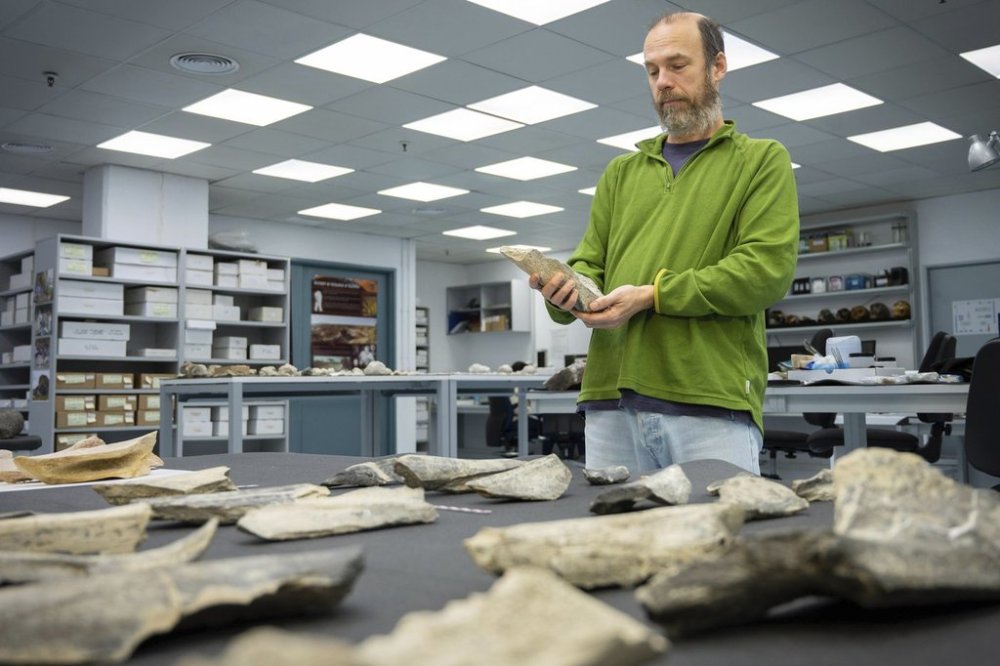
In this photo provided by the Spanish National Research Council (CSIC), researcher Ignacio de la Torre holds a bone tool found in Tanzania's Olduvai Gorge, at the CSIC-Pleistocene Archaeology Lab in Madrid in 2023. (Angeliki Theodoropoulou/CSIC via AP)

The well-preserved bone tools, measuring up to around 16 inches (40 centimeters), were likely made by breaking off the thick ends of leg bones and using a stone to knock off flakes from the remaining bone shaft. This technique was used to create one sharpened edge and one pointed tip, said study co-author Ignacio de la Torre, a researcher at the Spanish National Research Council.

The bone tools were “probably used as a hand axe” – a handheld blade that’s not mounted on a stick – for butchering dead animals, he said.

Such a blade would be handy for removing meat from elephant and hippo carcasses, but not used as a spear or projectile point. “We don’t believe they were hunting these animals. They were probably scavenging,” he said.

Some of the artifacts show signs of having been struck to remove flakes more than a dozen times, revealing persistent craftsmanship.

The uniform selection of the bones – large and heavy leg bones from specific animals – and the consistent pattern of alteration makes it clear that early humans deliberately chose and carved these bones, said Mírian Pacheco, a paleobiologist at the Federal University of Sao Carlos in Brazil, who was not involved in the study.

The bones show minimal signs of erosion, trampling or gnawing by other animals — ruling out the possibility that natural causes resulted in the tool shapes, she added.

The bone tools date from more than a million years before our species, Homo sapiens, arose around 300,000 years ago.

At the time the tools were made, three different species of human ancestors lived in the same region of East Africa, said Briana Pobiner, a paleoanthropologist at the Smithsonian’s Human Origins Program, who was not involved in the study.

The tools may have been made and used by Homo erectus, Homo habilis or Paranthropus boisei. “It could have been any of these three, but it’s almost impossible to know which one,” said Pobiner.

___

The Associated Press Health and Science Department receives support from the Howard Hughes Medical Institute’s Science and Educational Media Group and the Robert Wood Johnson Foundation. The AP is solely responsible for all content.


Report Error Submit a Tip

More Stories

A measure of hope a decade after senseless death, injustice

Niigaan Sinclair 5 minute read Preview

A measure of hope a decade after senseless death, injustice

Niigaan Sinclair 5 minute read 3:29 PM CDT

I’m a few hundred kilometres from the farm near Biggar, Sask. — the place where 22-year old Colten Boushie from Cree Red Pheasant First Nation was shot and killed by farmer Gerald Stanley precisely 10 years ago.

“You need to remind people about the 10-year anniversary,” a nearby, rural school principal tells me at the education conference I just finished speaking at.

“That death is a wound that continues to bleed in all of us,” a principal from Regina adds. “I hear about it from our students all the time.”

On Aug. 9, 2016, Boushie’s death entered the Canadian consciousness, representing what then-Saskatoon mayor Charlie Clark declared “a defining moment for this community and this country.”

Read
3:29 PM CDT

Family hopes police alert will bring missing woman home

Morgan Modjeski 3 minute read Preview

Family hopes police alert will bring missing woman home

Morgan Modjeski 3 minute read Yesterday at 6:59 PM CDT

The family of Ashley Arason has made a desperate plea for her to come home.

The 41-year-old last had contact with her family on April 6, 2019, which was her 34th birthday.

“I’ve got a place for her,” said her older sister, Pamela Arason, through tears on Thursday. “She has a place to go, a home to come to.”

On Thursday, Winnipeg Police Service renewed the call for help from the public to solve the missing person case.

Read
Yesterday at 6:59 PM CDT

Federal government to build $267-M emergency research lab in Winnipeg

Chris Kitching 6 minute read Preview

Federal government to build $267-M emergency research lab in Winnipeg

Chris Kitching 6 minute read Wednesday, Aug. 5, 2026

The federal government says it will build a $267-million medical countermeasures laboratory in Winnipeg with the goal of preparing Canada for future pandemics or outbreaks.

Expected to open in 2033, the national site will help the country develop vaccines, therapeutics and diagnostic tools, Winnipeg Liberal MP Terry Duguid said.

“This is a big deal for our city and for our province, a big deal for life sciences in Canada,” he told reporters Wednesday. “This facility is going to help protect the nation and help protect the world.”

Ottawa said the site — to be located next to the National Microbiology Laboratory’s Canadian Science Centre for Human and Animal Health on Arlington Street, just north of William Avenue — draws on lessons learned during the COVID-19 pandemic.

Read
Wednesday, Aug. 5, 2026

Chrysler refines Pacifica and Grand Caravan as buyers return to practical family hauler

Kelly Taylor 5 minute read Preview

Chrysler refines Pacifica and Grand Caravan as buyers return to practical family hauler

Kelly Taylor 5 minute read 3:00 AM CDT

BURLINGTON, Ont. — The mighty minivan — relegated to the scrap heap by the rush to crossovers and SUVs — is making a comeback, and Chrysler hopes to lead the way with its top-selling, Canadian-made Grand Caravan and Pacifica models.

While many manufacturers — Mazda, Ford, GM, Hyundai and Nissan — abandoned the once-popular family hauler, Chrysler has continued to play in the segment since it was launched by Lee Iacocca in 1983.

For 2027, the Pacifica gets a cosmetic refresh and the Grand Caravan is a holdover, but new this year are price savings of up to $7,200, Chrysler product planner Mike Szymkiewicz told journalists assembled here for the launch of the two vehicles.

“It’s primarily that we’re taking less margin, but we’re also adding content,” he said. “So less margin but we hope more volume.”

Read
3:00 AM CDT

Walk on Portage Avenue reveals difficult present, some cause for optimism

Dan Lett 5 minute read Preview

Walk on Portage Avenue reveals difficult present, some cause for optimism

Dan Lett 5 minute read Updated: Yesterday at 3:23 PM CDT

On a recent visit back to Winnipeg, I got to witness the multitudes of Portage Avenue.

From my Airbnb on Hargrave Street, I had the opportunity to do quite a bit of walking on Portage Avenue, from Portage and Memorial all the way down to the recently opened intersection at Portage and Main.

Along the way, I saw it all: huge and dynamic construction projects, persistent urban decay and the occasional oasis of revitalization.

All in the space of 10 blocks.

Read
Updated: Yesterday at 3:23 PM CDT

Puzzles Palace

1 minute read Monday, Jul. 27, 2026

To solve our puzzles, please subscribe with this special offer: |