Risks of state abortion reporting mandates outweigh the benefits, an advocacy group says
Advertisement
Read this article for free:
or
Already have an account? Log in here »
To continue reading, please subscribe:

Digital Subscription
One year of digital access for only $205*
- Enjoy unlimited reading on winnipegfreepress.com
- Read the E-Edition, our digital replica newspaper
- Access News Break, our award-winning app
- Play interactive puzzles
*First annual payment billed as $205.00 + GST for one year. This annual subscription will automatically renew at $233.00 + GST every 52 weeks (10% off the regular annual price of $259.35). Offer available to new and qualified returning subscribers only. Cancel any time.
To continue reading, please subscribe:
Add Free Press access to your Brandon Sun subscription for only an additional
$1 for the first 4 weeks*
- Enjoy unlimited reading on winnipegfreepress.com
- Read the E-Edition, our digital replica newspaper
- Access News Break, our award-winning app
- Play interactive puzzles
*Your next Brandon Sun subscription payment will increase by $1.00 and you will be charged $17.95 plus GST for four weeks. After four weeks, your payment will increase to $24.95 plus GST every four weeks.
Read unlimited articles for free today:
or
Already have an account? Log in here »
Hey there, time traveller!
This article was published 11/03/2025 (584 days ago), so information in it may no longer be current.
States should stop requiring health providers to file reports on every abortion because the information poses a risk to both them and their patients in the current political environment, a research group that advocates for abortion access says.
The Guttmacher Institute says in a new recommendation that the benefit of mandated and detailed data collection is no longer worth the downsides: It could reveal personal information, be stigmatizing for patients and cumbersome for providers — or could be used in investigations.
“It would be a mistake for anyone to assume now that the information a state could collect about abortion would not be used to harm people,” said Kelly Baden, Guttmacher’s vice president for public policy.

Roe v. Wade reversal sparks a battle over reports
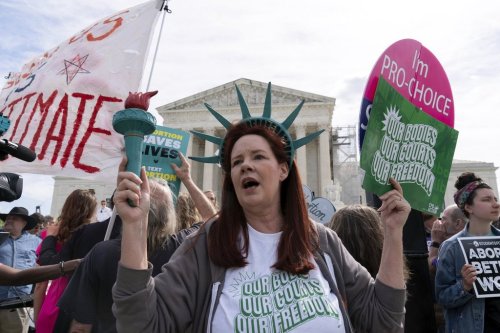
When the U.S. Supreme Court overturned Roe v. Wade nearly three years ago, it opened the door for states to ban most abortions. It also ignited policy battles over information collected about ending pregnancies.
The possibility of reports being used in investigations has increased with the return of President Donald Trump and anti-abortion officials in key federal government jobs, Baden said.
Most state health departments require medical providers to report data about each abortion, though without including patient names. Massachusetts and Illinois mandate that providers give the state only aggregated data.
The states that collect the information, in turn, produce reports on abortion statistics and send their information to the U.S. Centers for Disease Control and Prevention for a nationwide tally. Together, that information gives a picture of how often abortion takes place, when in the pregnancy the abortion occurs and the age of patients.
Those reports provide the fullest government pictures of abortion nationally, but they come with a lag time of about two years and lack data from states that don’t require the reports: California, the country’s most-populous state, as well as Maryland, Michigan and New Jersey.
Reports with personal information could hurt patients, data scientist says
Certain information that some states collect — such as the patient’s marital status or ZIP code and the reason for the abortion — do not serve a meaningful research purpose and could stigmatize patients, says Guttmacher data scientist Isaac Maddow-Zimet. In conjunction with other data, these details could even be used to identify people who obtain abortions, he said.
The same level of detail is not required to be reported to the state for other medical care, Maddow-Zimet added.
“The real concern here is that it fits into a broader pattern of abortion exceptionalism,” he said.
But Carol Tobias, president of National Right to Life, said rolling back reporting requirements can be detrimental: It could downplay the frequency of abortion complications, for instance, she said. Additionally, details such as the reason for the abortion could shape public policy if it reveals increases in sexual assault, she said.
“The more information we have, the better it is for women,” Tobias said.
An Indiana anti-abortion group began using public records requests to obtain individual abortion reports from the state in 2022 and report on alleged violations by providers — including submitting the reports late.
The state Health Department eventually declared that individual reports are not public records because a ban on most abortions means so few happen that the reports could be used to reveal who’s obtaining them. Earlier this year, state Attorney General Todd Rokita settled a lawsuit from the group, Voices for Life, by mandating that reports — with some personal information redacted — be available to the public. But the documents are not being provided as litigation continues.
Melanie Garcia Lyon, the Voices for Life executive director, said in an email that one doctor had his licensed suspended in part because of a violation that someone spotted in a terminated pregnancy report. “Abortion reporting protects women,” she said in an email.
Some states are reducing or eliminating reporting requirements
Michigan has halted required reporting. Minnesota has removed some required information, such as the marital status, race and ethnicity of patients.
Arizona’s Gov. Katie Hobbs, a Democrat in a state where Republicans control the legislature, is calling for that state to drop mandated reporting. A bill that would repeal the requirements hasn’t advanced.
Connie Fei Lu, a medical fellow in complex family planning at the University of Illinois Chicago, said the 2022 Illinois change to collect a tally of abortions rather than detail on each one can protect the privacy of patients, especially those who travel from other states for abortion.
But she said the data collection policies need to be thoughtful.
“I completely understand the delicate balance in abortion data collection in an environment where that data can end up in the wrong hands,” she said. “From a research perspective, from a scientific perspective, not having this data is not a good thing.”
While Guttmacher wants an end to mandatory abortion reports, it’s not calling for states to get out of the abortion data-collection business entirely; the group says states could instead use voluntary approaches to gather information.
Guttmacher and another abortion-rights group, the Society of Family Planning, have been surveying providers over the past few years. The groups’ analyses rely in part on estimates, but they have been released much more quickly than government data and have become key resources for understanding the impact of state bans and restrictions since Roe was overturned.