Predicting the future predicated on our present
Advertisement
Read this article for free:
or
Already have an account? Log in here »
To continue reading, please subscribe:

Digital Subscription
One year of digital access for only $205*
- Enjoy unlimited reading on winnipegfreepress.com
- Read the E-Edition, our digital replica newspaper
- Access News Break, our award-winning app
- Play interactive puzzles
*First annual payment billed as $205.00 + GST for one year. This annual subscription will automatically renew at $233.00 + GST every 52 weeks (10% off the regular annual price of $259.35). Offer available to new and qualified returning subscribers only. Cancel any time.
To continue reading, please subscribe:
Add Free Press access to your Brandon Sun subscription for only an additional
$1 for the first 4 weeks*
- Enjoy unlimited reading on winnipegfreepress.com
- Read the E-Edition, our digital replica newspaper
- Access News Break, our award-winning app
- Play interactive puzzles
*Your next Brandon Sun subscription payment will increase by $1.00 and you will be charged $17.95 plus GST for four weeks. After four weeks, your payment will increase to $24.95 plus GST every four weeks.
Read unlimited articles for free today:
or
Already have an account? Log in here »
Hey there, time traveller!
This article was published 15/03/2025 (557 days ago), so information in it may no longer be current.
When thinking of “yesterday’s tomorrows” — how the future was imagined in the past — it’s tempting to reduce it to visions of art deco skyscrapers, flying cars and jetpacks.
While such visions are certainly present in Glenn Adamson’s A Century of Tomorrows, his new book is a much more comprehensive exploration of what is referred to as “futurology,” or the attempt to discern future events.
A museum curator and historian of design and crafts, Adamson is well-qualified to address the aesthetic and material history of futurism. Yet he also shows how predicting and seeking to shape the future is as much a social, political and moral project as it is one of technological advancement.
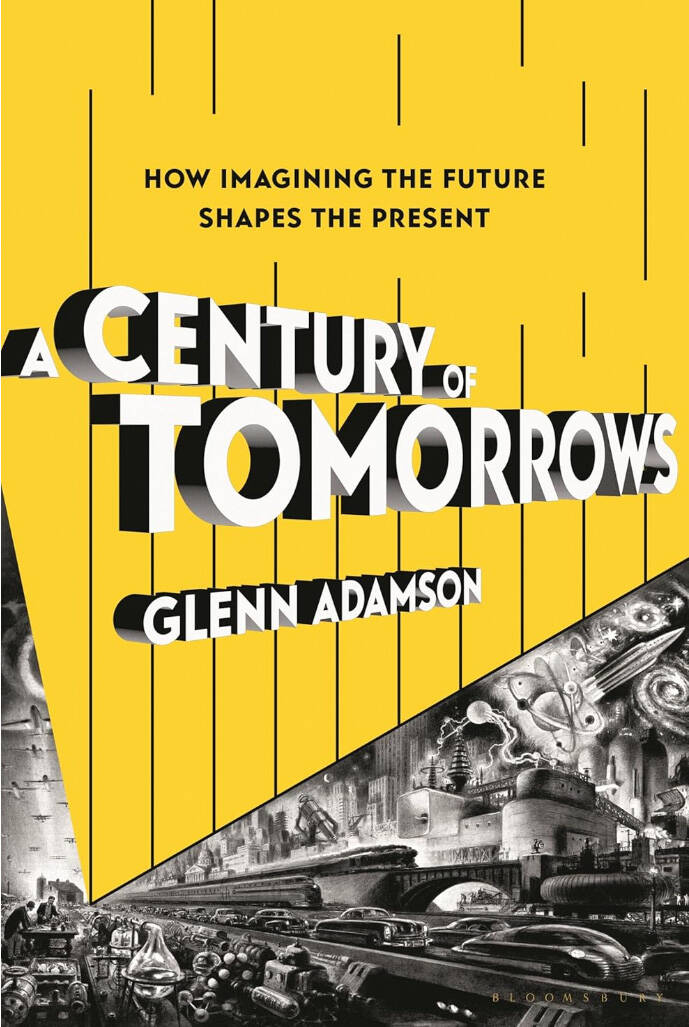
As Adamson explains in this expansive and entertaining history, peering into the future is a project that has engrossed individuals and groups representing an extremely diverse range of professions and persuasions, including “social theorists, political activists, trend forecasters, insurance executives, architects and industrial designers, urban planners and military war gamers, fiction writers and film directors.”
Furthermore, he shows how every attempt to map out the future is undertaken with a particular motivation and arises in its own historical context. This recognition informs the book’s structure: while presenting the 20th century more or less chronologically, each of the book’s six chapters addresses a specific theme, capturing how the zeitgeist of the time viewed the art of prediction.
Chapter One, Heaven and Hell, sweeps the reader from the response to Edward Bellamy’s sensational 1888 bestselling time-travel manifesto Looking Backwards, to fire-and-brimstone preachers, to the birth of modern advertising and the drive for civil rights for Black Americans and women’s rights campaigners, who drew inspiration from Bellamy’s utopian book.
In the second chapter, Machine, we see how society was transformed by the flurry of inventions and industrial design following the First World War, as well as by the logics of mechanization. This aesthetic would be cemented in the popular imagination by the 1939 World’s Fair and its “World of Tomorrow,” and in particular General Motors’ “Futurama” diorama, with its sea of highways and skyscrapers from the far-off year of 1960.
The future of the city takes centre stage in Chapter Three, Garden, with Frank Lloyd Wright’s Broadacres and Ebenezer Howard’s Garden City informing generations of urban planners with competing versions of suburbia.

The professionalization of futurology by experts and think tanks — notably the Rand Corporation and its attempts to plan America’s doomed war in Vietnam — is described in Chapter Four, Lab, as is the emergence of hard science fiction as a literary genre.
Chapter Five, Party, shows how the future was sought not only by science fiction visionaries and the psychedelics-fueled counterculture of the 1960s — synthesized in the trippy visuals of Stanley Kubrick’s film 2001: A Space Odyssey — but also by Native American civil rights activists.
Futurology becomes mainstream, corporatized, data-driven, frenetic and digitized in the final chapter, Flood, in which a string of bestselling books of varying prognosticating power (The Population Bomb, Limits to Growth, Future Shock, Megatrends, The Great Depression of 1990) combined with the consumer computing revolution (heralded by Apple’s iconic 1984 advertisement) revealed how our grasp on the art of prediction in an era of seismic transformation had become increasingly tenuous.
As the author of five previous books on the history of craft as an art form (including 2022’s Craft: An American History and 2019’s The Invention of Craft), Adamson could easily have confined his investigation to the material aspects of futuristic aesthetics. Instead, this is a compassionate social history that delves into the profound ways in which seeking and shaping the future — a project that takes on special urgency for social groups who have faced oppression and injustice — is an essential part of what makes us human.
Michael Dudley is a librarian at the University of Winnipeg.