

Report highlights how communities hardest hit by climate change can build resilient water systems
Advertisement
Read this article for free:
or
Already have an account? Log in here »
To continue reading, please subscribe:

Digital Subscription
One year of digital access for only $205*
- Enjoy unlimited reading on winnipegfreepress.com
- Read the E-Edition, our digital replica newspaper
- Access News Break, our award-winning app
- Play interactive puzzles
*First annual payment billed as $205.00 + GST for one year. This annual subscription will automatically renew at $233.00 + GST every 52 weeks (10% off the regular annual price of $259.35). Offer available to new and qualified returning subscribers only. Cancel any time.
To continue reading, please subscribe:
Add Free Press access to your Brandon Sun subscription for only an additional
$1 for the first 4 weeks*
- Enjoy unlimited reading on winnipegfreepress.com
- Read the E-Edition, our digital replica newspaper
- Access News Break, our award-winning app
- Play interactive puzzles
*Your next Brandon Sun subscription payment will increase by $1.00 and you will be charged $17.95 plus GST for four weeks. After four weeks, your payment will increase to $24.95 plus GST every four weeks.
Read unlimited articles for free today:
or
Already have an account? Log in here »
Hey there, time traveller!
This article was published 18/03/2025 (575 days ago), so information in it may no longer be current.
Malynndra Tome was helping to map livestock ponds in the Navajo Nation when she saw something that inspired her to act. An elderly woman was filling milk jugs with water at the back of a gas station in the Native American reservation, where about 30% of people live without running water.
“How can we be living in the United States of America … one of the most powerful countries in the world, and people are living like this here?” asked Tome, a citizen who grew up in the community of Ganado, Arizona, in the nation’s largest Native American reservation at 27,000 square miles (69,930 square kilometers) in Arizona, New Mexico and Utah.
A report published Tuesday identifies ways historically neglected communities most vulnerable to climate change, like Tome’s, can create resilient water and wastewater systems. Its highlights include nature-based solutions, tailoring approaches to each community and using technology — all the while recognizing barriers to implementing them.
“What we hope to do with this report, what I hope, is that it actually gives people hope,” said Shannon McNeeley, a report author and senior researcher with the Pacific Institute, which published the report with DigDeep and the Center for Water Security and Cooperation. “In spite of some of the major federal funding sources becoming uncertain and possibly not available, I think people will find other ways.”
Climate impacts and the Trump administration
Weather extremes made worse by climate change have disrupted people’s access to water.
In September, more than 100,000 residents in western North Carolina were under boil-water notices for nearly two months after Hurricane Helene destroyed much of a local water system. In January, several water providers declared their drinking water unsafe after wildfires roared through Los Angeles. One utility in Pasadena, California, sent out its first notice since it began serving water more than a century ago.
Aging water systems leak trillions of gallons, leaving residents in some of the country’s poorest communities with a substantial financial burden to fix them.
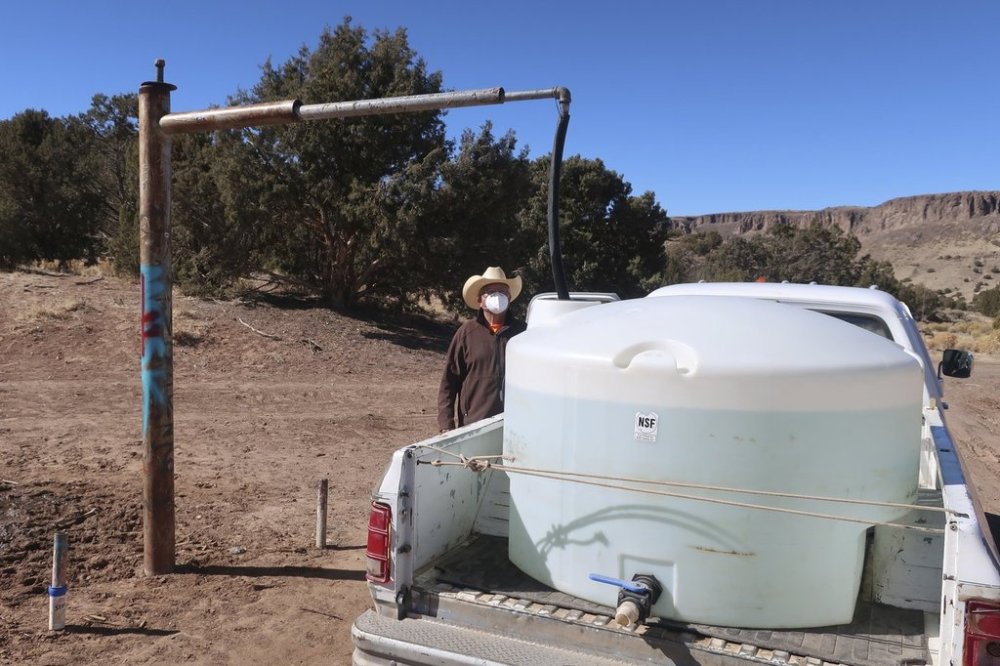
An estimated 30% of the population in the Navajo Nation lives in homes that don’t have running water, and many residents drive long distances to get water from public spigots, according to the Navajo Nation Department of Water Resources and the Natural Resources Defense Council.
The report also notes that some federal resources and funding have become unavailable since Donald Trump returned to the White House. The Trump administration has cut or paused funding for critical water infrastructure projects, touted a reversal of diversity, equity and inclusion policies, and eliminated environmental justice policies meant to protect the communities the report centers on.
Greg Pierce, director of the Human Right to Water Solutions Lab at the University of California, Los Angeles, said the report “comes at a very depressing moment where we’re not going to see federal action in this space, it doesn’t seem, for the next four years.”
Solutions come with challenges
The report synthesizes existing literature about water, climate change and solutions. Its authors reviewed academic studies, government and private reports and interviewed experts to identify ways low-income and communities of color can build water and wastewater systems to withstand extreme weather.
The report highlights technology like rainwater harvesting and gray water reuse systems that can decrease water demand and increase resilience to drought. But it adds that implementing and maintaining technology like it can be too expensive for poorer communities.
The report also advocates nature-based solutions such as wetlands, which studies find can reduce the length and severity of droughts, provide flood control, reduce or remove pollutants in water and protect water supplies. Communities across the country are increasingly recognizing the benefits of wetlands. In Florida’s Everglades, for example, officials have spent billions of dollars to build engineered wetlands that clean and protect a vital drinking water source.
The report argues for government-funded water assistance programs to help poorer households pay water and sewer bills, like the Low Income Household Water Assistance Program launched during the COVID-19 pandemic.
But some are benefiting communities
Gregory Moller, a professor in the soil and water systems department at the University of Idaho, notes that some approaches are too complex and expensive for smaller or poorer communities. “Our innovations also have to be on a scale and stage that is adaptable to small systems,” he said. “And that’s where I think some of the most serious challenges are.”
Some solutions the report highlights are benefiting communities. In the Navajo Nation, hundreds of solar-powered home water systems have brought running water to more than 2,000 people. Kimberly Lemme, an executive director at DigDeep, which is installing the systems, said it can be a complex and lengthy process. But it shows that solutions do exist.
“Water is a basic human right,” said Tome, whose encounter with the elderly woman inspired her to pursue a doctorate in water resources. “And in order for people to live productively, to have healthy lives, I think water is a big part of that.”
___
The Associated Press receives support from the Walton Family Foundation for coverage of water and environmental policy. The AP is solely responsible for all content. For all of AP’s environmental coverage, visit apnews.com/hub/climate-and-environment.



